The annual BE@Penang conference for Asia’s business events community will return this year with a virtual format, allowing industry players to connect despite ongoing travel restrictions.
The fifth edition, taking place December 10 and 11, presents the theme, Be Inevitable, which urges the industry and professionals to be fearless and bold in charting the path to success, no matter what crisis comes their way.
The fifth BE@Penang conference will be hosted online this year
Eddie Obeng, a thought leader and British educator who is recognised for his success as a motivational speaker, innovator and author, will helm the keynote slot on December 10’s morning.
Other notable speakers at the online conference include Kuala Lumpur Convention Centre’s Angeline van den Broecke; Tourism New Zealand’s Leonie Ashford; Firefly’s Phillip See; Nuskin’s Jex Wong; Pico International’s Eric Ho; and Digital Penang’s Tony Yeoh.
The two-day event will conclude with a closing keynote by Roshan Thiran, founder and CEO of Leaderonomics, a cause-driven leadership development firm in Asia-Pacific.
A registration fee of RM50 (US$12.25) applies, with all collections going to a local charity.
The event is owned by Penang Convention & Exhibition Bureau and supported by the Penang State Government.
International Convention Centre Sydney (ICC Sydney) is one of the first purpose-built MICE venues in Australia to establish a comprehensive set of operating principles to guide the safe resumption of events in a Covid-19 era.
Described as an “industry benchmark” by ICC Sydney’s CEO Geoff Donaghy, the ICC Sydney EventSafe Operating Framework spans 16 key areas of event management, including the customer journey, environmental hygiene, food service, technology and equipment, employees and public awareness, and covers meetings, conferences, exhibitions, live events and internal operations.
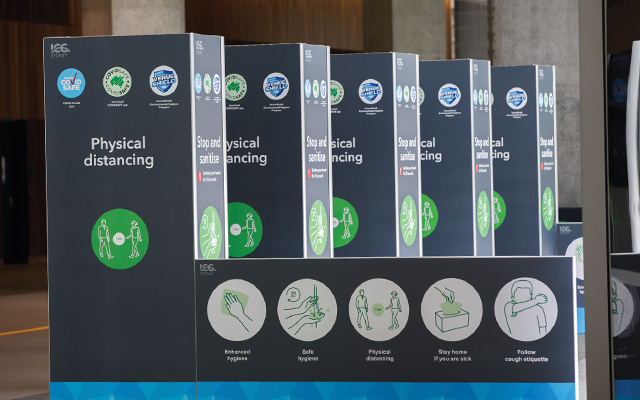
EventSafe measures enforced at the HealthCert conference
Besides consolidating inputs from national and international industry bodies, the Framework also integrates best practice from parent group ASM Global’s VenueShield, an advanced hygiene programme built on the expertise of public health authorities as well as medical and industry leaders.
In addition, the protocol abides by Safe Work Australia’s Codes of Practice and national Covid-19 Safe Workplace Principles.
ICC Sydney’s safety assurance is built on a strong track record – the venue has numerous International Standards Organisation Certifications in areas such as food safety, environment, Work, Health and Safety, and quality management.
Donaghy said the Framework would safeguard clients, visitors, contractors and team members against the risk of Covid-19 and reinstall confidence in events, which would in turn reboot the industry and Australia’s economy.
“As Australia and the rest of the world starts to return to business as usual, it is critical that we all continue to safeguard against further outbreaks of Covid-19, especially when bringing people together,” he remarked.
ICC Sydney’s events specialists are on hand to help event owners and organisers navigate health and safety guidelines while fulfilling their unique event requirements.
As countries hunker down for a travel season focused on the domestic market, Koh Samui’s luxury hotels are doing the same in Thailand.
“With the domestic market being the only lifeline at present, we learnt very quickly that the key to attracting the local market is to use social media – such as Facebook, Line and Instagram – to both promote and facilitate simple transaction options,” shared Remko Kroesen, Banyan Tree cluster general manager for both Banyan Tree Samui and Banyan Tree Krabi. The latter opened its doors in October 2020.
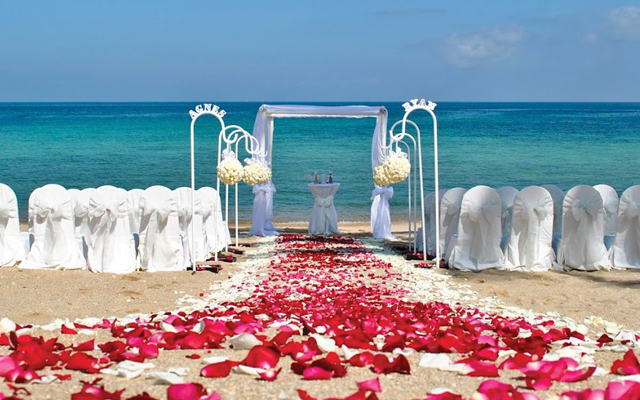
Wedding setup at Banyan Tree Koh Samui
Kroesen added that other initiatives such as hosting bloggers or celebrities – who post regularly on social media platforms – have also helped to promote the resort and destination. Selling vouchers at travel fairs have proven popular too.
All these “attractive deals and aggressive promotions via the right channels” are key to driving business, cited Kroesen.
As for Meliá Koh Samui, the hotel is aiming to make its Sunday brunch profitable, said its general manager Ernesto Osuna.
Meliá Koh Samui has also packaged the brunch with pool and gym access, which has brought about “very good response” from both locals and expats. Previously the Imperial Boat House Beach Resort, the overhauled property opened just before the pandemic hit in January 2020.
Christian Lueke, cluster sales and marketing director for Meliá properties in Koh Samui and Chiang Mai (pre-opening), shared that the properties are now focused on “creating experiences” and additional packages that will entice the local market, such as add-ons like on-property childcare for parents.
The Thai government’s We Travel Together campaign, and Bangkok Airways’ Flyer Pass promotion in the past few months has given Koh Samui’s events industry a boost.
“This has encouraged some domestic group and incentive business, but numbers remain modest in comparison with destinations like Phuket and Krabi.
“However, weddings will continue to play a large part of (bringing) guests to Koh Samui as is one of the (country’s) most popular wedding destinations,” Kroesen told TTGmice.
BE Reconnected reminded us all that this is a very human industry which thrives on people connecting, relationships evolving, teaching, learning, listening, transacting, innovating and creating
New Zealand’s only showcase for the business events industry this year, BE Reconnected, brought together over 420 event organisers and suppliers from around the country to Auckland on December 1.
Organised by Business Events Industry Aotearoa (BEIA), the event showed business events are not only safe, but also a vital component for widespread economic recovery.
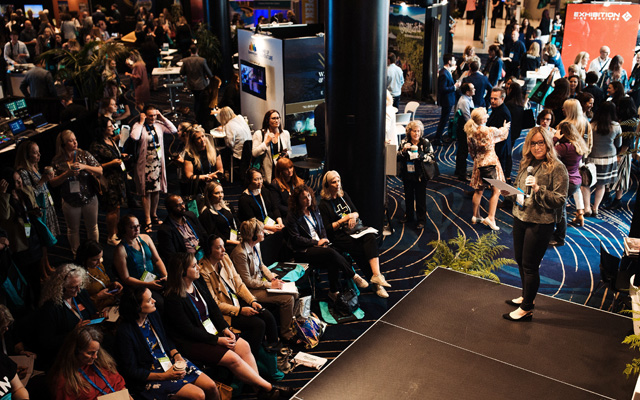
BE Reconnected reminded the industry that it is a very human industry which thrives on people connecting; the showfloor pictured
The event included three keynote speakers, Sir John Kirwan, Cam Calkoen and Lisa O’Neill, as well as a series of regional updates from 14 different regional convention bureaux from around New Zealand, plus briefings from Tourism New Zealand Business Events.
Every attendee scanned the COVID tracer app on arrival, before walking past a thermo-imaging camera on entry to the show floor. Individually-packed lunches and disposable cups for drinks, allowed guests to quickly grab and go. A St John first responder was on site for the entire day, to ensure immediate medical attention if needed. Self-check-in kiosks were managed by staff so there would be less people handling the kiosk. The kiosks also noted the time attendees checked in and out of the event to ensure help for further contact tracing. Masks were given to those who wished to wear one at the event, and everyone who travelled to the event by air, or public transport was required to wear a mask while travelling.
BEIA chief executive, Lisa Hopkins, said attendance at BE Reconnected highlighted the pent-up demand to gather in person with colleagues at meetings and incentives — and she remains optimistic about the future of business events.
“More than 290 buyers walked through the showfloor connecting with 120 suppliers, which will go towards supporting domestic recovery. We are thrilled with the enthusiasm this event created, and how much was accomplished in one day.
“Over the next three years, New Zealand will open three international convention centres, with a combined floor space of 10 rugby fields, creating over 1,000 new jobs directly while also supporting other industries such as accommodation, hospitality, food producers and suppliers, and airlines,” she added.
Tourism New Zealand’s business events global manager, Lisa Gardiner, also presented results of a recent industry survey which showed Covid-19 has increased the value New Zealanders put on face-to-face meetings.
The survey of 125 New Zealand-based organisations found that 97 per cent are planning to hold a business event in 2021.
“The appetite for meeting is coupled with an increasingly positive attitude towards business events: 92 per cent consider in-person conferences and offsite meetings important for their organisation, up from 79 per cent of respondents in Tourism New Zealand’s May 2020 survey; and more than half (56 per cent) said they appreciate the importance of face to face meetings more now than pre-Covid-19, up from 39 per cent in May.”
Hopkins noted that BEIA is working closely with the government, and contributing to industry taskforces, to ensure that the road to recovery is as rapid and smooth as possible.
“We were reminded that in our professional industry, nothing is left to chance, and best-practice safety and hygiene can still make for an enjoyable, relaxing and inspirational event. After a year when we learned all about creating virtual and hybrid events, we all agreed nothing beats meeting face-to-face in a space where everyone feels safe and engaged,” Hopkins concluded.
Global DMC Partners, a global network of independently owned destination management companies (DMCs) and creative event experts, has concluded its seventh annual, and first virtual, Connection event.
Nearly 400 attendees, including approximately 300 meeting planners, international and domestic DMCs, convened online on November 9 and 10 to discuss current issues pertaining to the pandemic, identify ways for the industry to overcome challenges together as it rebounds, and experience virtual activities organised by GDP DMCs.
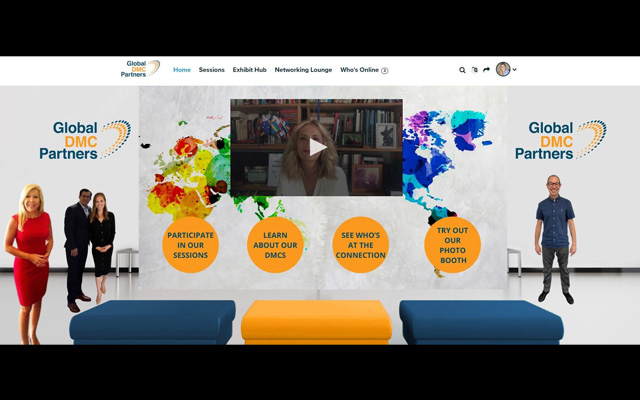
The landing page of the online event
Global DMC Partners’ president and CEO, Catherine Chaulet, kicked off the event with a keynote address that highlighted insights from Global DMC Partners’ most recent Meetings & Events Pulse Survey.
There were 447 respondents from the meetings and events industry, with 90 per cent being meeting planners. Key highlights of the findings included:
Over 90 per cent reported that some or all of their 2020 events have been postponed to 2021.
Nearly three-quarters of planners are moving their face-to-face events to virtual or hybrid in 2021. While most respondents predict that their face-to-face events will resume in the first half of 2021, many are planning to include a virtual option with their live event, indicating that 2021 will be a hybrid year.
82 per cent believe a vaccine is the most important factor in bringing back face-to-face events.
The conference agenda also included general sessions with a panel composed of industry leaders discussing the continued impact of the global pandemic on this trillion-dollar industry. Experts shared innovative strategies and ideas that MICE planners should consider as the industry continues to adapt and embrace more virtual and hybrid events as it moves into 2021.
There were also peer-to-peer breakout discussions to reconnect and share best practices in today’s Covid-19 world. Discussion topics included best practices for virtual events and for hybrid/in-person events, contracting with vendors, new cancellation/force majeure terms, event technology, and creating unique attendee experiences in a virtual world.
Attendees also heard from several inspiring and motivational speakers, including Lucy Bloom, an award-winning businesswoman, consultant and author from Australia.
Unique to this year’s conference were all-new virtual destination experiences. These interactive online activities brought a taste of the respective destinations into participants’ homes while showcasing how DMCs are successfully pivoting for virtual and hybrid events.
Highlights included a Parisian art tour, a yoga city tour through Vienna, a world-class illusionist from Budapest, live music from a Texas musician and song writer, samba and salsa dancing lessons from South America, Polish pierogi making, an undercover, and at-home spy experience from Washington, DC.
Planners also had the opportunity to visit live with over 60 global DMCs and sponsors in the Connection Exhibit Hub. At each booth, attendees could learn more about each DMC and their destinations by viewing resources like destination overview videos and informational brochures.
For those who wanted to connect further, they could speak directly with each Exhibitor through instant chat messaging or live video call.
Onsite guests in attendance at the opening ceremony
Hot idea
Launch the pioneer breed of hybrid events, keeping strict hygiene measures and tracing procedures to ensure a safe event for all attendees
Onsite guests in attendance at the opening ceremony
Event brief
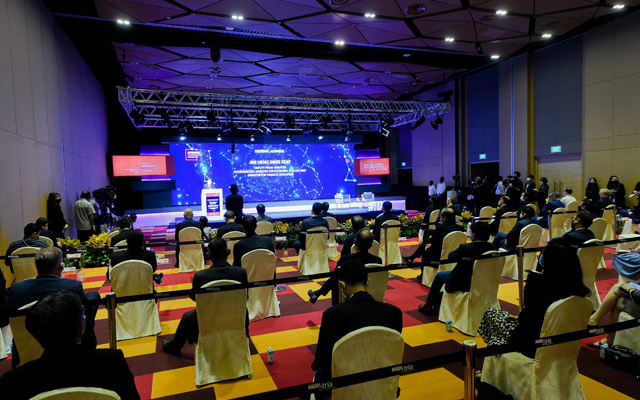
Set amid the pandemic, the third edition of the industrial transformation Asia-Pacific 2020 (ITAP) was worlds apart from its predecessors. Although the bulk of the event was held virtually, it had one physical element: the opening ceremony. It was set to be the first physical event in Singapore Expo since Covid-19, and had to be configured to adhere to strict safe management measures.
On the virtual front, ITAP had to serve as a platform for participating businesses to meet objectives such as optimising operations to lower costs, establishing new partnerships, identifying new markets and pivoting towards emerging sectors.
The event was also an opportunity to explore emerging Industry 4.0 solutions in manufacturing technologies, such as cyber-physical systems, the Internet of things and cloud computing.
Event highlights
MAX Atria, an event area at Singapore Expo, was properly cordoned off to host the opening ceremony for 100 pax. In order to prevent bottlenecking, attendees were given staggered different registration time slots.
Attendees also had to check in via SafeEntry, measure their temperature, and follow a routed path up to the event space.
Rather than the breakfast snack counters and coffee stations of the old days, the entire dining experience was governed by a detailed zoning system. Before the event, each attendee had been assigned to a zone of maximum 50 pax and cohort of up to 20 pax. These determined a delegate’s entry and seating in the breakfast holding room as well as at the opening ceremony.
A smaller ballroom served as the holding room, and was split into different sections based on cohort. Every section held five tables, spaced apart, accommodating only five chairs each. Meanwhile, meals from SingEx’s new Kinetic Kitchen was served in individual packaging on biodegradable trays.
Seating for the opening ceremony similarly followed sectioned zones, with no intermingling in between. Chairs were spaced one metre apart, and on stage, speakers kept their masks on unless taking group shots. The event received an opening address and exclusive dialogue session with Singapore’s deputy prime minister Heng Swee Keat, and upon conclusion, attendees were escorted from the plenary ballroom in cohorts.
To test its physical “bolt-on” capabilities, SingEx organised for Singapore-based participants to partake in face-to-face engagement tours to locations that exemplified industrial transformation and deployment concepts for Industry 4.0. These activities were simultaneously streamed online through the event’s integrated platform, ITAP CONNECTED, allowing virtual attendees to interact with the physical delegates.
The rest of the event proceeded online on ITAP CONNECTED, where some 5,000 participants from more than 50 countries picked from a variety bite-sized educational content, as well as accessed personalised recommendations of solutions and products, targeted networking and lead generation opportunities. Exhibitors could also showcase their innovative products, including Industry 4.0 offerings, through online showcase areas and thematic zones.
Challenges
As Singapore EXPO shifted from its massive physical expertise into a digital-first hybrid format, the team found itself having to reconfigure the “traditional exhibition show floor into a central command centre and studio production space”, described James Boey, executive director, events business, SingEx Exhibitions.
He said: “We needed to deliver a differentiated event experience that could integrate live studio recordings, pre-recorded content, live-streaming from physical locations, as well as real-time engagement amongst event attendees both onsite and online. We needed to ensure that our stakeholders and customers reap the maximum benefits from our new offerings as the event experience in the new normal will be diversely different.”
In order to meet the demands of its stakeholders and clients – especially for regional stakeholders – SingEx consulted them extensively to understand their needs, and to design its content and engagement systems “in a sustainable manner”.
The physical opening ceremony posed another challenge to the team, as it was one of Singapore’s first MICE events to be organised in line with the government’s safe management measures. To meet these strict guidelines, the organising team worked with MAX ATRIA to implement the zoning system, staggered timings, as well as physical reminders and barriers to guide the on-site attendees. Safe Distancing Ambassadors were also deployed to reinforce social distancing of one metre, and to remind delegates to mask up before and after our meals.
Boey shared: “To prepare for this hybrid-event model that will very likely become the default in a Covid-safe world, SingEx acquired new capabilities in several areas. These include safe management protocols, digital solutions, data insights and community engagement. We have been preparing for a blended business environment, thus, the space that we can utilise today has to be designed and used effectively to engage both our digital and physical audience, who would have varying expectations.”
Event Industrial Transformation ASIA-PACIFIC 2020 Organiser SingEx Holdings Venue MAX Atria, Singapore Expo Dates October 20-22, 2020 Attendance 100 (physical) and 5,000 (virtual)
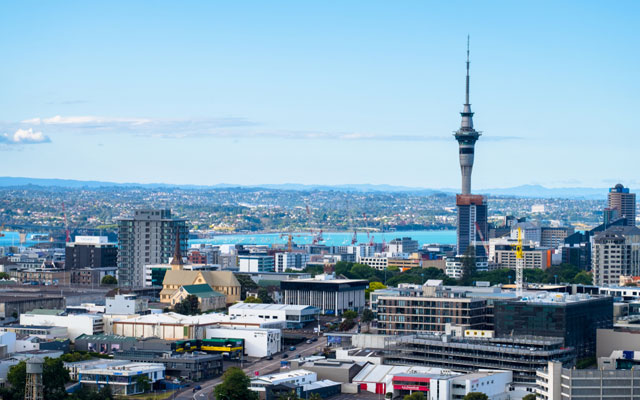
The New Zealand government has allowed business events of no more than a 100 to start; Auckland skyline pictured
The city of Auckland has won the hosting rights for two conferences – the International Association of Women in Police (IAWP) Annual Conference, and the International Conference of Women Engineers and Scientists (ICWES) – both scheduled for 2023.
This will be the first time IAWP will be held in New Zealand. The five-day conference will happen in September, and is set to attract more than 600 senior police, researchers and policymakers from around the world – all dedicated to strengthening the profile and inclusion of women in the Police.
These two wins are a boon for the economy after a challenging year; Auckland skyline pictured
Auckland Convention Bureau (ACB), a division of Auckland Tourism, Events & Economic Development (ATEED) with support from Tourism New Zealand, worked alongside the Australasian Council of Women and Policing and the New Zealand Police joined forces to bring the conference to the country. It is worth an estimated NZ$1.3 million (US$920,205) to the local economy.
Auckland will also have the chance to showcase its expertise in science and engineering in the same year at ICWES.
It will be the first time the flagship event has been held in New Zealand in its 56-year history.
Over 450 delegates from across the world are expected to attend the five-day conference to discuss the importance of diversity and growth of women within the fields of Science, Technology, Engineering and Mathematics (STEM).
The conference will deliver an NZ$881,000 economic contribution to Auckland and almost 2,600 visitor nights.
Tourism New Zealand’s global manager business events, Lisa Gardiner says securing these. conferences is a hugely positive signal for the sector.
“It will give a much-needed boost to our business events sector just knowing that we’ve got great events like this down the pipeline. The sector contributes so much to New Zealand, not just in economic terms. With a number of key conferences choosing New Zealand that focus on women, it is a huge opportunity to share knowledge that will bring long-lasting benefits to Kiwis.”
In light of the challenges presented by Covid-19, more and more events are taking place online. But thanks to digital platforms, it’s easier than ever for businesses to deliver meetings, conferences and seminars via the Internet.
We’ve seen a rapid shift to digital platforms: in April, Microsoft announced that all of its events will be “digital-only until July 2021” due to the coronavirus pandemic, while many others, such as Apple, Facebook, IBM, Dell, Intel, and SAP, have followed suit.
Moving events reduce costs and carbon footprints, while make attendance accessible to a wider audience
So while the short-term future of events may be digital, “going online” isn’t as simple as downloading a tool, switching it on and asking delegates to participate, especially for those that need to host global events in multiple languages.
For these businesses, the only real option is an online conference platform capable of delivering events at scale and to a multilingual audience.
But with so many different online conference platforms to choose from, what should you be looking for and how can you get the most out of the technology? Here is a quick checklist for event managers looking for a capable online conferencing platform for their next conference.
1. Get technical
Taking your events online requires much more than just a platform – you need a partner that’s capable of helping you to configure and manage your event.
The right provider will be able to explain how the solution works, implement it for you and provide dedicated support before, during and after your events.
Other questions to ask include, if they:
Provide training to you and your team on how to use the platform?
Offer dedicated support before, during and after the event?
Help set up any equipment? (Not so much providing the equipment itself, but explaining how to get the best possible audio/video quality out of current devices)
Record audio and/or video for use after the event, including for transcripts?
These are all relatively obvious questions to ask, but they must be asked nonetheless. To make the most of your online conference platform, find a supplier that can help you with every aspect of it as this will significantly help improve your event.
2. Remote events
In the current climate, the only feasible way businesses can host large online events for audiences of multiple languages is to connect attendees and organisers remotely.
This kind of technology enables people to work from anywhere, and without the use of complicated specialist equipment – they can simply use their own laptop in any location that they choose.
With an online conference platform in place, the plus side is that there is:
No need to bring equipment onsite – events become much more resilient as if there’s a problem onsite, for example, if equipment stops working, or someone is unable to travel due to Covid-19 restrictions, they have the option to work remotely.
More flexibility – events are no longer restricted to a single location and can be moved online with anyone delivering their services remotely. More people are also able to attend as they are no longer restricted by travel and events could even be hosted as hybrid or cluster events – part onsite, part online.
Lower costs – no need to pay guests or speakers for travel or accommodation, only for their services. The money saved can then be spent on providing a stunning event experience, such as offering the event content in more languages, inviting guest speakers and working with media sponsors.
3. Host a more inclusive event
When you take your events online you reduce and/or remove a few barriers to entry – mainly location, time and cost. But what about language?
Onsite events are limited in that there’s only so much space for interpreter booths, so often only the few most popular languages are chosen – space which could have been used to host more attendees.
However, by taking events online you don’t have to worry about space and can enlist as many interpreters as you like. Also, because your events are now online, you suddenly have access to a much larger audience.
The money saved on infrastructure can be used to acquire more conference-level interpreters, including for language interpreters for only a few delegates. Not only will this attract more people to your online events, it will also make them more inclusive as it shows you have considered everyone.
Platform for success
Virtual events have quickly become the new norm, and for good reason.
Being able to host events from anywhere in the world can save a serious amount of investment while still allowing businesses to engage with global audiences and potential customers, generate leads, build brand awareness and establish themselves as industry leaders.
Virtual events have been an effective way to reach people all over the world a long time before the pandemic hit, they simply became much more important in the aftermath.
Marina Bay Sands was built around its sustainability features. What consideration led to the construction of these elements? As a Sands property, Marina Bay Sands is guided by its global sustainability strategy Sands ECO360 to minimise environmental impact, and lead the way in sustainable building development and resort operations.
During the design and construction phase, energy conservation and efficient water usage were high on the agenda. To reduce the need for additional lighting, the building was designed to introduce abundant natural daylight to illuminate indoor areas. Specially designed convex and concave roofs reduce heat gain into the podium interior. Sun shading across the glass façade in the form of balconies, vertical fins and canopies were also installed.
How were the types of measures and equipment decided upon?
Our practice is to adopt an evidence-based, impact-first approach when introducing any sustainability initiatives on property. We also constantly find new ways to make our operations more resource-efficient.
For instance, we introduced five anaerobic digesters in the third year of operations after studying what the industry was doing and how we could do better. We conducted extensive research and piloted different solutions before we decided on the right one for the company.
To continue making our business even more sustainable, we constantly talk to peers in the industry and are always looking to embrace new technologies. For instance, we have now enhanced our food waste minimisation efforts, using food waste technology in selected kitchens to help chefs monitor and reduce the amount of food waste produced.
What difficulties did the resort face in implementing and maintaining its sustainability efforts? The main challenge for any organisation implementing and maintaining its sustainability efforts is how well it engages its stakeholders and rallies them towards a common vision. From suppliers and vendors to team members, we actively engage stakeholders in the sustainability journey, sharing our goals and encouraging them to make business decisions that reduce environmental impact wherever possible.
What are some examples of such responsible business decisions? Our sustainable purchasing policy provides guidelines to vendors, encouraging them to adopt solutions, materials and goods that minimise environmental impact. The purchasing policy covers a wide range of supplies, such as responsible food sourcing and earth-friendly packaging materials.
Procurement teams are also guided by this policy and consciously review procurement decisions. Chefs collaborate closely with vendors and procurement teams to plan dishes made with sustainable ingredients. Overall, advocating a culture of sustainability empowers over 10,000 team members to create a positive impact not only at Marina Bay Sands but also in their personal lives.
How much more challenging is maintaining Marina Bay Sands’ sustainability commitment during this pandemic, as the higher hygiene standards necessitate single-use packaging and more resources for sterilisation? Like any other business, we have been trying to navigate the ongoing pandemic. Hygiene and sanitisation priorities are higher than ever, but we continue to stay focused on the goal to decouple our environmental footprint from our business growth.
We are scrutinising the chemicals in cleaning products and choosing those that are enzyme-based, PH neutral, safe and non-toxic to sanitise all high-touch surfaces. Our restaurants also provide all diners with a paper mask-holder made from Forest Stewardship Council-certified paper. While these are a few examples of what we have been doing, the team at Marina Bay Sands is proactively looking for solutions to continue minimising our impact on the environment even in the midst of this pandemic.
As small business gatherings slowly trickle back, are clients still concerned about sustainability, on top of safety and hygiene? We’re seeing the gradual resumption of Singapore’s MICE industry and have been the proud host of several recent pilot hybrid events held at Sands Expo and Convention Centre. Throughout the course of this pandemic, we’ve seen how clients had to adjust very quickly to the evolving situation, revamp their business models, fine-tune delegate engagement strategies and move towards new event formats.
While the focus in the industry has been on business survival together with safety and hygiene, we continue to help clients run sustainable events at no additional cost to them.
As we look towards the new normal, what initiatives is the team currently working on to further your sustainability accomplishments? One key partnership we’re really excited about is our investment in the Drop by Drop Project with Seven Clean Seas, a Singapore-based social enterprise tackling plastic pollution in our oceans. Our support will go towards the development of the River Plastic Recovery System, a floating plastic collection system that captures river plastic before it reaches the ocean.
We’re also looking for more ways to diversify our sources and increase support for local food producers. Marina Bay Sands currently procures 63.5 per cent of our food within Asia-Pacific, and we are making steady progress towards our 75 per cent target. To minimise food waste, we’re looking at expanding our existing unserved food donation partnerships with local food banks, and also plan to halve our food loss and waste by 2030.
TTGmice will be taking a break from December 4 after a very challenging year. We’ll be back on January 5, 2021, and will definitely continue to bring you the most breaking news in the business events industry.
The entire TTG Asia Media team wishes all readers a Merry Christmas and Happy New Year.
The newly-opened Ritz-Carlton, Bangkok anchors the One Bangkok development with cosmopolitan elegance. Featuring the city's largest ballroom and a spectacular new penthouse suite, it delivers exceptional hardware and deeply authentic, soulful service for business and leisure travellers alike
Behind the imposing, Brutalist concrete that defines Zurich’s Oerlikon district lies a surprising secret. While its exterior honours the neighbourhood’s industrial roots, stepping inside Mama Shelter reveals a vibrant, neon-soaked world that is a far cry from its rigid shell
A polished urban retreat designed for business travellers, Hyatt Regency Kuala Lumpur at KL Midtown combines thoughtful design, seamless service, and exceptional facilities.