The Kuala Lumpur Convention Centre (the Centre) has launched a brand-new, one-stop virtual solution to deliver virtual and hybrid events.
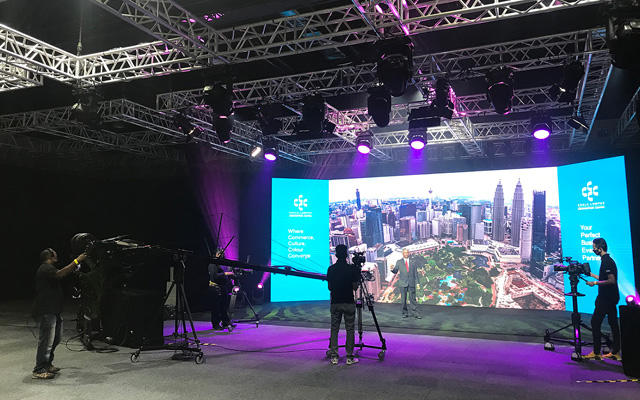
This solution comprises brand new studios that have been fitted with production-grade audio and visual equipment, 400 Megabit of Internet bandwidth, two separate power supplies, a dedicated network backbone and a qualified team of technical experts to help in the setup, event production and technical design to live broadcast and streams.
A sample of a hybrid event setup
As part of the One-Stop Virtual Solution, the Centre also offers an interactive and immersive virtual platform that integrates livestreams and existing video hosting tools, including Zoom, YouTube and Vimeo, and is equipped with a systematic registration for attendees.
Depending on the event and client requirements, the Centre also offers other solutions such as a Command Centre.
Hybrid Studio packages start from RM23,200 nett (US$5,740) per day, while the Virtual Studio packages start at RM9,280 for a minimum of four hours.
The Sheraton Hong Kong Tung Chung Hotel in Lantau, situated a 10-minute drive from Hong Kong International Airport and Asia-World Expo, is now open.
The 218-key property offers 3,400m2 of indoor and outdoor meeting spaces, comprising the pillar-free Graqnd Ballroom that can accommodate 1,300 guests and delegates, and divided into three independent areas. For smaller events, other function areas include four multifunction meeting rooms, as well as two outdoor terraces – one of which boasts 270-degree ocean views.
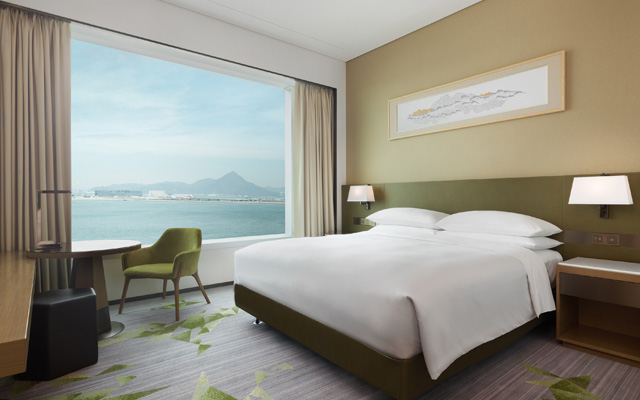
Deluxe King Oceanview
After finishing their event, delegates can retire to their rooms. Regardless of category, each living space has full-length windows that open up to the mountains and the sea, alongside modern amenities such as 49-inch LCD televisions, and high-speed Wi-Fi.
Other facilities include four dining venues ranging from a rooftop Grill restaurant to a modern Chinese diner, an Executive Lounge, a 24-hour fitness centre, and swimming pool. Business guests can also take advantage of the hotel’s community programme, where Sheraton Hong Kong Tung Chung Hotel has partnered with a local bee farm, Mui Wo Lychee Hill Holiday Farm to offer exclusive tours for guests.
As businesses maintain hybrid remote-working models and anticipate other potential disruptions in 2021 and beyond, the role of automation and AI use cases in the workplace will grow
Digital transformation has been the talk of the town for the longest time, but it is only during times of necessity that we see an acceleration of digital transformation in many organisations.
The pandemic in 2020 has seen many companies in the early and mid-stages of digital transformation adapt and speed up their transformation to address the unprecedented global disruption.
As businesses maintain hybrid remote-working models and anticipate other potential disruptions moving forward, the role of automation and AI use cases in the workplace will grow
Moving into 2021, as businesses maintain their hybrid remote working environment and anticipate other potential disruptions, artificial intelligence (AI) and machine learning (ML) will play a greater role than ever.
What’s more exciting is that due to rapid adoption of technologies like cloud, AI and data analytics, the Asia Pacific digital transformation market is projected to grow at a CAGR of 20.7 per cent from now to 2025. This makes APAC the world’s fastest-growing region (global CAGR is 16.5 per cent).
Automation will therefore start to be an essential part of APAC organisations’ work processes in many aspects.
1. Improving workflow efficiency
The broader use of AI and ML allows businesses to eliminate manual processes, improve productivity, and get a competitive boost. An SAP Concur survey conducted earlier in 2020, for instance, has shown that as many as 38 per cent of employees are still processing claims manually in the Asia Pacific region.
The emergence of the digital business environment is expected to increase pressure on companies to manage budgets in real-time, increase compliance and eliminate errors.
The adoption of AI and ML also opens up new possibilities for travel and expense management. Prompt reimbursement, and reduced manual review and approval of claims, are some possibilities that finance teams in organisations can expect from AI and ML adoption.
Algorithms can be trained to pick up fraudulent claims, which can be missed by human beings. Automation allows mundane tasks to be eliminated from employees’ workflow, and finance teams can spend more time looking at expense reports that contain privacy violations and fraudulent expenses.
At SAP Concur, we use AI and ML to make everything from travel booking to expense auditing smarter, more automated, and easier for employees.
2. Adding intelligence to applications
AI and ML are not only useful in eliminating manual processes. Adopting automation into an organisation’s workflow can bring extra value to employees at a different level to grow, scale and improve employee satisfaction.
By introducing AI and ML to an organisation’s workflow, employees can receive recommendations for business travel and accommodation options based on their history, and yet still be compliant with company policies. ML algorithms can be used to analyse employees’ behaviours and recurring patterns for the system to provide the most suitable options. When the algorithms are properly trained, the perfect travel options can be provided with just the first few recommendations.
AI and ML are not limited to travel options, and automation can play a role in intelligently adjusting travel policies within organisations’ expense management systems based on the data mined. Employees booking flight tickets or accommodation at prices that exceed allowed limits would typically be flagged for violation, but the AI-analysed data can allow the system to automatically adjust travel policies to accommodate current prices so that employees would not be flagged for violation. This way, other departments will not have to intervene and slow down processes.
3. Empowering business leaders’ decision making
At a higher level, AI and ML can sieve through a huge amount of data and garner key insights from it, swiftly empowering business leaders to make important business decisions.
Finance managers are always on the lookout to cut travel-related costs, and often need to gather insights on which business processes are prone to cash leakages. With automation being the key driver in gathering and analysing data, key insights and recommendations can be delivered to business leaders to action on, while providing an overview of organisations’ travel and expenses domain such as employee behaviour, travel expenses, spending and travel patterns.
AI and ML can deliver decision making value at an even higher level when the system is tasked to deliver risk assessments on the next key business decision while considering all historical projects. Business leaders can then make informed decisions based on comprehensive insights rather than perspectives to maximise budget management and liquidity, increasing compliance and eliminating errors, and maximising profitability.
As we head into 2021, there’s no doubt that the clear business value AI and ML bring will increasingly see them being integrated into organisations.
Andy Watson is the senior vice president and general manager for Asia Pacific Japan and Greater China at SAP Concur, where he is responsible for leading the business for SAP Concur in this region. A 30-year IT industry veteran who’s been a CFO, Watson has also held global and regional leadership roles in SAP SuccessFactors and SAP Cloud.
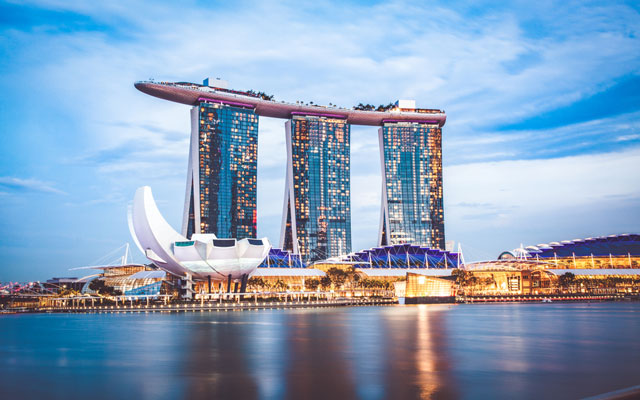
Taking on a hybrid online/offline format, PCMA Convening Leaders 2021 will be held in Singapore from January 11 to 15, 2021, beaming to a worldwide audience from the Global Broadcast Center at Marina Bay Sands (MBS).
Produced with the support of Singapore Tourism Board (STB) and MBS, the event will offer a combination of streaming broadcast TV – with a live studio audience in some locations, digital community-building as well as face-to-face experiences through PCMA’s Official Network Partners.
PCMA Convening Leaders 2021 will be delivered at the Global Broadcast Center at Marina Bay Sands, Singapore
Thomas Friedman, a three-time Pulitzer Prize-winning journalist and bestselling author of The World is Flat will deliver the keynote. Other notable speakers and presenters include Julia Gillard, former prime minister of Australia; Paul Tambyah, president-elect, International Society of Infectious Diseases; and Keith Tan, CEO, STB.
Sherrif Karamat, president and CEO of PCMA, said: “We know how important it is to our community and the industry to come together in January at Convening Leaders and we are excited with this new event model keeping everyone’s safety in mind.
“We want to meet you where you are and how you choose to participate. While we have had thousands of people attending Convening Leaders in person in the past, 2020 has taught us to become more agile and ready to adjust to what our audiences truly need today, and beyond the pandemic.”
Commenting on the event, Paul Town, senior vice president, resort operations, MBS, said: “We are proud to lead the next chapter of the business events industry together with PCMA and STB as the industry gears up for recovery. We look forward to delivering an impactful event experience that leaves unforgettable memories for its global audience at Convening Leaders 2021.”
Leisure and entertainment destination, Blue Tree Phuket, kicked off its reopening in December with a three-day arts extravaganza that sets the stage for its drive to position Phuket as a destination for music, fashion, arts and crafts and food.
Nora Dance, a Southern Thai tradition, was performed during The Living Art Festival 2020
The Living Art Festival 2020, held from December 17 to 19, 2020, featured concerts, street art, street performances, workshops, art films, panel talks, and fashion shows – all delivered by top Thai artists such as Prateep Kochabua, Mueangthai Busamaro, Jarupong Juntarapech, Paretas Hutanggura, Synth X Factor, EKA Soundz, DJ Nicola Vega and DJ Fen.
A welcoming destination for all ages, Blue Tree Phuket on the popular Thai island’s west coast takes in array of amenities, such as the signature four-storey Tree House Restaurant & Beach Club, a kid’s club, walking and jogging trails, retail and lifestyle outlets. These facilities surround a 17,000m2 lagoon that is also a playground for adrenaline junkies.
The ACI Report 2021, an annual salary and employment trends study, has painted a bleak picture of a travel and tourism industry afflicted with job losses and reduced employee confidence.
Drawing inputs from a sample of 829 travel, tourism, hospitality and lifestyle personnel from across Asia-Pacific and surrounding regions, the study identified 74 per cent of respondents whose jobs were impacted by the Covid-19 pandemic. Twenty-four per cent were made redundant in 2020 while 50 per cent experienced salary cuts, with a majority 36 per cent taking a 25-50 per cent reduction and 28 per cent shouldering a steeper cut of 50 per cent or higher.
68% of respondents plan to leave their employers or the industry in the next 12 months
Among retrenched respondents, 83 per cent were employed in their organisation for under five years while the most vulnerable age group was 46-55 years old, with 53 per cent of respondents from this age bracket being affected.
Twenty per cent of respondents have indicated reduced confidence in the travel and tourism industry and will instead pursue a career elsewhere; technology/IT, health care and education emerged top alternative industries.
At the same time, 68 per cent of respondents plan to leave their employers or the industry in the next 12 months, with 27 per cent open to exploring opportunities outside of the industry compared to just 15 per cent the previous year. The study pointed out that desires to exit the travel and tourism industry have been growing the past two years.
In terms of salary progression, only 28 per cent of respondents had received some form of increment in 2020 – representing a large drop compared against 2019 where 65 per cent enjoyed a pay growth. Thirty-nine per cent received a bonus in 2020, compared to 60 per cent the previous year, with the majority 40 per cent enjoying one to two months of bonus and 32 per cent receiving less than a month’s bonus.
While 74 per cent viewed career progression as extremely important or very important – compared to 70 per cent in 2019 – only 32 per cent surveyed said they believed their employer offered excellent or good opportunities for career progression, down from 2019’s 40 per cent. A further 34 per cent indicated that career prospects with their present employer were poor or zero, up from 30 per cent in 2019.
Andrew Chan, founder and CEO of ACI HR Solutions, the company behind the annual survey, told TTG Asia that while the results “were certainly distressing to read”, they reflected industry observations throughout 2020.
“Not surprising, most respondents thought deeply about their career progression amid this pandemic crisis, and really evaluated how their employer, or perhaps even if the industry could satisfy that. We saw one of the biggest discrepancies and disconnect on this issue in this year’s report compared to our previous surveys,” said Chan.
Chan: fiscal responsibilities and staff morale is a challenge to balance at the moment
Commenting on the strong desires to exit a travel and tourism job or the industry, Chan explained that the 20 per cent who lost confidence in the industry might be finding it challenging to regain employment.
“Young graduates who were just entering the industry (might also be) spooked by the pandemic,” he said, adding that the report highlights an unemployment rate of nine per cent.
“The 68 per cent considering changing jobs over the next 12 months was surprisingly high. However, if we consider that many are still working on reduced salary, and perhaps functioning on fewer resources and/or covering colleagues who were retrenched, their work stress would be elevated. So, perhaps it is not surprising that many are keeping one eye out for new opportunities that would see their salary expectations returned and work stress reduced,” he added.
When asked about recovery solutions that are available to employers who hope to rebuild staff loyalty despite current business conditions, Chan advised continued internal communications that highlight key timelines to staff so they know when salary levels may be reinstated or when staffing levels may return to ease their work loads.
He acknowledged that “fiscal responsibilities and staff morale is a challenge to balance at the moment, and very much still depends on the macro environment”, but emphasised that respondents are mostly happy with how their employers have handled the crisis.
“A high percentage of 56 rated their company’s handling of the pandemic as excellent or good, and another 28 per cent thought it was fair, which indicates to me that employees are generally very understanding of the situation,” he remarked.
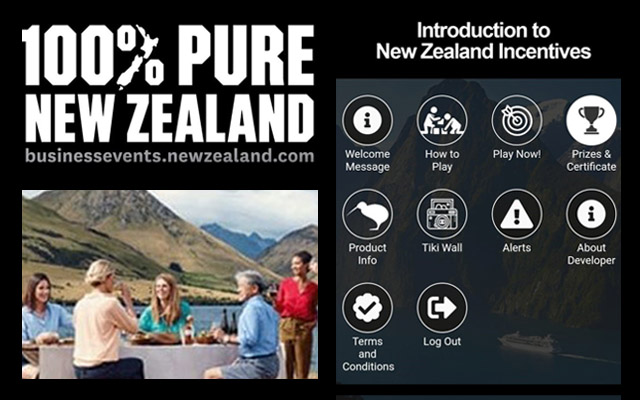
Tourism New Zealand has launched a new app-based learning platform that aims to bring critical product knowledge to incentive agents through gamification.
The app will take the agents through four modules, which will cover a range of topics and categories, from ‘Incentive Activities and Attractions’, ‘Unique Venues’, ‘New Zealand Trivia’, and even ‘People’, where agents will get to know the team behind Tourism New Zealand even better. Each module will. be launched weekly and cover 25 questions.
Screenshots from the new learning platform
To encourage further proactive learning, links will be provided for agents to independently seek information that is essential for itinerary planning.
Agents who complete the training with a score of 75 per cent and above will receive an exclusive Certificate of Completion, and the first 500 agents scoring 75 per cent and above will receive a branded gift.
The Top 10 scorers will receive further rewards such as personalised team training with Tourism New Zealand’s business events manager for South East Asia, priority destination updates, as well as priority invitations for fam trips and in-market events. The best-performing agent will also receive a hamper of New Zealand confectionaries.
The competition begins today (January 6) and will conclude on February 23.59.
To take part, incentive agents will need to first register online, following which they will receive a confirmation email with a username and password as well as QR codes and links to download the app.
The app will launch first in Singapore, and subsequently, in Indonesia and Malaysia.
Steven Dixon, regional trade marketing manager, Asia for Tourism New Zealand said in a statement: “Agents have been overloaded with scheduled webinars and online lecture-style training. It is not easy for incentive planners to retain and recall a fairly large amount of product information, especially through webinars, and so we want to turn the entire experience around with elements of gamification that will add a spark of fun.”
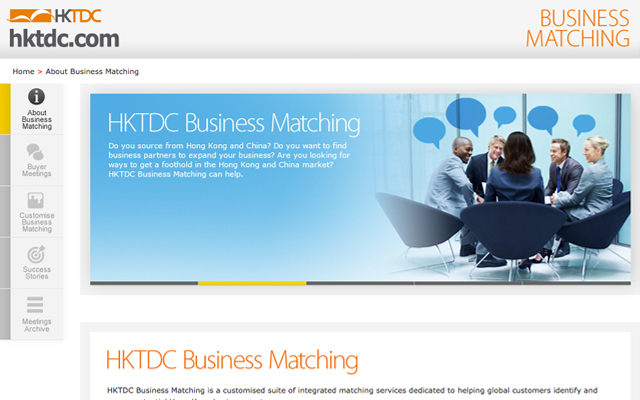
HKTDC will make use of its platform to connect local SMEs with global buyers
The Hong Kong Trade Development Council (HKTDC) will reconfigure its industry trade fairs and conferences in 1H2021 as part of its efforts to find ways to help Hong Kong companies continue doing business during the pandemic.
In addition to the exhibition that combines online fairs with physical fairs and symposiums, the HKTDC will also organise new local exhibitions and hold a number of its key international conferences online.
HKTDC will make use of its platform to connect local SMEs with global buyers
For instance, HKTDC will launching a brand-new sourcing event, the HKTDC International Sourcing Show, that will consolidate seven HKTDC trade fairs originally scheduled to be held in spring. The new event will run from March to July 2021 and will be held in online and physical formats, exploring business opportunities across a range of industries.
The seven exhibitions include the HKTDC Hong Kong Toys & Games Fair, HKTDC Hong Kong Baby Products Fair, HKTDC Hong Kong Houseware Fair, HKTDC Hong Kong International Home Textiles and Furnishings Fair, HKTDC Hong Kong Fashion Week, HKTDC Hong Kong Gifts & Premium Fair, and the Hong Kong International Printing & Packaging Fair (co-organised with CIEC Exhibition Company (HK)).
The International Sourcing Show will be the first hybrid fair launched by the HKTDC, with participating buyers and exhibitors able to use an online exhibition platform for business matching and video conferencing beginning from March 2021. The physical fair will be held in Hong Kong in July.
In addition to the seven above-mentioned fairs, the HKTDC Hong Kong International Jewellery Show and the HKTDC Hong Kong International Diamond, Gem & Pearl Show have been rescheduled to run at AsiaWorld-Expo from July 2-6, 2021.
HKTDC will also launch a year-round business promotion through its hktdc.com sourcing platform to connect local SMEs with global buyers. The theme for the promotion in the first quarter will be “Everything from Home”, focusing on products such as computers, fitness supplies, video games and kitchen appliances associated with the rise of the stay-at-home economy.
Other key international events that will be online include the Asian Licensing Conference and HKTDC Hong Kong International Licensing Show (January 11-15, 2021), the Asian Financial Forum (January 18-19, 2021), HKTDC Hong Kong International Film & TV Market (January 15-18, 2021) and MarketingPulse (March 2021).
EASE UP offers a unique dining experience for groups taking advantage of the grant
The Thailand Convention & Exhibition Bureau (TCEB) has created EASE UP, a package of financial and in-kind incentives to woo international corporate meeting and incentive events from Singapore.
EASE UP is a collaborative financial grant offering up to 1,500 baht (US$50) per person or a dining experience of up to 300,000 baht per event. Applications are open until August 30, 2021, for events taking place not later than September 30, 2021. Application for support must be submitted to TCEB a month prior to the event.
EASE UP offers a unique dining experience for groups taking advantage of the grant
TCEB’s participating DMC partners will provide added support such as complimentary airport transfer and local experience, sightseeing or CSR teambuilding activities for up to 20 delegates. And for up to 20 paying guestrooms booked, participating hotels will also match the same number with complimentary guestrooms.
Qantas NDC offer is “not just about price”, and “would never be just about price”, but is about delivering “a better experience” and richer content to travellers
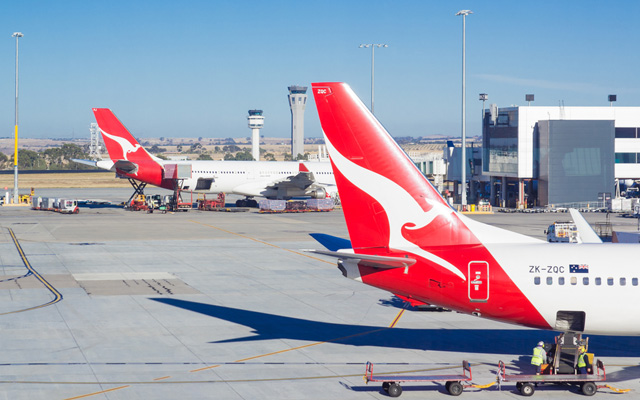
Qantas and Japan Airlines (JAL) will be forming a new joint business agreement, which will bring about more premium business and premium economy seats, as well as more streamlined processes.
The coordination made possible through a joint business would enable Qantas and JAL to ramp up flights between Australia and Japan sooner than would otherwise be possible. The airlines have also flagged an intention to launch a new route between Australia and Japan and which will be announced once regulatory approval is received, borders open and demand returns.
Qantas and Japan Airlines deepen their partnership
The proposed five-year agreement also includes:
An expanded codeshare relationship and optimised schedules on flights between Australia and New Zealand and Japan, opening up more connections to more destinations beyond the major city gateways. Qantas customers would have access to 14 new codeshare destinations in Japan and JAL customers would have access to 15 new codeshare destinations in Australia and New Zealand.
Enhanced frequent flyer benefits for Qantas and JAL customers, including improved earn of Qantas points or JAL miles on routes under the joint business, as well as the ability to upgrade using points or miles on each other’s services.
Improvements in the customer experience, including streamlined processes for disruption management and investments in product and service inflight and on the ground.
More premium travel opportunities, with Qantas able to offer customers a greater number of Business and Premium Economy seats on flights operated by JAL.
Coordination of pricing, schedules, sales and tourism marketing to develop new and improved travel products.
The airlines have submitted an application for authorisation to regulators in Australia and New Zealand, with a decision expected within six months. Subject to this regulatory approval, it is anticipated that the joint business would commence operations around July 2021, when Qantas has said it expects its international network to gradually restart.
Qantas Group CEO Alan Joyce said this venture would play a vital role in reviving trade links with the world’s third-largest economy and deliver significant benefits for customers travelling between Australia and Japan.
“The joint business means we’ll be able to build on our existing relationship with JAL through oneworld to offer more routes, better flight connections and more benefits to frequent flyers. It also helps us diversify our portfolio of joint businesses amongst Australia’s key trading partners,” noted Joyce.
Japan Airlines’ president Yuji Akasaka added: “We believe that a joint business with Qantas will make for a quicker recovery between both countries with the ability to expand connectivity within each carrier’s respective domestic network, providing more customer choice and travel growth opportunities.”
The newly-opened Ritz-Carlton, Bangkok anchors the One Bangkok development with cosmopolitan elegance. Featuring the city's largest ballroom and a spectacular new penthouse suite, it delivers exceptional hardware and deeply authentic, soulful service for business and leisure travellers alike
Behind the imposing, Brutalist concrete that defines Zurich’s Oerlikon district lies a surprising secret. While its exterior honours the neighbourhood’s industrial roots, stepping inside Mama Shelter reveals a vibrant, neon-soaked world that is a far cry from its rigid shell
A polished urban retreat designed for business travellers, Hyatt Regency Kuala Lumpur at KL Midtown combines thoughtful design, seamless service, and exceptional facilities.




 Andy Watson is the senior vice president and general manager for Asia Pacific Japan and Greater China at SAP Concur, where he is responsible for leading the business for SAP Concur in this region. A 30-year IT industry veteran who’s been a CFO, Watson has also held global and regional leadership roles in SAP SuccessFactors and SAP Cloud.