Destination Gold Coast (DGC) has appointed Patricia O’Callaghan as its new CEO, effective since November 23.
Set to commence her duties in early February 2021, O’Callaghan will build on the current strong position of DGC and the City of Gold Coast, through a focused approach on the company’s future strategies and plans.
Stepping into the role during an unprecedented time, she will work with stakeholders to rebuild the city’s visitor economy, with a focus on attracting the domestic crowd ahead of international recovery.
That will entail ensuring there is a sharp focus on the continued development of experiences and infrastructure investment to optimise the benefits for the city’s businesses, residents, workers and other key stakeholders.
Previously, O’Callaghan was the CEO of Townsville Enterprise over the past six years, where she had been instrumental in attracting major investment to the region and achieving economic growth for her hometown.
South-east Asia has become an increasingly important market for Switzerland, with a noticable increase in corporate groups from the region choosing it for their incentives.
An insurance company from Thailand that chose Switzerland for its reward programme, said that the “dream destination” was one of the safest and cleanest in Europe. One of its cities, Lausanne, also holds a special place in their hearts.
Sledding down a Swiss mountain makes for a memorable incentive moment
Its spokesperson added: “Lausanne is where Thailand’s beloved King Rama 9 studied and lived for many years. We could not deny selecting Lausanne as a destination to take our top agents there to follow in his footsteps.”
Over in Indonesia, Ary Leonardo, vice president MICE from AntaVaya, spoke of how accommodating suppliers were, when it came to adhering an incentive group’s dietary requirements.
“The group was extremely impressed how restaurants, even the remote mountain ones, were able to come up with delicious Muslim-friendly meals. The highlight for the group was a gala dinner that showcased Swiss traditions and cuisine in a farm near Zurich,” he shared.
But a farm-style gala dinner is just a small part of the rich variety of landscapes and cultures that a five-day programme can pack in. It takes only four hours to cross the country from East to West, and three hours from North to South.
There is also a range of social programmes available, such as skiing in the morning, cow-milking in the afternoon, and a evening dinner cruise.
Backing the country’s myriad offerings are Switzerland Convention & Incentive Bureau’s and its partners’ varying support policies.
For example, groups of 300 pax will be given access to an additional airport counter for tax refunds, while a 500-strong group will be provided with an award ceremony with folklore music group as entertainment.
Meanwhile, Lake Lucerne Navigation Company offers a 10 per cent discount on charter cruises excluding F&B and additional services, while over in Lake Geneva, Glacier 3000 offers a free Snowbus ride on the glacier.
In light of the pandemic, Switzerland’s tourism suppliers have also implemented a Clean & Safe protocol.
Reto Kaufmann, Kuoni Tumlare’s vice president sales and operations, South-east & South Asia, summarised: “Switzerland offers MICE organisers from Asia a value for money proposition. Critical supply such as hotels, transportation, venues, F&B as well as entertainment can be found in a wide quality and price range, which is key to building enticing incentive programmes.”
Business events leaders in Indonesia and beyond will come together for an online panel on December 15 to discuss how regional and local trends, challenges and opportunities will shape strategies to get the industry up and running once more.
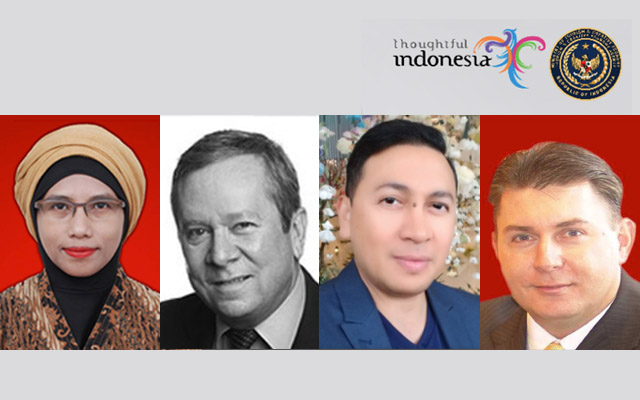
(From left) Ministry of Tourism and Creative Economy of the Republic of Indonesia’s Masruroh; GainingEdge’s Gary Grimmer; Bali Convention and Exhibition Bureau’s Levie Lantu; and Jakarta International Expo’s Ralph Scheunemann are speakers on this panel
The event, branded under Travel Spark by TTG Asia Media, a new initiative to support trade players in their efforts to spark off travel and events desire, and speed up business recovery, will be hosted by Mimi Hudoyo, editor-Indonesia of TTG Travel Trade Publishing, TTG Asia Media.
She will be joined by panellists Masruroh, director of MICE, Ministry of Tourism and Creative Economy of the Republic of Indonesia; Gary Grimmer, executive chairman, GainingEdge; Levie Lantu, CEO, Bali Convention and Exhibition Bureau; and Ralph Scheunemann, chief marketing director, Jakarta International Expo.
The event is free to attend, but comes with limited seats.
FHA Match will be a series of six virtual events held throughout 2021
FHA-Food & Beverage, an industry event serving the global food and hospitality community, will not have a physical version in 2021.
Instead, the event will reopen in 2022 from March 28-31 at its original
location, Singapore EXPO & MAX Atria.
FHA Match will be a series of six virtual events held throughout 2021
For 2021, organiser Informa Markets will be holding a virtual series – comprising a total of six FHA events. Powered by Saladplate.com, the virtual event, named FHA Match, will run for two days packed with AI-driven meetings to match businesses, enabling participants to form new connections and unlock new opportunities across markets.
Attendees can also catch demonstrations to discover new and breakthrough products, and join sessions that will discuss the trends impacting their businesses.
Designed to be sector-focused, the first edition of FHA Match will centre on Meat, with subsequent editions spotlighting Dairy, Frozen Food, Drinks, Sweets & Snacks, and Fine Food respectively.
The FHA team will contact all exhibitors, visitors and partners to discuss their future participation in FHA-Food & Beverage in 2022.
Destination management specialist Kuoni Tumlare has added a new feather in its cap, with the launch of a virtual and hybrid event solution for corporate clients here in Asia.
The solution, which is built upon OnAIR by EventsAIR event management platform, will draw on the expertise of its sister company, Kuoni Congress, in the initial launch phase, said Tim Martin, COO at Kuoni Tumlare. This will ensure that clients get the “best technical support” out of Europe as well as assistance from the Asia team.
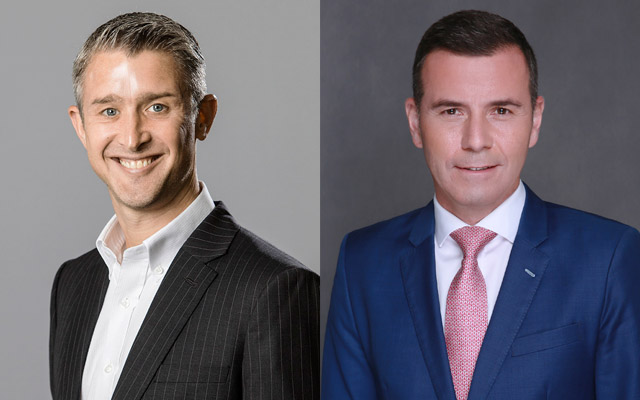
Kuoni Tumlare’s Tim Martin and Reto Kaufmann will lead the launch of a new online and hybrid event solution to corporate clients in Asia
In the next three months, Kuoni Tumlare will take the virtual and hybrid event solution to Singapore, Hong Kong, Thailand and Shanghai. Martin expressed intentions to debut the service in the US after phase one, and expand it to even more markets in Asia some time in 2Q2021 when Kuoni Tumlare has established technical teams across its Asian network.
The new service offering will see Kuoni Tumlare enhancing its business model, from one where it used to deal only with large MICE or travel agencies to going direct to the corporate client today.
Martin said: “In this moment in time when it is critical to diversify to remain relevant, we find ourselves able to maintain our traditional partnerships on our core business while supporting corporates across Asia in their online and hybrid event needs.”
However, he explained that this was not a “surprising shift” since many of the corporate clients were already “familiar with us and are aware of our credibility in event management (in Europe)”.
Reto Kaufmann, vice president – sales & operations South East & South Asia, Kuoni Tumlare, told TTGmice that the initial response from the marketplace had exceeded expectations and most of the events enquired for were strategic meetings and business kick-offs happening soon.
“The type of event enquiries we are getting is in line with the time of the year when many corporates need to engage with staff, stakeholders and management teams. Many multi-level marketing companies are also gearing up now for multiple product launches in 2021,” said Kaufmann.
Kaufmann believes that Kuoni Tumlare’s point of differentiation from other event management agencies lies in the company’s physical presence across the world, allowing his teams to produce unique destination experiences and make them part of an online event.
For instance, a cultural performance pre-recorded or executed live in Spain or Russia could be broadcasted to the opening ceremony of a virtual or hybrid event. Clients could also weave an online paella cooking class conducted by a chef in Spain or wine tasting session by a sommelier in Italy into meetings.
While Martin and Kaufmann recognised a strong desire for online or hybrid meetings among corporate clients, they said that most were still unfamiliar with the process of producing a virtual event.
“Hence, our virtual and hybrid event solution also includes confidence building and having the client understand that we are here to hold their hand and get them through the process with our expertise,” said Kaufmann.
Meanwhile, Kuoni Tumlare is in the midst of establishing partnerships with select hotel chains in Asia to provide a one-stop hybrid event solution for corporate clients. This arrangement will allow hotel partners to rely on Kuoni Tumlare for hybrid event management expertise, while Kuoni Tumlare will position partner hotels as preferred venues.
“Our trump card in such an arrangement is that we have people in many of the key business cities in Asia, and they can be on the ground to support our hotel partners as well as clients,” said Kaufmann.
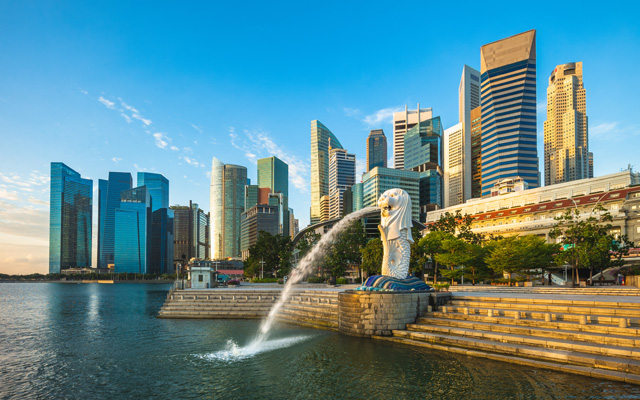
Singapore (pictured) has been chosen to host next year's World Economic Forum
The World Economic Forum (WEF) will convene its Special Annual Meeting in Singapore next year from May 13-16.
The event will be the first global leadership event to address worldwide recovery from the Covid-19 pandemic, said WEF in a press release.
Singapore (pictured) has been chosen to host next year’s World Economic Forum
Usually held annually in Davos, Switzerland, WEF decided that Singapore was best placed to hold the meeting, and the change in location reflects the Forum’s priority of safeguarding the health and safety of participants and the host community.
In another press release, Singapore’s Ministry of Trade and Industry said WEF’s decision in location reflects the confidence in the country’s management of the pandemic thus far. The hosting of this event will have a positive trickle-down effect on the country’s MICE and hospitality sectors.
This is the second time the WEF Special Annual Meeting will be held outside of Switzerland since its establishment in 1971, and the first time it will be held in Asia.
Founder and executive chairman of WEF Klaus Schwab said a global leadership summit is of “crucial importance to address how we can recover together”.
He added that the Special Annual Meeting 2021 would be a place for leaders from business, government, and civil society to meet in person for the first time since the start of the pandemic.
WEF will also hold a virtual event from January 25-29, 2021, during the usual Davos week.
It will feature participation from heads of state and government, chief executive officers, civil society leaders, global media and youth leaders from across the globe.
The annual BE@Penang conference for Asia’s business events community will return this year with a virtual format, allowing industry players to connect despite ongoing travel restrictions.
The fifth edition, taking place December 10 and 11, presents the theme, Be Inevitable, which urges the industry and professionals to be fearless and bold in charting the path to success, no matter what crisis comes their way.
The fifth BE@Penang conference will be hosted online this year
Eddie Obeng, a thought leader and British educator who is recognised for his success as a motivational speaker, innovator and author, will helm the keynote slot on December 10’s morning.
Other notable speakers at the online conference include Kuala Lumpur Convention Centre’s Angeline van den Broecke; Tourism New Zealand’s Leonie Ashford; Firefly’s Phillip See; Nuskin’s Jex Wong; Pico International’s Eric Ho; and Digital Penang’s Tony Yeoh.
The two-day event will conclude with a closing keynote by Roshan Thiran, founder and CEO of Leaderonomics, a cause-driven leadership development firm in Asia-Pacific.
A registration fee of RM50 (US$12.25) applies, with all collections going to a local charity.
The event is owned by Penang Convention & Exhibition Bureau and supported by the Penang State Government.
International Convention Centre Sydney (ICC Sydney) is one of the first purpose-built MICE venues in Australia to establish a comprehensive set of operating principles to guide the safe resumption of events in a Covid-19 era.
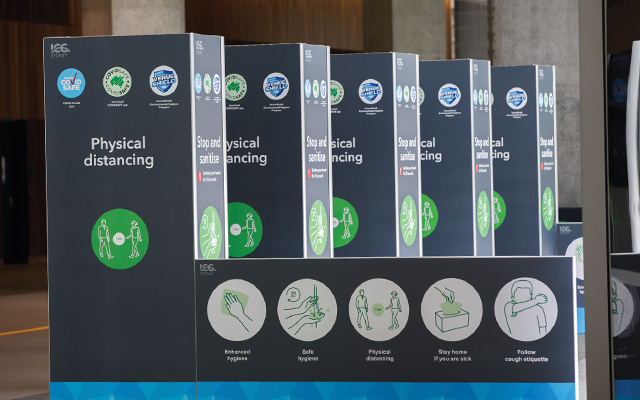
Described as an “industry benchmark” by ICC Sydney’s CEO Geoff Donaghy, the ICC Sydney EventSafe Operating Framework spans 16 key areas of event management, including the customer journey, environmental hygiene, food service, technology and equipment, employees and public awareness, and covers meetings, conferences, exhibitions, live events and internal operations.
EventSafe measures enforced at the HealthCert conference
Besides consolidating inputs from national and international industry bodies, the Framework also integrates best practice from parent group ASM Global’s VenueShield, an advanced hygiene programme built on the expertise of public health authorities as well as medical and industry leaders.
In addition, the protocol abides by Safe Work Australia’s Codes of Practice and national Covid-19 Safe Workplace Principles.
ICC Sydney’s safety assurance is built on a strong track record – the venue has numerous International Standards Organisation Certifications in areas such as food safety, environment, Work, Health and Safety, and quality management.
Donaghy said the Framework would safeguard clients, visitors, contractors and team members against the risk of Covid-19 and reinstall confidence in events, which would in turn reboot the industry and Australia’s economy.
“As Australia and the rest of the world starts to return to business as usual, it is critical that we all continue to safeguard against further outbreaks of Covid-19, especially when bringing people together,” he remarked.
ICC Sydney’s events specialists are on hand to help event owners and organisers navigate health and safety guidelines while fulfilling their unique event requirements.
As countries hunker down for a travel season focused on the domestic market, Koh Samui’s luxury hotels are doing the same in Thailand.
“With the domestic market being the only lifeline at present, we learnt very quickly that the key to attracting the local market is to use social media – such as Facebook, Line and Instagram – to both promote and facilitate simple transaction options,” shared Remko Kroesen, Banyan Tree cluster general manager for both Banyan Tree Samui and Banyan Tree Krabi. The latter opened its doors in October 2020.
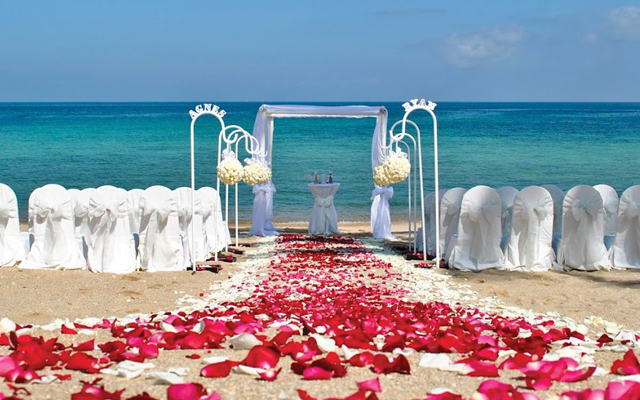
Wedding setup at Banyan Tree Koh Samui
Kroesen added that other initiatives such as hosting bloggers or celebrities – who post regularly on social media platforms – have also helped to promote the resort and destination. Selling vouchers at travel fairs have proven popular too.
All these “attractive deals and aggressive promotions via the right channels” are key to driving business, cited Kroesen.
As for Meliá Koh Samui, the hotel is aiming to make its Sunday brunch profitable, said its general manager Ernesto Osuna.
Meliá Koh Samui has also packaged the brunch with pool and gym access, which has brought about “very good response” from both locals and expats. Previously the Imperial Boat House Beach Resort, the overhauled property opened just before the pandemic hit in January 2020.
Christian Lueke, cluster sales and marketing director for Meliá properties in Koh Samui and Chiang Mai (pre-opening), shared that the properties are now focused on “creating experiences” and additional packages that will entice the local market, such as add-ons like on-property childcare for parents.
The Thai government’s We Travel Together campaign, and Bangkok Airways’ Flyer Pass promotion in the past few months has given Koh Samui’s events industry a boost.
“This has encouraged some domestic group and incentive business, but numbers remain modest in comparison with destinations like Phuket and Krabi.
“However, weddings will continue to play a large part of (bringing) guests to Koh Samui as is one of the (country’s) most popular wedding destinations,” Kroesen told TTGmice.
BE Reconnected reminded us all that this is a very human industry which thrives on people connecting, relationships evolving, teaching, learning, listening, transacting, innovating and creating
New Zealand’s only showcase for the business events industry this year, BE Reconnected, brought together over 420 event organisers and suppliers from around the country to Auckland on December 1.
Organised by Business Events Industry Aotearoa (BEIA), the event showed business events are not only safe, but also a vital component for widespread economic recovery.
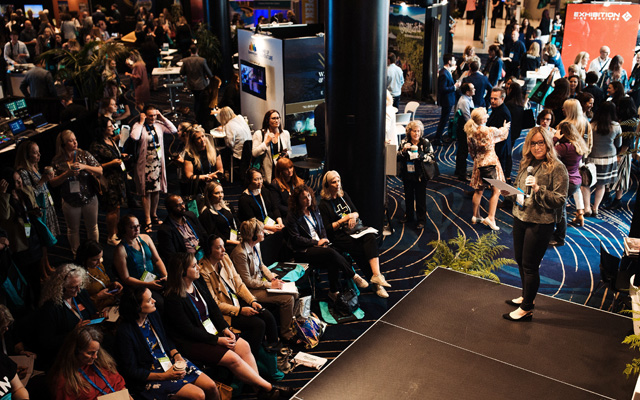
BE Reconnected reminded the industry that it is a very human industry which thrives on people connecting; the showfloor pictured
The event included three keynote speakers, Sir John Kirwan, Cam Calkoen and Lisa O’Neill, as well as a series of regional updates from 14 different regional convention bureaux from around New Zealand, plus briefings from Tourism New Zealand Business Events.
Every attendee scanned the COVID tracer app on arrival, before walking past a thermo-imaging camera on entry to the show floor. Individually-packed lunches and disposable cups for drinks, allowed guests to quickly grab and go. A St John first responder was on site for the entire day, to ensure immediate medical attention if needed. Self-check-in kiosks were managed by staff so there would be less people handling the kiosk. The kiosks also noted the time attendees checked in and out of the event to ensure help for further contact tracing. Masks were given to those who wished to wear one at the event, and everyone who travelled to the event by air, or public transport was required to wear a mask while travelling.
BEIA chief executive, Lisa Hopkins, said attendance at BE Reconnected highlighted the pent-up demand to gather in person with colleagues at meetings and incentives — and she remains optimistic about the future of business events.
“More than 290 buyers walked through the showfloor connecting with 120 suppliers, which will go towards supporting domestic recovery. We are thrilled with the enthusiasm this event created, and how much was accomplished in one day.
“Over the next three years, New Zealand will open three international convention centres, with a combined floor space of 10 rugby fields, creating over 1,000 new jobs directly while also supporting other industries such as accommodation, hospitality, food producers and suppliers, and airlines,” she added.
Tourism New Zealand’s business events global manager, Lisa Gardiner, also presented results of a recent industry survey which showed Covid-19 has increased the value New Zealanders put on face-to-face meetings.
The survey of 125 New Zealand-based organisations found that 97 per cent are planning to hold a business event in 2021.
“The appetite for meeting is coupled with an increasingly positive attitude towards business events: 92 per cent consider in-person conferences and offsite meetings important for their organisation, up from 79 per cent of respondents in Tourism New Zealand’s May 2020 survey; and more than half (56 per cent) said they appreciate the importance of face to face meetings more now than pre-Covid-19, up from 39 per cent in May.”
Hopkins noted that BEIA is working closely with the government, and contributing to industry taskforces, to ensure that the road to recovery is as rapid and smooth as possible.
“We were reminded that in our professional industry, nothing is left to chance, and best-practice safety and hygiene can still make for an enjoyable, relaxing and inspirational event. After a year when we learned all about creating virtual and hybrid events, we all agreed nothing beats meeting face-to-face in a space where everyone feels safe and engaged,” Hopkins concluded.
Just 10 minutes from Phuket International Airport on the serene northern coast, this 178-key, Bill Bensley-designed resort offers delegates a quiet, tropical paradise steeped in Phuket’s tin-mining heritage
The newly-opened Ritz-Carlton, Bangkok anchors the One Bangkok development with cosmopolitan elegance. Featuring the city's largest ballroom and a spectacular new penthouse suite, it delivers exceptional hardware and deeply authentic, soulful service for business and leisure travellers alike
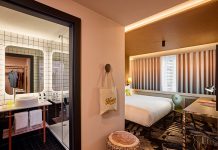
Behind the imposing, Brutalist concrete that defines Zurich’s Oerlikon district lies a surprising secret. While its exterior honours the neighbourhood’s industrial roots, stepping inside Mama Shelter reveals a vibrant, neon-soaked world that is a far cry from its rigid shell