Asia/Singapore Tuesday, 23rd December 2025
Page 621

Bangkok’s first dusitD2 coming in 2023

0
Dusit International has inked a pact with Tian Teck Property to open its first dusitD2 property in Bangkok come 2023. In attendance at the official signing ceremony held at Dusit International’s corporate headquarters in Bangkok were (from left): Tian Teck Property’s Gerald Cheong; Dusit International’s Chanin Donavanik and Thierry Douin

Dusit International has signed a hotel management agreement with Hong Kong-based Tian Teck Property to operate dusitD2 Samyan Bangkok, which will be the first dusitD2 branded property in Bangkok.

Slated to open in June 2023 on Si Phraya Road, a thoroughfare which runs parallel to Silom and Sathorn Roads in Bangkok’s CBD, the new hotel will boast 181 guest rooms across 23 floors. The hotel facilities will include a lobby bar, a swimming pool with children’s pool, a fitness centre, an all-day dining restaurant and a large meeting room for business travellers.

Dusit International has inked a pact with Tian Teck Property to open its first dusitD2 property in Bangkok come 2023. In attendance at the official signing ceremony held at Dusit International’s corporate headquarters in Bangkok were (from left): Tian Teck Property’s Gerald Cheong; Dusit International’s Chanin Donavanik and Thierry Douin

Dusit-branded hotels currently operating in Bangkok include Dusit Suites Hotel Ratchadamri, Bangkok and Dusit Princess Srinakarin Bangkok. In 2023, Dusit will also open its new flagship Dusit Thani Bangkok as part of Dusit Central Park, a landmark mixed-use project currently being developed opposite Bangkok’s Lumpini Park.

Dusit International’s property portfolio comprises 271 properties (nine owned and 260 managed) operating under six brands across 13 countries. The company has more than 50-Dusit branded hotels in the pipeline and expects to open at least 10 to 12 hotels per year in key destinations from 2019.

Oakwood opens in coastal Chinese city of Sanya

0

Oakwood has announced the official opening of Oakwood Apartments Sanya, its eighth property in China.

There are a total of 163 units ranging from studios to three-bedroom options. In addition to a private balcony offering panoramic views, all units are equipped with a kitchen featuring a Nespresso coffee machine, and in-room entertainment via a home theatre sound system.

Guests can make use of the property’s range of facilities, such as the outdoor swimming pool, fully-equipped fitness centre, 24-hour launderette, and kids’ club. Café O is Oakwood’s all-day dining restaurant, serving up hawker-style South-east Asian specialities and international dishes.

For a full cultural immersion, Oakwood Apartments Sanya organises monthly heritage excursions. Some highlights include a visit to the Areca Valley Aboriginal Culture Spot where the Li and Miao tribes reside, neighbourhood tours, golfing, and watersports activities.

Located within the Tianya district, this is the Chinese coastal city’s first internationally-branded serviced apartment. Famous attractions in the vicinity include the Nanshan Temple, Tianya Haijiao Romance Park, and the Railway Station Seafood Market.

Los Angeles Tourism ramps up APAC efforts with SE Asia added to regional director’s portfolio

0

The Los Angeles Tourism & Convention Board is expanding its presence in the region with the appointment of Craig Gibbons to now oversee Indonesia, Malaysia, the Philippines, Singapore, Thailand, Vietnam, in addition to Australia and New Zealand.

Based in Sydney, Gibbons has been Los Angeles Tourism’s regional director for Australia/New Zealand since 2014.

In his expanded role, Gibbons will develop and support air service for Los Angeles International Airport; design a destination training programme for the travel trade utilising the L.A. Insider programme; and attend key industry trade shows in the region.

Prior to joining Los Angeles Tourism, Gibbons was the commercial & trade executive, South-east Asia & Australia for Visit Britain and held the role of Australia country manager for Visit Indonesia.

“South-east Asia continues to be an expanding source-market for travel to the US and we are keen to increase and support airlift from the region,” stated Kathryn Smits, vice president, tourism for the Los Angeles Tourism & Convention Board.

Vincent Billiard joins The St Regis Singapore as GM

0

The St Regis Singapore has appointed Vincent Billiard as general manager, an experienced hotelier with over 18 years of hospitality experience in luxury properties.

Prior to his move to Singapore, Billiard held numerous key leadership roles in several Ritz-Carlton hotels, and was involved in the opening of 10 other properties across a portfolio of brands including Ritz-Carlton, Edition and Bvlgari.

Most recently, Billiard led the launch of the Bvlgari Hotel and Residences Shanghai as general manager.

Evason Ana Mandara welcomes GM

0

Mathias Gerds has been appointed general manager at Evason Ana Mandara in Nha Trang, Vietnam.

Gerds brings a wealth of knowledge to his new position, having spent over 20 years in different roles across luxury city and resort properties across the globe.

The German first began his career in the F&B sector, and then worked in senior roles at hotels such as Anantara Siam Bangkok in Thailand, Kempinski Grand Hotel Heiligendamm in Germany, St Regis Kuala Lumpur in Malaysia, and Relais & Chateaux Palais Coburg in Austria.

Over coffee with Renato Padilla

0
Renato Padilla

The Philippines was once the toast of the business events industry in Asia, with PICC being the first convention centre in South-east Asia. How can we bring back the heyday?
What we need is a mindset from the Department of Tourism (DoT) to strengthen, and work on selling and marketing the Philippines as a convention destination to international and regional associations.

We tried that in 1978 when I was the marketing manager of the Philippine Convention and Visitors Corp. (PCVC), now the Tourism Promotions Board (TPB, DoT’s marketing arm). We were very successful.

Renato Padilla

Convention promotion was handled by TPB while DoT concentrated on tourists. (As such) we already had one foot in the associations door in the 1980s.

TPB formed a MICE department recently, but a Philippine Convention Bureau must be formed. Today, practically every city in the world has a convention bureau to handle destination market. In comparison, we do not have a convention bureau and neither do our cities.

Infrastructure is being built and new hotels are coming up but the government has to take the lead in promoting and marketing (the country for events).

Is the government receptive to these ideas?
Ten years ago, we tried persuading them to have a convention bureau. It’s all in the mindset. Local government units (LGUs) have to be development-oriented and help the business events industry. Some LGUs are doing that but (in a) very limited (way). We tried to talk to Pasay City (where Manila’s main convention centres including PICC are located), but they don’t understand.

Philippine convention centres are dwarfed by big venues in the region. Can the Philippines catch up?
We’re already behind in Asia. At the moment, our South-east Asian and (wider) Asian neighbours have managed to build structures as huge as 100,000m2.

We cannot even bid for big trade exhibitions. If a country is to become a member of the United Federation of Exhibition Centres, (it needs to have a) minimum of 30,000m2 of exhibition space.

Sad to say we don’t have that in the Philippines. PICC has 5,000m2, World Trade Center Manila has 10,000m2, and SMX Convention Center Manila has 10,000m2. All three combined offer less than 30,000m2 of space.

How is PICC doing on the exhibition front?
We need an honest to goodness exhibition centre connected to PICC. We need an area where we can exhibit heavy materials like military equipment, boats, trucks, etc.
Money is in exhibitions. Where before an exhibition was part of a congress, now exhibitions are standalone events.

Organisers will sell on a per square foot basis that they get from an exhibition centre, and that is where the money (comes from), even for local associations.

But there’s not enough space within the PICC grounds.
PICC is within the Cultural Center of the Philippines (CCP) complex. CCP has divided the 60-hectare property into seven zones to develop into revenue-producing clusters like theatre, condominium, etc.

I brokered discussions between CCP and the Development Bank of the Philippines – the infrastructure bank of the government – to sell the land to Bangko Sentral ng Pilipinas (Philippine Central Bank), which owns PICC. An international convention centre and an international exhibition centre are complementing projects (but there are no results yet).

Being government-owned, does PICC get marketing assistance from the government?
PICC has to market itself.

So what is PICC doing itself to bring in business?
One of the successful things PICC did was to have the Office of the President issue a circular in 2017 directed at government agencies and government-owned and controlled corporations to hold events at PICC, where no downpayment was required.

The campaign is snowballing. We had a 30 per cent increase in business but more now.
Several years ago, we formed the PCAAE (Philippine Council for Associations and Association Executives) with CEO Bobby Peralta and TPB in the hope that it will pick up the education and information aspects for local associations, and empower them to be able to bid for their counterpart institutions and congresses.

PICC has provided the venue for the yearly PCAAE summit.

Veteran luxury hotelier named GM of China World Summit Wing, Beijing

0

Alex Willats has been appointed as general manager of China World Summit Wing, Beijing, operated by Shangri-La Hotels and Resorts.

Prior to joining China World Summit Wing, Beijing, he was general manager of Shangri-La at The Shard, London.

Willats is originally from the UK and has more than 25 years of experience in the hotel industry. During his career, Willats has also managed The Ritz London, Claridge’s; and Dusit Thani Bangkok.

Willats first joined Shangri-La Hotels and Resorts in 2015 and has since worked at Shangri-La properties in Qatar, Oman, India and The Philippines.

Art of decluttering travel

0

You wrote an interesting opinion piece on how one can KonMari – declutter – the business travel process. What parts of the process do you think are outdated and should be disposed of?
I am traditionally a CFO (chief financial officer), so I understand the needs of a CFO when it comes to managing expenses, travel, and invoicing. But as a traveller myself now and having to deal with those processes, I’m also seeing this from another angle.

Once upon a time I had to go through the process of describing where I wanted to go, getting the answers I didn’t like, giving it back and trying again, finally making my trip and then collecting all my receipts and glueing them on a nice piece of A4 paper.

As a CFO, I need a process that my employees can use and enjoy while allowing me to drive policy and make changes to preferred suppliers, for instance, easily. I also need to take the pain out of the journey.

You want to know you are driving a reliable process, without necessarily making it a painful one. Perhaps the key to decluttering the business travel process is automation.

Would bringing in automation means having to use more apps and software?
From an SAP Concur perspective, we go beyond writing code for an automated process. We look at the whole experience. We are hiring a lot of millennials and Gen Z, and they barely need pen and paper to write. We need to make sure the travel process is something that they are used to.

We partner with over 200 companies, from transportation services and credit card companies to accommodation and airlines, to bring the whole experience onto one platform that handles travel, expenses, invoicing, etc.

It isn’t just a piece of code.

So it is one single app to do it all?
Your entry point is the SAP Concur platform. You get an invoice, take a photo, and because of the intelligence we’ve built in, the system can recognise the various text fields to extract information. When I set up a sales dinner meeting, for example, I would have keyed in the names of all the attendees in my meeting request. These names will be added to the expense claim later on so I won’t have to struggle to remember who my guests were.

As a traveller, I use TripIt, a beautiful little travel application which is also by SAP Concur. I would go in and see all my past and upcoming trips, and each will list all my flight connections, notice for gate changes, etc.

Do you think companies are decluttering their travel process fast enough?
There is great growth in the market. As we simplify the process and build up the (partner) eco-system, more customers are coming onboard.

But we are just touching the tip of the iceberg. We are seeing some markets with tremendous growth potential here in Asia, and some markets like China and India with huge travel appetite.

SAP Concur is in the position to drive these markets, as we are the only solution that gives end-to-end coverage across the travel, expense and invoice processes.

There are other areas that come into play. I spoke about the need to declutter, to take away the manual processes of travel management, to make it a pleasurable experience. But there are other growing needs in travel management.

We see a lot more women travelling for work, and so the need for duty of care for employees becomes even more important. We can work partner hotels with women-only floors into the policy.

Furthermore, there are many incidents in our region today – like in Hong Kong. We have to make sure our travellers know what they are going into and we need accuracy in destination updates.

What drives market adoption in Asia?
In my region here, there are homegrown solutions that address certain needs, like the need to manage expenses. However, the whole global travel business – the duty of care, the experience we bring from 200 partners – that’s all very much new.

So that, together with the growing economies of Asia and therefore companies’ need for easier travel management solutions, drives market adoption here.

Does tech culture play a role in speed of adoption?
Absolutely! We’ve seen it in Japan where a whole need for electronic invoice enabled our growth in the market. China is another one. In some places, you cannot even pay in cash anymore and only electronic payment is allowed. In Singapore, the workforce is becoming very mobile. One hardly needs to come into office anymore. This means a bigger reliance on mobile first.

This is a message I had to bring home to the company myself. If a company needs to develop mobile solutions, it has to come to Asia and have a look.

So, we are doing more and more to enable the right user experience that matches the needs of this generation while providing the solutions the CFO is looking for.

How does General Data Protection Regulation (GDPR) and Singapore’s Personal Data Protection Act (PDPA) impact the way companies collect and use travellers’ data for better business travel management?
SAP is the largest application software on the planet, and we take all these data requirements very seriously. We have a massive presence in Germany. Guess where GDPR was born?

If I look at what we have invested in our software development over the years, a lot goes into security, data privacy protection, architecture and functionality, cloud solutions, etc.

Data security is always a theme that comes up in our conversations with clients, and I love it when it does. I am very proud to be backed by a company that has invested in top data centres. In fact, when the first sniffings of GDPR came out, SAP was part of the discussions. It is our strong point.

Lastly, how do you utilise tech yourself in your travel planning and purchases?
I’m fully on board the Concur platform and I use TripIt to look into my itinerary. I’m the sort of traveller who leaves Singapore with one agenda, but it very often changes. I may have to get on a different flight, book into a different city, change my route back, etc.

The solutions give me the flexibility to do that. The days of waiting for a travel agent to make the changes for me are over. And no longer do I need to turn up at the airport early and beg for an earlier flight out.

Corporate travellers tend to worry about compliance, whether they are booking to policy, and then how they are going to file that claim and when they will get their money back. The Concur platform takes that worry away from me. Whatever I book and buy, I know I’m doing it right because this is a verified process.

When I am on the road, the moment I’m out of the taxi, I know that with one click my expense claim is pretty much done. When I check out of my hotel, I don’t even need an invoice because all expenses are captured electronically and my assistant already has all the information she needs for my claims.

Our studies have shown that our system reduces effort in the booking process by about 40 per cent, and in the expense claim process by about 65 per cent.

We got business cases from our customers that make me think we should have charged them a bit more for the software at the start. (Laughs) The returns they get are immense.

With Celcom, for instance, they saved almost US$900,000 in their first year (of using SAP Concur). With Dimension Data (part of the NTT Group), they saved about 30 per cent on their travel expenses by implementing our software.

My family relies on TripIt. My wife is signed up as a TripIt Pro user. I have all my work and personal trips on TripIt, so my wife knows just by checking the app and can plan our social events around them.

My family’s trips are in the app too. They are now in Europe and I can see that the hotel and car rental have been booked. Delays are flashed up, so I know. I’ll be informed when and where they land, so I know to make my way to Terminal 4 and not Terminal 2. A weather alert also goes out before the trip, so we are prepared. This is just fabulous.

USANA decides on South Korea for 2020 meeting

0
Bukchon Hanok Village in Seoul, South Korea, pictured

About 11,000 employees of global health food manufacturing company USANA Health Science will be heading to South Korea from May 6-10, 2020.

The Utah-based company will be holding its 2020 USANA ASIA PACIFIC Corporate event, which will include meetings to discuss new product development and marketing strategies as well as visits to key attractions in the Seoul and Gyeonggi areas.

Bukchon Hanok Village in Seoul, South Korea, pictured

The event will be jointly hosted by the Korea Tourism Organization (KTO), Gyeonggi Tourism Organization and the Goyang Convention Bureau, and will see representatives from 11 Asian countries in attendance.

For the past five years, from 2015 to 2019, USANA hosted its corporate meetings in Singapore. However, due to rapid growth in the Asia-Pacific market and an increase in the number of participants, the group chose to consider other countries to host next year’s corporate meeting.

KTO triumphed over bids from China, Malaysia, and Taiwan.

Park Jung-Ha, KTO’s executive vice president of the international tourism division said in a statement: “The USANA corporate meeting holds great significance for the development of the Korean tourism industry in that the meeting will see the greatest number of participants among any corporate meeting Korea has hosted thus far.

“Furthermore, the production inducement effect is estimated to be 50 billion won (US$41.1 million), the value-added effect 22.5 billion won, income-inducement effect 10.8 billion won and employment-inducement effect 497 persons. If the 2020 Korea event is successful, there are plans to secure the event in Korea for the next five consecutive years until 2025.”

Young business travellers prefer solo sightseeing and social workspaces: Hilton

0
Meeting space design concepts including dynamic, social work areas that feature all of the amenities needed by remote workers, Hilton McLean Tysons Corner Innovation Gallery pictured

Young business travellers aged between 23-35 and who attend meetings on the road have revealed to Hilton Hotels & Resorts in a survey that while buzzing social environment and in-person interactions during regular work hours, this segment would rather spend their evenings on their own.

The research identified that 84% of young business travellers say that they cherish their alone time during business trips, and nearly three-fourths (73%) report that they have a better experience when they spend downtime on their own.

Meeting space design concepts including dynamic, social work areas that feature all of the amenities needed by remote workers, Hilton McLean Tysons Corner Innovation Gallery pictured

When asked how this group prefers to spend their free time, results included: eating at local restaurants (69%); exploring the city and/or neighbourhood (59%); sleeping or relaxing (56%); working out (35%); and attending a Happy Hour (38%) or unwinding at the lobby/hotel bar (32%).

“We’ve all had over-scheduled business trips – with meetings from 09.00 to 17.00. and social obligations the rest of the evening – and the result is pure exhaustion. We applaud this next generation of travellers for highlighting a tension point many of us have dealt with for years,” said Vera Manoukian, senior vice president and global head, Hilton Hotels & Resorts.

In looking at preferred work styles while travelling for business, findings were consistent with Hilton Hotels & Resorts’ 2018 survey results with 81% of respondents believing that they can get more done in-person.

Findings also underscore how their workspace – whether that’s a formal meeting room or multifunctional common space – plays a key role in spurring creativity, encouraging collaboration and ultimately contributing to positive outcomes. Key findings include:

Bustling environment: Two-thirds of respondents (63%) are more inspired in a busy, social environment when they are working alone/independently

Natural Light: 92% prefer natural light/windows in a meeting space

Colourful Spaces: 80% prefer a colourful meeting space with elements inspired by their surroundings

Intuitive Technology: 82% prefer a meeting space with ad

Reviews

Hyatt Regency Kuala Lumpur at KL Midtown

A polished urban retreat designed for business travellers, Hyatt Regency Kuala Lumpur at KL Midtown combines thoughtful design, seamless service, and exceptional facilities.

A versatile powerhouse

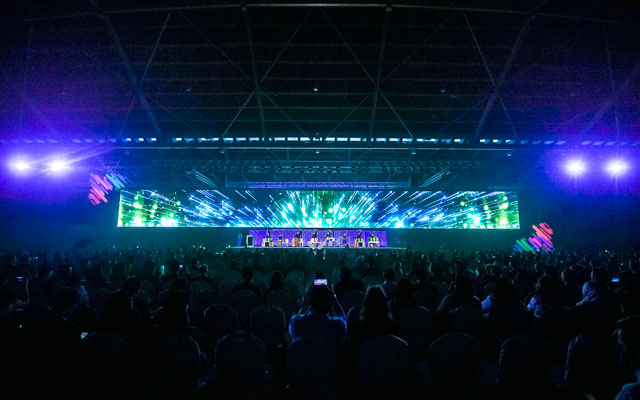
Arena @ Expo, a multipurpose concert hall at the Singapore Expo is a flexible space for high octane concerts and lifestyle events.

Amari Bangkok

The five-star property excels in backing its expansive facilities with seamless service and personalised attention, setting the benchmark for luxury in Bangkok.