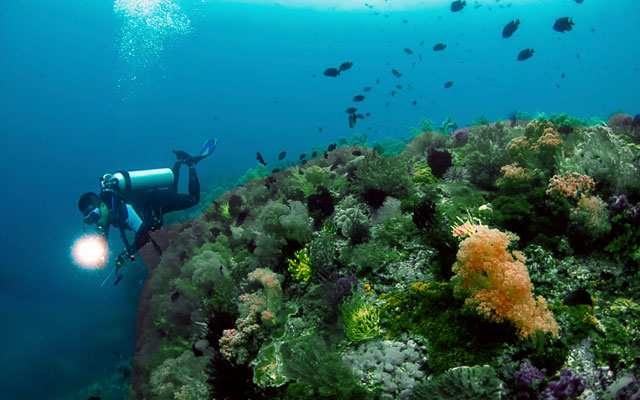
Diving in the Philippines is a popular activity for Europeans visiting the country, hence it’ll be one of the niche interests the TPB is highlighting
With a recent refresh of its destination campaign, the Philippine Tourism Promotions Board (TPB) is extending its focus on more granular marketing content to European markets.
TPB recently revived the It’s More Fun in the Philippines campaign with a strong focus on crowd-sourced visual content shared by tourists online.
Diving in the Philippines is a popular activity for Europeans visiting the country
While this may signal the weight that TPB is placing on digital marketing, Marie Venus Tan, COO of TPB told TTGmice that visuals and other content serve to paint a clearer picture of fun in the destination, meant to resonate both online and offline.
“Our (marketing content) are meant to illicit interest, and not simply (highlight the destination), but what’s in the destination. It’s important that we don’t merely focus on beaches, as this is a very competitive area regionally, or mountains. We would have to go deeper into culture and folklore, for example.”
TPB intends to highlight more tourism assets that appeal to niche interest, and part of that will involve opening up new destinations.
“We are appealing to areas that address specific niche interests. For instance, surfing in Siargao. We will use more action shots that will evoke curiosity.”
She added: “Boracay does not need promotion – it needs enhancements. We are opening up Iloilo, and other destinations outside of Mindanao such as Bukidnon. These areas are interesting for experiential tourism, (and figure into) the strategic direction towards special interests.”
Content will be targeted to different markets. “Diving is an important niche while we’re here in Europe. In the UK, it is birdwatching, among other activities. And in India and the Middle East, weddings.”
In Europe, the UK, Germany and France are the top performing source markets in terms of both volume and growth, Tan said. Emerging markets in eastern Europe, such as Poland and Russia, are also coming onto the radar, she added.
As tourist numbers grow and new parts of the Philippines are promoted to visitors, industry observers foresee connectivity to be a continued challenge with the lack of direct international connections and capacity strains at the country’s main gateway.
Tan stated that communications is vital to “manage expectations” of travellers, as well as to tie back to what makes the Philippines different from its neighbours.
“We are an archipelago with many islands, not a landlocked country (offering) seamless and contiguous travel. How we communicate that to manage the expectations of travellers is very important.
“Connectivity is a challenge. But at the same time, talking about it is one way to bridge knowledge of what the Philippines is. Many people tend to look at the countries in South-east Asia as similar, which is not right.”
Down the line, Tan shared that there may be plans to appoint MICE representation in Europe. In the region, the destination has had offices in Frankfurt and London since the 1990s.
Tan elaborated: “We are now strategising and working out a MICE action plan. (In addition to the tourism offices) the Philippine Department of Tourism already has, we are probably going to have MICE representation in Europe or the Middle East.”
This is the first informative MICE brochure the country has launched
Multi-media marketing organisation We Are Lao, together with group of 16 hotels offering event venues and facilitates, have launched The MICE Guide to Laos at ITB Berlin last week to promote the country as “The Last Frontier” for business events and incentives.
“Laos is a relatively new player in the MICE industry compared to neighbouring countries like Thailand, Cambodia and Vietnam,” said Denis Dupart, general manager of Pullman Luang Prabang, which recently launched a Meet and Play MICE package that blends outdoor experiences, socially-responsible events and corporate meetings together.
This is the first informative MICE brochure the country has launched
“This means we can provide experiences that are much harder to find in the more established markets, such as highly-personalised services, as well as unique locations and activities,” he added.
Luang Prabang View’s general manager and managing director of We Are Lao, John Morris Williams, agreed: “Laos has huge potential as a MICE destination, but it has yet to be tapped, as it is still seen as a new destination in the eyes of many overseas travel agents.”
“Vientiane is a great destination for MICE as it combines the conveniences of modern infrastructure, such as the recently extended airport, a variety of hotels at different levels, and a number of experienced ground-handlers and DMCs that offer authentic experiences that only Laos has to offer in this part of the world,” said
Having successfully hosted a number of ASEAN and multi-national events, Vientiane’s recent expanded airport and diversity of hotels across different market segments and a pool of experienced groundhandlers and DMCs also made the Laotian capital idea “a great destination for MICE”, stated Crowne Plaza Vientiane’s general manager Oliver Horne .
Southern Laos also has offerings for the business events market, industry players pointed out.
“Pakse already has four MICE-ready hotels and a newly-built event hall in town,” said Dyan Barutzki, marketing advisor at Swiss Contact Laos, noting the destination is “still largely undiscovered by international companies.”
“The key to success is how to approach the right target audience with the right way of communication,” said Champasak Grand Hotel’s manager Korlarp Kaewthai. “A strong southern Laos MICE community could help impact our approach to reach that target.”
Spanish hotel group Meliá Hotels International will be taking over the management of The Reed Hotel in Ninh Binh, Vietnam, from May onwards.
The property, occupying the highest building in the area, will be rebranded to as Meliá Ninh Binh by January 2020, and will have 153 rooms alongside facilities such as an infinity pool, fitness centre, VIP lounge and three F&B options.
Melia adds The Reed Hotel in Vietnam to portfolio
In addition, the next-door convention centre will also fall under Melia’s management. Event planners may avail the 4,000m2 of meeting space across multiple meeting rooms.
The hotel group will also position Meliá Ninh Binh as a bleisure-focused property, in recognition of the destination’s growing MICE market.
Meliá Hotels International continues to expand its presence across Vietnam with a total of six operating hotels and seven in the pipeline. In total, the group has 20 properties currently in operation and 32 properties in the pipeline that are expected to be open by 2022.
New Zealand’s Christchurch Town Hall has reopened to the public some eight years after the deadly 2011 earthquake.
The heritage-listed building, located in the city’s downtown on the banks of the Avon River, received a three-year refurbishment costing NZ$167 million (US$114 million).
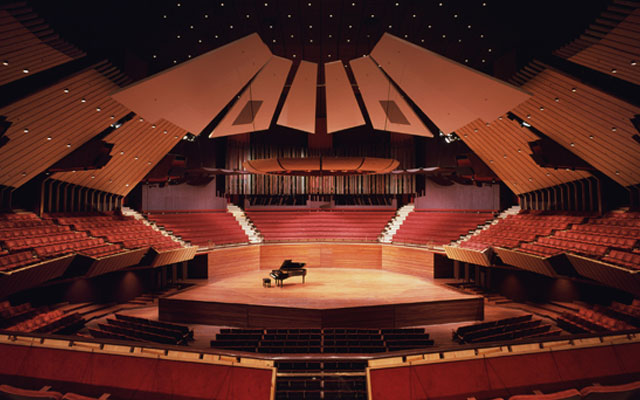
Christchurch Town Hall auditorium
Several spaces are already open, such as the 460m2 Douglas Lilburn Auditorium, which can hold up to 2,250 people theatre-style, and the 225m2 Victoria Room, which can seat 140 in banquet-style.
The renowned acoustics and array of spaces are linked by light and airy concourses, making this venue ideal for conferences and seminars to gala dinners and performances.
According to New Zealand news website Stuff.co.nz, the entire complex will be restored by August, with The James Hay Theatre to reopen in April, and the Christchurch Symphony Orchestra’s new headquarters will be complete in May.
Rooms
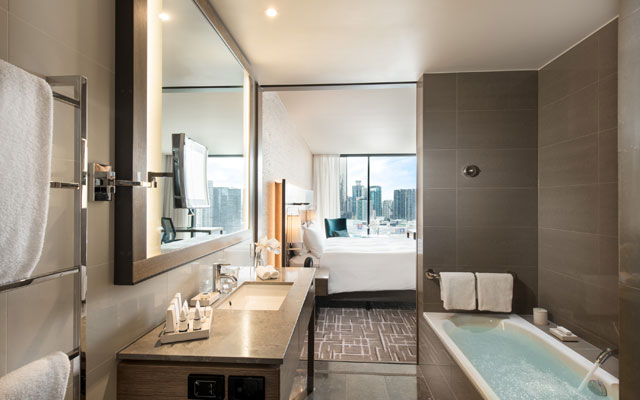
Pan Pacific Melbourne has 396 guestrooms and suites in total. I stayed in a 38m2 Premier King City Skyline Room on the 17th floor, and the first thing I noticed when I walked in was the floor-to-ceiling windows overlooking the Yarra River and the Melbourne cityscape. The large work desk facing the windows was a perfect scenic perch to work from.
I liked that several USB charging ports were available at the side of the bed. However, I noticed that the power outlets were not universal, so a traveller with more gadgets might need to bring along their own adaptor. Reading lights are also cleverly tucked away in the headboard, and come in handy for business travellers needing to share a room.
Pan Pacific Melbourne
1 of 5
Lobby
Pacific Club Room
Club Lounge
Dock 37
Woodside 2 meeting room
The marble-clad bathroom was surprisingly spacious, and came furnished with a bathtub – the property provides bath salts which are replenished during the turndown service – as well as a separate toilet and showering area.
Overall, my room felt like a cloistered sanctuary removed from the hustle and bustle of the city, despite standing in the heart of it all.
MICE facilities
Pan Pacific Melbourne is located right next to the Melbourne Convention and Exhibition Centre, the largest event space in the Southern Hemisphere. By choosing Pan Pacific Melbourne, delegates needn’t get up early to attend conferences, and they also save on transport costs.
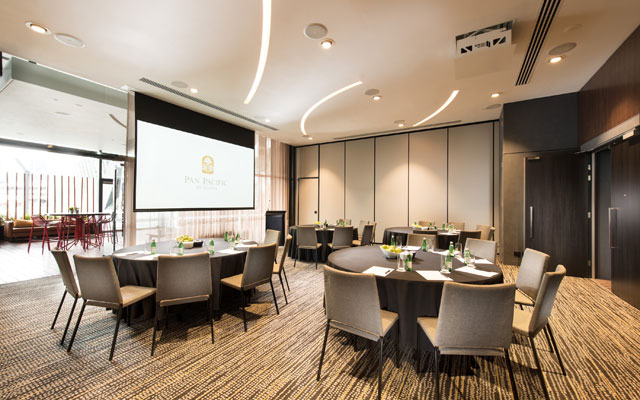
The five-star property itself boasts 450m2 of indoor and outdoor event space, the largest being The Woodside Room which can hold up to 200 pax cocktail-style. The warm space also features floor-to-ceiling windows, a private pre-function area with views into the semi-open kitchen as well as a heated undercover terrace.
Red Desert Dreamings has also partnered with Pan Pacific Melbourne to open a gallery on level four of the hotel. The art gallery specialises in Aboriginal art from the Central and Western desert regions, and holds both contemporary and traditional work, from the old masters of the Aboriginal art movement to up-and-coming second-generation artists.
The gallery can also be hired for corporate functions, ranging from small cocktail parties for up to 120 pax to intimate sit-down dinners for 34 guests in a long-table configuration. Business events groups can also make bookings for art talks, or arrange for a guided tour around the gallery.
Other facilities
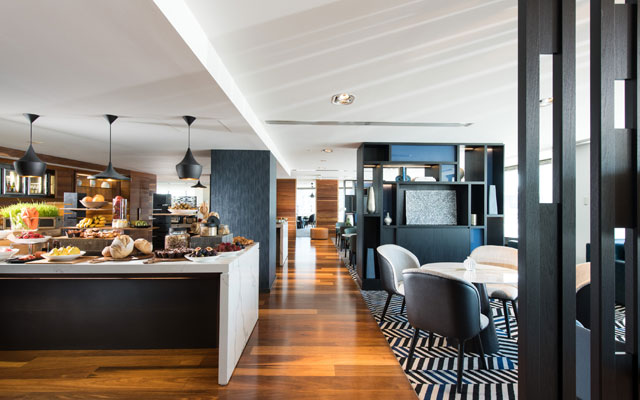
As the room came with club access, I made sure to drop by and cool down with an ice-cold drink as the weather outside was scorching. As such, I did not venture outside to the outdoor terrace but I’d imagine that space would be coveted area during the cooler months of the year. In the evenings, the lounge also offers complimentary canapés and alcoholic beverages.
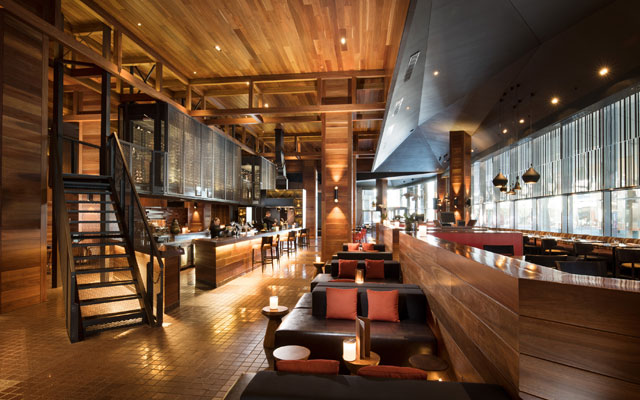
Other amenities include a 24-hour fitness centre, all-day Cafe Orr for light bites, and the Dock 37 Bar & Kitchen for modern Australian cuisine.
While there is no hotel carpark, guests can park at the DFO South Wharf’s carpark at a discounted rate of A$24 (US$18) a day. Speaking of DFO South Wharf, the outlet mall – also less than a minute’s walk away – is home to 170 Australian and international brands offering up to 70 per cent off, making it easy for business travellers to indulge in a spot of retail therapy after a long day of work.
The South Wharf Promenade, just in front of the property are a variety of restaurants and bars. Pan Pacific Melbourne is also a short 10-minute walk from the Crown Entertainment Complex, where more F&B options can be found.
Service
The staff were exemplary, and went above and beyond to ensure my every need was taken care of.
Verdict
An excellent property that I would definitely return to, due to its enviable location, comfortable digs and welcoming staff.
Number of rooms 396 Contact Email enquiry.ppmel@panpacific.com Website https://www.panpacific.com/en/hotels-and-resorts/pp-melbourne.html
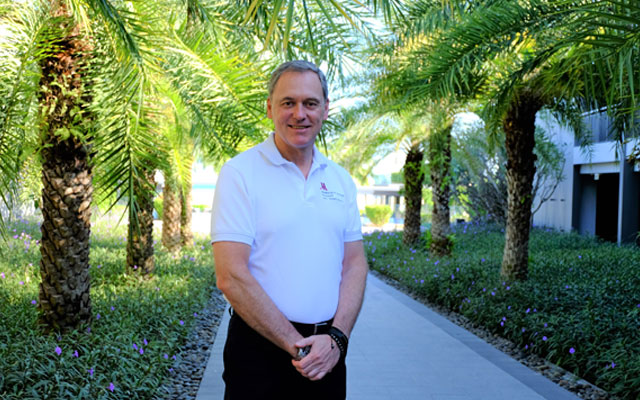
Gerd Kotlorz has joined Phuket Marriott Resort and Spa, Nai Yang Beach as general manager, taking over from David Ippersiel who has been stationed there since 2016.
Joining the company in 2013, Kotlorz was previously Marriott’s area director of sales & distribution for Thailand, Vietnam, Cambodia and Myanmar.
He spent his formative years working in the aviation industry with airlines including Pan Am and Japan Airlines before moving into the hospitality industry. He cut his teeth at European hospitality companies such as Maritim Hotels and Tui Hotels, before joining InterContinental Hotels Group where he spent a decade in destinations including Oman, German, Kenya and the UAE.
In 2011, Kotlorz moved to South-east Asia to join the InterContinental Danang in Vietnam as director of sales & marketing.
Sydney Harbour Boat Tours has launched a privately chartered Seafood Beach picnic tour designed as a luxury and fun experience for small corporate groups.
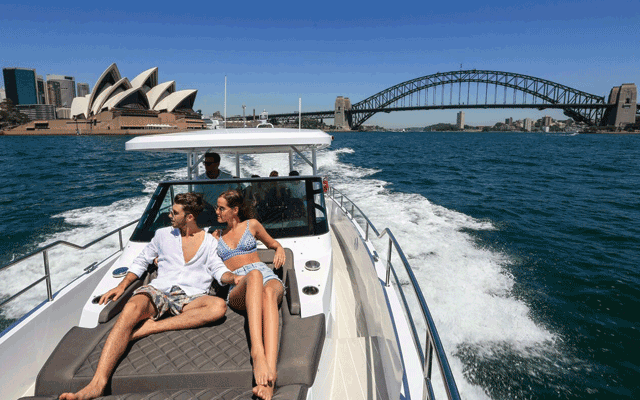
The exhilarating ride takes up to 10 people on the Spectre, an Italian Riviera-style sports cruiser which won the 2017 European Sports Boat of the Year. It is equipped with a queen bed downstairs, kitchenette and toilet facilities, while allowing for generous space for enjoying the sun about the boat.
A three-hour tour will take guests past Sydney’s famous sights and icons such as the Opera House, to land on Store Beach, which is home to New South Wales’ only little penguin colony.
A seafood lunch of local oysters, prawns, sashimi and fruit complete with wines and beers will be served by a personal steward, who also serves as a guide and commentator.
Guests can be picked up or dropped off at any publicly-accessible or private harbour wharf for their convenience. The tour costs A$1,980 (US$1,397) per group which includes the services of a skipper, plus A$110 per guest for the seafood lunch.
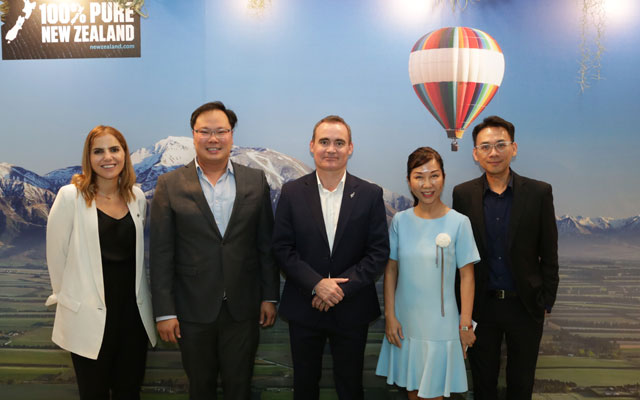
From left: Air New Zealand’s Jenni Martin; Singapore Airlines’ Edwin Chiang; Tourism New Zealand’s Steven Dixon; Dynasty Travel’s Alicia Seah; and Chan Brothers Travel’s Jeremiah Wong
Tourism New Zealand has launched a new region-specific campaign focusing on two North Island destinations (Wellington and Wairarapa); and three South Island destinations (Nelson, Marlborough and Canterbury).
This is in light of Singaporeans’ soaring interest in New Zealand as a holiday destination, where the annual number of visitors in 2018 increased to 61,464, a 30 per cent rise from 2014.
From left: Air New Zealand’s Jenni Martin; Singapore Airlines’ Edwin Chiang; Tourism New Zealand’s Steven Dixon; Dynasty Travel’s Alicia Seah; and Chan Brothers Travel’s Jeremiah Wong
Steven Dixon, regional manager South & South-east Asia, Tourism New Zealand, said: “These regions were chosen due to their connectivity, and the experiences and natural produce they offer. For example, you can shuck oysters and drink regional wines on a yacht in the Marlborough Sounds.
“Singaporeans are familiar with New Zealand’s iconic regions, but increasingly we are finding they want to branch out beyond the traditional tourist highlights. Singaporean travellers desire authentic experiences and want to ‘live like a local’ while on holiday and these new regions offer abundant opportunity to do so. With this launch, we want to encourage visitors to include the new regions into their itineraries and experience a different perspective on New Zealand.”
Calling Singapore an “incredibly valuable market”, Dixon revealed that more Singaporeans are heading to New Zealand than ever, with an increase of six per cent year-on-year. And of these, 30 to 55 per cent are repeat visitors.
This new regional focus is supported by two of Tourism New Zealand’s key airline partners, Air New Zealand and Singapore Airlines.
Jenni Martin, Air New Zealand’s head of South and South-east Asia, told TTGmice: “To support the campaign, the airline has reduced up to 50 per cent of its fares for 41 domestic routes to 20 destinations in the country. This is the largest restructure to domestic fares Air New Zealand has made in 10 years, and is aimed at stimulating domestic tourism and regional dispersal.”
Similarly, Martin indicated that Singapore is a very important market, hence the launch of its first-ever global brand campaign in the country earlier in January.
When asked about the campaign’s length, Dixon shared: “It will run for the next four months online and offline. We will then look at its performance, and explore whether there are other regions that we can look at.”
He added that this is the first time that Tourism New Zealand is promoting a market-specific strategy for Singaporean consumers as the market is “very mature”, compared to other markets like India where we “talk about New Zealand as a whole”.
Travel agency bigwigs Chan Brothers Travel and Dynasty Travel, who also participated in the panel discussion, revealed that New Zealand is also a popular destination among their corporate customers, and the new regional focus is in line with the trend they are seeing among travellers who seek more off-the-beaten-track destinations.
Alicia Seah, Dynasty Travel’s spokesperson, added: “New Zealand is jam-packed with activities, and is a value-for-money destination. With favourable exchange rates, corporate groups are able to stretch their budget, so this campaign will definitely boost numbers for incentives. I think that this segment will be able to grow 15 per cent year-on-year.”
She pointed out that due to the distance to New Zealand – a 10-hour flight – incentive groups usually stay for “four to six nights, and tend to visit mono islands”. “But with Singapore Airlines’ Wellington route, incentives can now visit both islands easily via domestic flights with Air New Zealand, or take a ferry.”
“We want Singaporean travellers to stay longer, explore more widely, and enjoy our country in all seasons,” Martin said, adding that year-round travel would also bode well for incentive groups, who can take advantage of better deals during the low seasons.
Similarly, Jeremiah Wong, Chan Brothers Travel’s spokesperson told TTGmice that for his company, incentives to New Zealand has been “consistently growing year-on-year, as the country offers a lot of activities, is clean, safe and offers good food and wine”.
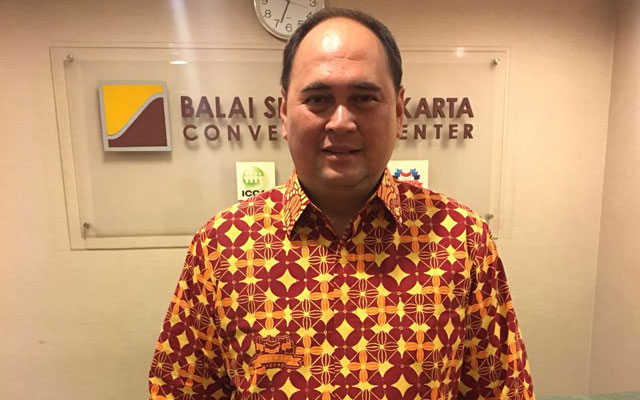
Hosea Andreas Runkat, a familiar face to business event players in Indonesia, has been elected as chairperson of Indonesian Exhibition Companies Association (IECA) for the 2019-2022 period, replacing Effi Setiabudi.
The election, which took place in Jakarta last month, marked several changes within the organisation, as it aims to become more dynamic to meet the expectations of today’s exhibition industry.
Andreas: plans in motion to better IECA’s reputation while strengthening government ties
Also the director of Convention Services at Jakarta Convention Center, Andreas is the first chairman who is not a owner of an exhibition organising company, and the first non-exhibition organiser.
Andreas revealed that during this year’s election, the board agreed to update the association’s bylaw, thereby allowing professionals to be candidates who can be organisers, venues and vendors.
He added that as organisers were not the only party that make an exhibition, and venues and vendors were needed, so therefore, they should also be given roles within organisations like IECA.
Now at the helm of the association, Andreas wants to reposition IECA into becoming a more “reputable and profession organisation”.
“I would also like to invite the younger generation of industry players to participate, as well as lobby the big players to be participate actively in ICEA. This is not just an association for small players, but all exhibition players in the country,” he said.
When asked about his future plans, Andreas said he wanted to focus on developing human resources to improve the competitiveness of Indonesia’s exhibition industry. In this aspect, both Andreas and his team will work with universities to conduct training, short courses and certification for members.
Andreas also plans to enhance the IECA partnership with the government, acknowledging that government support is important.
He elaborated: “It is undeniable that the government plays an important role in this industry, both to help with licensing or promotional issue, and other funding support. I will try to get IECA closer to the Ministry of Tourism.”
Other plans include building partnerships with Association of the German Trade Fair Industry, as he is “determined to bring more international tradeshows to Indonesia”.
Business travel encompasses all trips that are undertaken by employees on behalf of their companies or organisations, including attending meetings, sales missions, conferences, incentives and other events. Its contributions in driving global travel are considerable.
According to a study by the World Travel Tourism Council, global business travel spending is projected to be worth US$1,765 billion by 2028, commanding an impressive 23 to 25 per cent of the worldwide travel expenditure. Compared to the US and Latin America, Asia-Pacific (APAC) commands the most significant share of the global business travel market at 40 per cent, and that amount is growing year-on-year, owing to strong economic growth, increased infrastructure investment and high Internet penetration rates. Within the next few years, its significance will only grow.
AI-backed business travel solutions may prove to be a vital tool in improving profit yields for the travel industry
In Singapore, revenue from business and Meetings, Incentive Travel, Conventions and Exhibitions (MICE) travellers witnessed tremendous growth. From January to September 2018, spending rose by 10 per cent to S$3.4 billion (US$2.5 billion), compared to the same period in 2017, while visitor arrivals rose 14 per cent year-on-year to hit two million.
Technology has changed the way humanity experiences travel as a collective society and culture, from sharing and hashtagging our holiday photos on Instagram to seeking hotel recommendations and exclusive discounts via mobile travel apps. As more people travel for leisure, it’s only natural for them to expect the same ease and efficiency for their corporate trips.
According to a 2015 joint study by the Singapore Tourism Board and McKinsey, ever-connected and autonomous digital consumers now expect a travel experience that is personalised to one’s needs and wants, reliable in its execution and engaging on all levels. In response to this, legacy brands such as Lufthansa and Singapore Airlines have invested millions into establishing innovation hubs that would usher in a new age of technology and innovation for the travel industry.
These macro-level developments not only reflect the growing valuation of business travel but also echo the shifts in perceptions and preferences among business travellers. With APAC’s position growing, the travel industry must resort to smart and more efficient ways to understand and accommodate the needs of the Asian business traveller.
The role of AI in creating intelligent travel experiences
Artificial intelligence (AI) in essence, generally refers to computer software or machines that function tasks typically reserved for human-level cognition and intelligence.
Globally, AI is rapidly becoming a commonly-used competitive tool for businesses; from safeguarding digital security for banks, chatbots managing customer service and voice-activated virtual assistants such as Siri and Alexa dutifully remind you to purchase groceries after work. AI’s inclusion for the global travel industry can only aid in enabling a more seamless travel experience than there has ever been possible before. A great example of this innovation is Roxy, a speech-enabled device that provides instant access to hotel information and services, it has been making headways in the United States with its in-suite AI for hotel guests.
Here are three ways that AI is impacting Asia’s multi-billion dollar business travel sector.
1. Corporate travel management
Guided by algorithms and non-hard coded programming essentials, AI’s machine learning capabilities have the propensity to process, learn and analyse corporate travel behaviour and preferences at breakneck speeds. This has given rise to the potential of predictive models and forecasts to manage compliance; ergo maintaining the delicate balance between employee travel behaviour and company travel policy.
AI can streamline and design trip budgets based on multiple data sources such as corporate hierarchies, rate cards and other assorted expenses to eliminate over-budgeting, booking duplication and provide clarity on your CEO’s yearly travel expenditure. Employers, as well as employees, benefit from a real-time view of travel and expense spending. With AI, organisations can get actionable insights to make cost-saving decisions.
With predictive analytics, AI can anticipate and make travel recommendations based on global factors such as incremental weather conditions, festive peak periods such as Christmas and even geopolitical events such as the upcoming Trump-Kim Summit in Vietnam. These are variables that will have on global travel pricing and availability.
2. Travel personalisation
Planning a trip can be a taxing experience for many a corporate traveller or travel manager faced with time or resource constraints. With hundreds and thousands of potential travel offerings available online, how does one sift through the noise and find the ideal hotel or airline?
By tracking and studying user searches online, AI can customise and recommend travel solutions based on search histories or location-based parameters. This creates the opportunity for travellers and companies to improve the speed and accuracy in personalising travel offerings such as airline preferences, hotels and car rental companies based on established parameters such as location, schedule disruptions and frequency of trips.
3. Keeping business travellers safe
The recent spate of terror attacks, political instability and social unrest around the world, together with disease outbreaks and the increased frequency of natural disasters, have all helped to push safety and security to the forefront when it comes to business travel.
Authorities are actively experimenting with broader adoption of AI powered-biometric recognition at significant transit locations. Singapore’s Changi Airport is already experimenting with facial recognition technology to pinpoint and identify straggling passengers. In the US, the Transportation Security Administration (TSA) unveiled plans in October 2018 to utilise facial recognition software and biometric identification tools to improve traveller identification accuracy and accelerate wait times. These crucial investments will offer advantages in keeping travellers safe, as well as smoothing their journeys and preventing significant delays.
Conclusion
Within the global business travel sector, AI will offer all sorts of benefits. I imagine a future dominated by increasingly smart and predictive flight alerts, profoundly personalised booking experiences and more secure traffic management solutions for airports. More importantly, I believe that AI-backed business travel solutions will prove to be a vital tool in improving profit yields for hotels and airlines.
These are exciting times ahead for us and in order to enjoy the full benefits of intelligent corporate travel, corporates need to take the first steps towards adopting AI-driven platforms to manage their business travel, which can provide automated expense reporting, real-time view of travel and expense spending and tools to simplify the corporate travel booking process.
From a personal standpoint, I believe that to unlock the potential of today is to possess a mindset that would ensure incremental and impactful changes to the way companies travel, as well as an open mind about what is the infinite possibilities in an AI-centric future.
Prashant Kirtane is the CEO and co-founder of Travelstop. The Singapore-headquartered company aims to revolutionise business travel for SME’s by providing a flexible and integrated solutions for business travellers.
Prior to Travelstop, Kirtane co-founded vacation rental platform Travelmob, which was acquired by Expedia’s subsidiary Home Away. Prior to his ventures into startups and the travel/vacation industry, Kirtane worked for 12 years at Yahoo!, where he was senior director of engineering (video).
The newly-opened Ritz-Carlton, Bangkok anchors the One Bangkok development with cosmopolitan elegance. Featuring the city's largest ballroom and a spectacular new penthouse suite, it delivers exceptional hardware and deeply authentic, soulful service for business and leisure travellers alike
Behind the imposing, Brutalist concrete that defines Zurich’s Oerlikon district lies a surprising secret. While its exterior honours the neighbourhood’s industrial roots, stepping inside Mama Shelter reveals a vibrant, neon-soaked world that is a far cry from its rigid shell
A polished urban retreat designed for business travellers, Hyatt Regency Kuala Lumpur at KL Midtown combines thoughtful design, seamless service, and exceptional facilities.





 Prashant Kirtane is the CEO and co-founder of