Hilton has launched a Bringing Ideas to Life meeting package for its hotels in Malaysia.
Event planners who book this package at any participating Hilton hotel throughout Malaysia will receive discounts, complimentary rooms and upgrades, F&B deals, double Hilton Honors points and other value-added benefits.
Hilton promises to offer solutions that work to boost attendees’ levels of energy and creativity with sustainable practices
Available for booking from now until March 31, 2019, the Bringing Ideas to Life meeting package is in line with Hilton’s Meet with Purpose programme that offers solutions that boost attendees’ levels of energy and creativity.
Participating properties are Hilton Kuala Lumpur, Hilton Petaling Jaya, Hilton Kota Kinabalu, Hilton Kuching, DoubleTree by Hilton Kuala Lumpur, DoubleTree by Hilton Melaka, DoubleTree by Hilton Johor Bahru, DoubleTree Resort by Hilton Penang and Hilton Garden Inn Puchong.
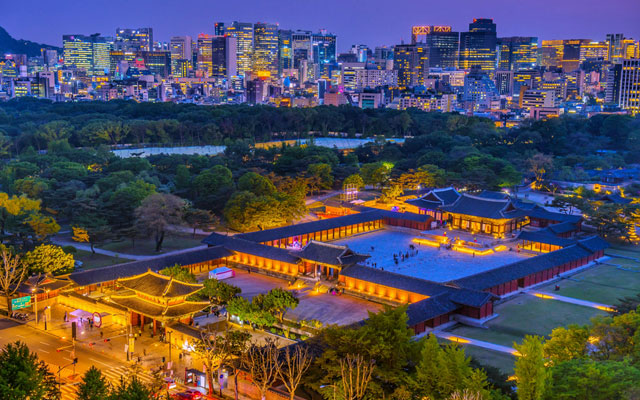
Incentive groups or corporate travellers heading to South Korea can now enjoy evening admission to Seoul’s Changgyeonggung Palace.
Previously, visitors were only allowed to enter the grounds during a special evening admission.
Changgyeonggung Palace is now open later at night
The new operating hours for the palace will be 09.00 to 21.00 from Tuesdays to Sundays. The last admission will be at 20.00.
The admission for foreigners will be the same as daytime fee of 1,000 won (US$0.90). For children and youngsters between the ages of seven to 18, the admission fee is 500 won. For children under six, seniors over 65 years old or visitors wearing the hanbok, admission will be free.
The first 200 visitors starting from 17.30 each day can also rent a cheongsachorong (traditional lantern) for free. Various cultural events will also be held on the palace grounds.
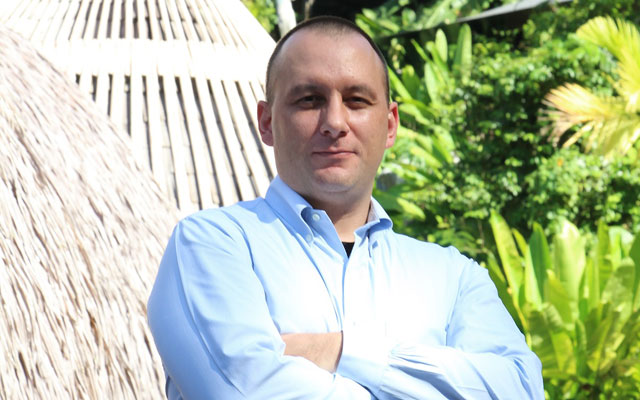
RoomIt by CWT, the hotel distribution division of Carlson Wagonlit Travel (CWT), has appointed Brian Zacker as vice president of global sales.
In this role, Zacker will be responsible for all aspects of hotel distribution sales and retention for both CWT clients and new external markets.
Based in Chicago, Zacker joined RoomIt and the CWT business finance organisation last June, as vice president of finance for RoomIt. He will remain a member of the RoomIt leadership team.
Prior to joining CWT, Zacker spent 18 years with Travelport in various roles, including vice president of global sales.
Jason Allen Villarino has been appointed general manager of Keemala boutique resort in Phuket.
He was most recently general manager of Silavadee Pool Spa Resort on Koh Samui. Prior to that, Villarino has experience working in the Maldives at Soneva Gili by Six Senses, and in Thailand at Tubkaak Boutique Resort, Krabi and Evason Hideaway & Six Senses Spa, Hua Hin.
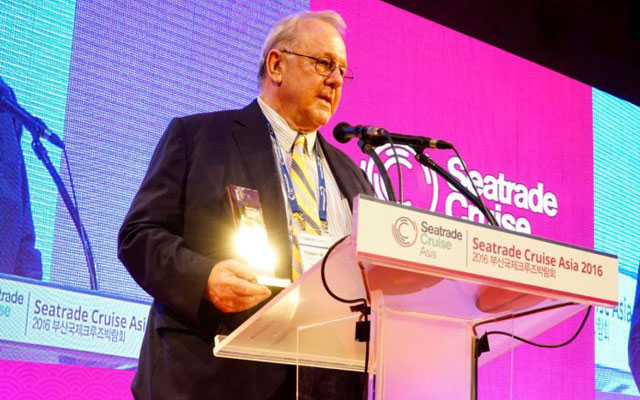
After nine years at Destination Asia that involved opening the Singapore office in 2010 and then Malaysia in 2011, Bob Guy has decided to fully step down at the company to enjoy retirement.
It was announced last year that he was concluding his role as managing director of Destination Asia in Malaysia and in Singapore. The latest announcement marks his full departure from the company’s Asian inbound, DMC, meeting and events and cruise business segments.
Guy speaking at a cruise event in 2016
At Destination Asia Malaysia, Guy is succeeded by Sadie Yeoh, general manager, who has led a team in the office since 2011. Yeoh will drive forward new initiatives to further develop the key sectors. She oversees all business activity from the four operational offices located across Malaysia (Kuala Lumpur, Penang, Langkawi and Kota Kinabalu).
Guy has had a 50-year career in the travel industry, with roles in the US, the Fiji Islands, Australia and numerous Asian countries including Singapore, where he was been based for nearly 40 years. His DMC experience began in Fiji in 1973.
Raffles Hotel Singapore has confirmed a mid-2019 reopening, which will see a host of refreshed interiors, layout and concierge service introduced to the iconic property.
Most prominently, the hotel will eliminate its front desk and check-in services from the lobby. Instead, guests will be served by dedicated butlers, who will provide services from in-suite check-in to running errands. Event planners will also communicate with an on-site butler for arrangements.
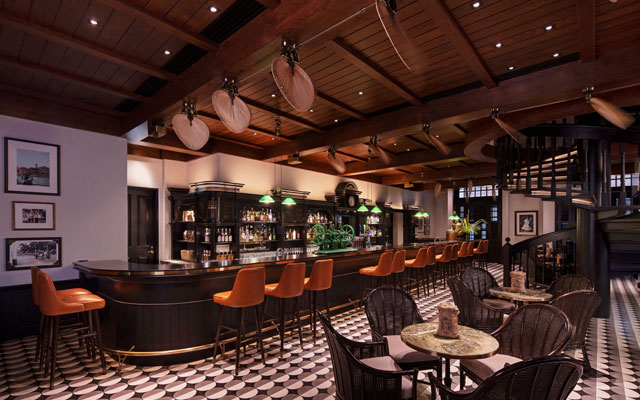
The refurbished Long Bar
This new concept will “revolutionise” the butler and concierge service in hospitality by providing guests “more focused, individualised and direct service”, revealed the hotel’s general manager Christian Westbeld yesterday.
The hotel will have a team of 25 butlers fluent in a diverse range of languages such as English, Mandarin, Korean and Russian.
Event venues will be renovated to give a “dramatic” increase to the hotel’s event footprint, remarked Westbeld. For instance, the theatre-style Jubilee Hall will be converted into a 302-pax ballroom, and the original ballroom will be refreshed and expanded to seat 200 pax. The East India ballroom and the outdoor lawn have also been given a modern update. All event venues will now feature an air-conditioned foyer.
Events and banquets with Chinese menus will be overseen by chef Jereme Leung – who will also head the yì by Jereme Leung restaurant – while planners can also choose to cater from any of the restaurants and bars in the hotel.
Room inventory will also increase by 10 per cent from 103 to 115 keys, which includes two Presidential Suites – also bookable for events. Renderings of the suites showed brighter colours and a more spacious and refined design, with some elements of new technology, such as operating the lights with an iPad.
Raffles Hotel Singapore will feature a total of 10 dining establishments spread throughout the property, with overhauls done to original restaurants Tiffin Room and Long Bar. The shopping arcade will also be “better integrated” into the hotel and feature 40 retail tenants, said Westbeld.
Meanwhile, Long Bar will introduce an “elevated” and “health-conscious” recipe for the Singapore Sling, he added, and the team hopes to craft another original beverage on the same level as the Singapore Sling.
Westbeld also confirmed that accompanying these enhancements is a 25-30 per cent hike in the room rates. Regardless, the hotel has already secured forward bookings in August.
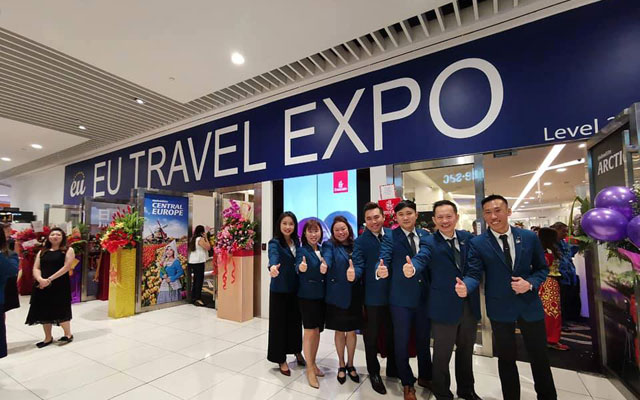
Travel agency EU Holidays has launched an expanded service centre in Suntec City Convention & Exhibition Centre, having relocated from Chinatown Point.
The new centre, named EU Travel Expo, is more than double the size of its previous centre. The 1,020m2 space comprises service counters each specialising in a destination region, MICE packages or cruise products; a private coffee and reading lounge; a conference room seating up to 100; a pre-tour briefing room with a capacity of 35 seats; as well as EU Holidays’ corporate office.
EU Holidays’ new service centre at Suntec City
The conference room is supported by Genting Cruise Lines, and the smaller briefing room is supported by Europamundo. These are used for pre-tour briefings, as well as events or training sessions.
“With the current major competition from online players, expanding as a traditional travel agency with this physical space is a very bold move,” expressed Ong Han Jie, managing director of EU Asia, the regional travel arm of EU Holidays.
The move was cemented after a series of client surveys conducted last year to “prove that we have a steady flow of regular customers”, explained Ong.
He confirmed that the move will also allow EU MICE to gain exposure and access to potential corporate clients in the area, whose banks are also situated nearby.
He added: “We’re coming here to a different league. Suntec sees more PMETs, so we must grow in our service level to match higher expectations of service. At Suntec, we should have enough space to grow our staff strength as well.”
The new centre affords both spaciousness and comfort, allowing staff to provide more personalised and intimate service to customers, said Ong.
“The MICE team usually deals with high-end and key personnel of big companies. With the lounge, we will be able to serve them in a closed-door room with sofa seats and WMF coffee, letting them feel like they are already taken care of before the tour,” he said.
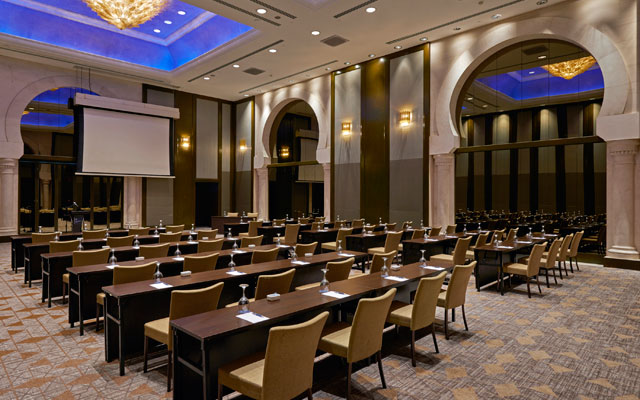
Sheraton Imperial Kuala Lumpur Hotel's Ballroom classroom setup
Sheraton Imperial Kuala Lumpur Hotel is ramping up its business events outreach efforts, as the property completes its eight-month-long, US$12 million renovation and refurbishment exercise.
Yvonne Lim, director of sales and marketing at the hotel, shared with TTGmice: “Business events are currently around 25 per cent of the business mix, but it has a lot of potential to develop further. While Asia-Pacific is our prime market, we are also looking at developing more business from Russian-speaking markets.”
Sheraton Imperial Kuala Lumpur Hotel’s Ballroom classroom setup
When asked why specifically this market, Lim elaborated: “Traditionally, Russian-speaking markets are attracted to Langkawi but we realised that they have to travel to Kuala Lumpur as the gateway first, in order to connect to Langkawi. Hence, we saw the opportunity to tap this market. In general, this market is high-yield, long-stay, and spend (well) on F&B.”
Lim shared that in December 2018, there was a small incentive group from Kazakhstan that stayed at the property for a week. This led to the hotel hosting a group of agents from Kazakhstan this month, with the aim of attracting more incentive groups.
“We also (plan to) work closely with Tourism Malaysia, local tour operators and Marriott Global Sales Offices to tap the Russian-speaking markets,” Lim said.
With the renovations, inventory has been increased to 398 keys, up from 385, and rooms have been refreshed with bright and contemporary finishing. Overall the hotel looks brighter.
Event planners can avail nine function rooms which have all been refurbished and outfitted with state-of-the-art audiovisual equipment. The hotel’s largest space, the Nusantara Ballroom, can hold up to 1,000 pax theatre-style.
In addition, the Pavilions Lounge & Bar has also been transformed into a library-esque area with built-in wine cellar and cigar humidor, making it suitable for intimate discussions and informal meetings.
Lim added that the hotel is banking on its strategic location in the commercial area of Jalan Sultan Ismail to pull in more business events. Also situated just opposite the hotel is Quill City Mall, which features its own event space that can hold up to 1,500 people. A short walk away is another function space in the Heritage Row historical area. Called Slate at the Row, that function area can fit up to 200 people.
These spaces could be used as venues for cocktail parties and dinners, where the hotel could provide catering services, Lim pointed out.
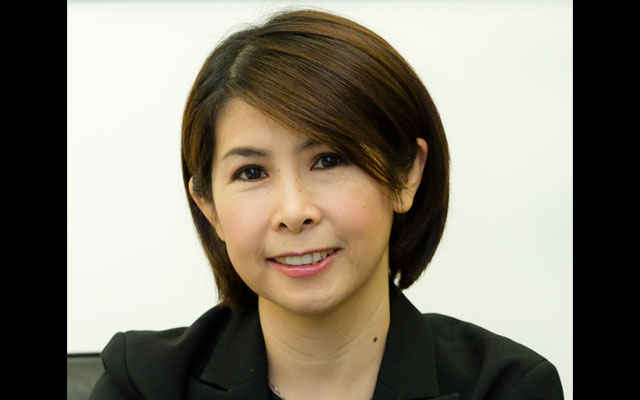
Ho Yoke Ping, who was part of the founding team of the Malaysia Convention & Exhibition Bureau (MyCEB), is now the new executive director of the Malaysian Association of Convention & Exhibition Organisers & Suppliers (MACEOS).
She will inject fresh perspectives and more than two decades of industry experience into the long-standing association of 29 years. Her crucial role will entail enhancing the profile of MACEOS in the business events industry through strategic plans including communications, government relations as well as partnership and collaborations.
Ho Yoke Ping
A MACEOS statement noted that under Ho’s leadership, MyCEB “has grown leaps and bounds especially in positioning both the Bureau and country internationally” in the global business events space.
Vincent Lim, president of MACEOS, said: “Her reputation in the industry is formidable and it is an honour to have her on board the Association. With her, we are in the strong opinion that MACEOS will be able to strategically move forward as not only her experience counts, but her ability to harness the support of many parties through her consistent good work will be in favour to grow the Association to the next level”.
Ho has also served various organisations on her own accord over the past years, such as chairperson for the ICCA Malaysia committee and key roles in the Malaysia Society of Association Executives and Business Events Council of Malaysia.
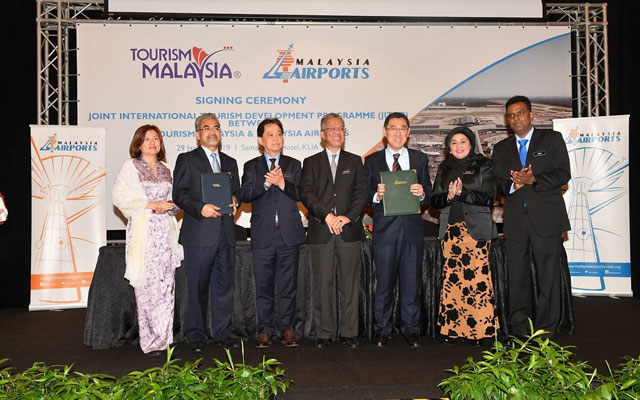
From left: Malaysia Airports’ Emelia Tay Ling Imm; Tourism Malaysia’s Musa Yusof; Minister of tourism, arts & culture Malaysia Mohamaddin Ketapi; Ministry of Transport Malaysia’s Kamaruddin Jaafar; Malaysia Airports’ Raja Azmi Raja Nazuddin; Ministry of Tourism, Arts & Culture Malaysia’s Haslina Abdul Hamid; and Ministry of Transport Malaysia’s Jana Santhiran
Malaysia Airports Holdings (MAH) and Tourism Malaysia have sealed an MoU for an enhanced version of the Joint International Tourism Development Programme (JITDP), which aims to increase inbound arrivals by incentivising airlines and charterers on their Malaysia campaigns and tacticals.
Following the successful launch of the pilot project last year, the programme’s budget has been increased by another RM5 million (US$1.2 million) this year, bringing it to a total of RM20 million, which will be shared equally between the two government entities.
From left: Malaysia Airports’ Emelia Tay Ling Imm; Tourism Malaysia’s Musa Yusof; Minister of tourism, arts & culture Malaysia Mohamaddin Ketapi; Ministry of Transport Malaysia’s Kamaruddin Jaafar; Malaysia Airports’ Raja Azmi Raja Nazuddin; Ministry of Tourism, Arts & Culture Malaysia’s Haslina Abdul Hamid; and Ministry of Transport Malaysia’s Jana Santhiran
In its second year, JITDP aims to further increase arrivals particularly from medium- and longhaul markets.
Tourism Malaysia director-general, Musa Yusof, is looking at attracting more arrivals from Russia and CIS countries, as well as the Middle East, which are both long-stay markets for Malaysia, with the latter among the top spenders in the country.
While there is no target number set, Musa hopes that all the allocated funds will be used by the end of the year.
To utilise the funds, airlines and charterers will have to submit their plans for campaigns or tacticals for inbound flights to Malaysia, which will be reviewed by both Tourism Malaysia and MAH.
Once approved, the funds can be used to bear 50 per cent of the total cost of marketing and promotions of Malaysia, with the airline bearing the remaining 50 per cent. Last year, 10 airline companies benefited from the programme.
Malaysian Association of Hotel Owners executive director Shaharuddin Saaid, said the onus of success of JITDP rests on Tourism Malaysia.
He told TTG Asia: “Tourism Malaysia has to work hard to promote Malaysia to ensure the flights coming in are full or nearly full. If JITDP manages to attract new airlines, but the flights coming in are half full, there is no point as the airline will not sustain its services for long.”
Uzaidi Udanis, president, Malaysia Inbound Tourism Association also urged local tour operators to actively take part and support JITDP by promoting Malaysia to their overseas partners to stimulate interest, which will in turn attract new airlines and charter flights to consider flying to Malaysia.
“We are going to educate our members on this programme and identify overseas airlines and partners who can benefit,” Uzaidi said.
Just 10 minutes from Phuket International Airport on the serene northern coast, this 178-key, Bill Bensley-designed resort offers delegates a quiet, tropical paradise steeped in Phuket’s tin-mining heritage
The newly-opened Ritz-Carlton, Bangkok anchors the One Bangkok development with cosmopolitan elegance. Featuring the city's largest ballroom and a spectacular new penthouse suite, it delivers exceptional hardware and deeply authentic, soulful service for business and leisure travellers alike
Behind the imposing, Brutalist concrete that defines Zurich’s Oerlikon district lies a surprising secret. While its exterior honours the neighbourhood’s industrial roots, stepping inside Mama Shelter reveals a vibrant, neon-soaked world that is a far cry from its rigid shell