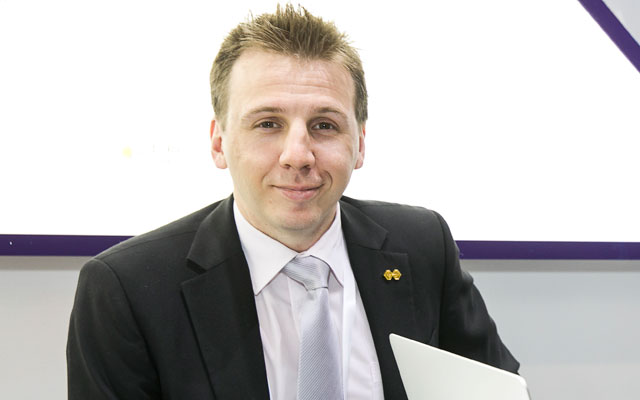
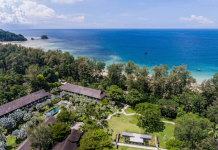
Pan Pacific Hotels Group (PPHG) has appointed Edward Kollmer as general manager of Parkroyal Penang Resort.
The industry veteran brings more than 25 years of experience having worked in his home country Ireland, the UK, and Asia.
Prior to joining PPHG, Kollmer was the general manager of Hotel Jen Manila by Shangri-La for three years, and has worked for different hospitality groups such as Forte Hotel Group, InterContinental Hotels Group and GLH Hotels.
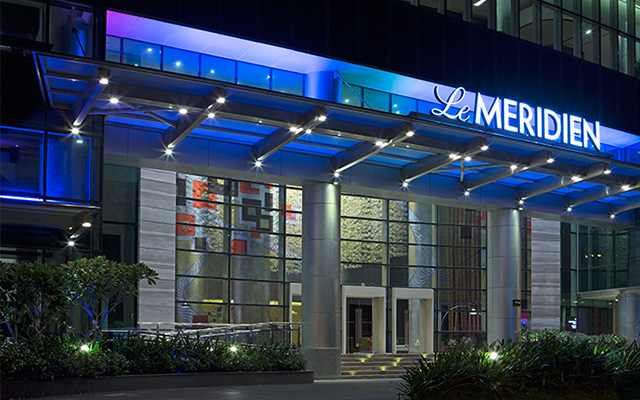
Situated on the banks of the Saigon River in District 1 of Ho Chi Minh City, Vietnam, Le Méridien Saigon offers both panoramic vistas of the Saigon river as well as the bustling cityscape. The Hotel provides convenient access to prominent commercial and entertainment hubs while Tan Son Nhat International Airport is located just 7 km away.
Rooms
Le Méridien Saigon features 343 contemporary guest rooms and suites categorized into 5 room types starting from 38 square metres including the Premier Classic, Grande Deluxe, Grande Suite, Executive Suite and Presidential Suite. Each guest room is furnished with a modern chaise longue and 42-inch smart LED TV. Ample workspace, stylish ergonomic seating and views on the meandering waterways and vibrant Ho Chi Minh City ignite the inspiration and maximise work efficiency, a delight for business and creative-minded travellers.
M.I.C.E. Facilities
With its exclusive location, Le Méridien Saigon is one of the leading addresses for M.I.C.E. business in this captivating city. The 945 square metre function space offers seven meeting rooms, all on one level, making it extremely convenient for meeting planners and delegates alike. Breakout rooms can be combined and extended to form larger multi-functional space, meeting the requirements of today’s planners. Le Méridien Ballroom, which can be split into 2 smaller sections, can cater for events of up to 350 persons. An artsy pre-function area dotted with contemporary installations and boasting of natural daylight is the ideal space for exhibitions, working lunches and networking sessions. All this space is further enhanced with the latest state-of-the-art AV gadgetry.
Other Facilities
An unrivalled culinary experience awaits you. Guests can indulge at three distinctive venues, including the brand’s specialty restaurant Bamboo Chic, a progressive Cantonese offering; Latest Recipe, a signature all-day-dining venue presenting an array of international buffets and a’ la carte options; Latitude 10 Lounge + Bar inspired by traditional European coffee houses in the day time, turning into a hip and stylish lounge at night. The wellness facilities include Explore Spa, providing aromatherapy massages and signature treatments using marine-based products and the fitness center equipped with the latest workout facilities and a dance studio. An indoor outdoor salt-water infinity pool offers impressive views where once can relax and wind down.
China’s Belt and Road Initiative (BRI) has led to the International Gas Union (IGU) appointing not only its first Chinese president but also the first woman to helm the organisation for the 2021-2024 term.
IGU will be hosting its largest event in Beijing come 2024 with an expected turnout of 12,000 delegates.
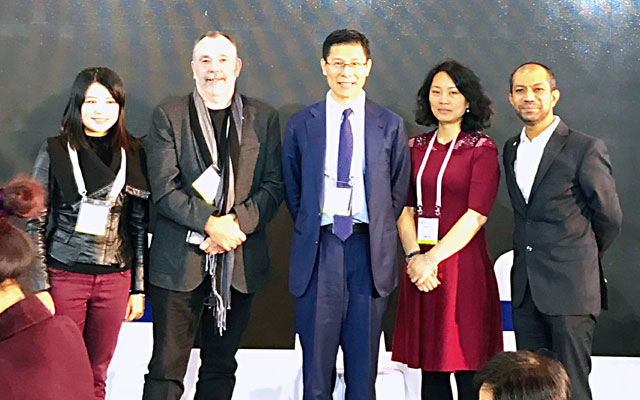
WFAS’ Luo Lu; IGU’s Rodney Cox; IEEE’s Hua Ning; China CYTS MICE Service’s Karen Sun; and ICCA’s Noor Ahmad Hamid
Rodney Cox, events director, IGU, told an Association Day Forum audience that Li Yalan, vice chairman, Beijing Gas Group, and one of four China members of the union, will be appointed vice-president at its Washington DC event this year, and will assume the presidency in three years’ time.
Cox said BRI presented “significant opportunities” for trade, the use of natural gas for transport, as energy as a clean source, and energy for industry and manufacturing.
“In China, IGU is prioritising its focus on the industry itself, advocacy, technology and innovation and education,” he said, adding that IGU – together with the Gas Technology Institute and the International Institute of Refrigeration – is presenting the 19th International Conference and Exhibition on Liquefied Natural Gas in Shanghai from April 1-5 next year, with an expected turnout of around 10,000 attendees.
Luo Lu, representative of the Word Federation of Acupuncture-Moxibustion Societies (WFAS), added that it started leveraging on BRI in 2015 to promote the federation all over the world.
WFAS is affiliated with the World Health Organization and ISO, and they celebrated its 30th anniversary in 2017.
Luo said: “As a result of BRI, we have met leaders in Mauritius, while countries like Hungary, Canada and Australia have legalised acupuncture.”
The Institute of Electrical and Electronic Engineers (IEEE) organises some 1,900 international events, with 30 per cent held in Europe and 30 per cent in Asia.
Ning Hua, senior director, Asia-Pacific business operations, IEEE, observed: “BRI is reinforcing the link between the two regions. In China, we organise some 200 international conferences for 300 to 3,000 people. IEEE will identify specific areas to organise technical conferences in China over the next one to two years in the areas of high-speed rail, AI, ultra high-speed electricity, etc.”
Forum delegate Kitty Wong, president, K&A International, suggested taking a closer look at China’s second- and third-tier cities as the next step, as these destinations can be expected to be “more eager and more cooperative”.
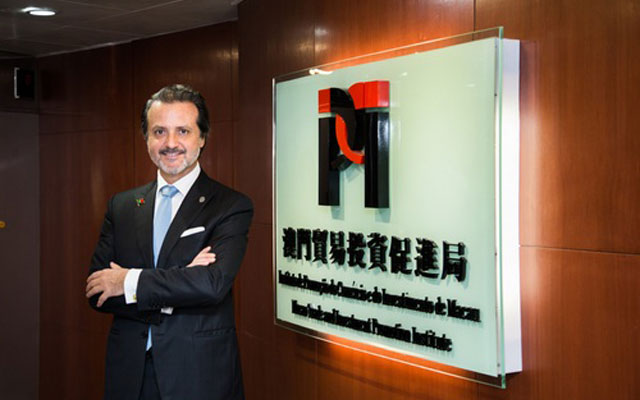
Orlando Monteiro da Silva, one of the six ambassadors. Photo credit: ipim.gov.mo
In line with the Macao SAR Government’s policy to place more priority on conventions, the Macao Trade and Investment Promotion Institute (IPIM) has appointed six well-respected professionals in different sectors from China and abroad as conference ambassadors.
The experts are Orlando Monteiro da Silva (dental specialist), Zhu Lilan (strategy scientist and chemist), He Jingtang (architect), Li Ning (entrepreneur and athlete), Tsui Lap-Chee (molecular genetics specialist), and Liu Chung Laung (IT expert).
Orlando Monteiro da Silva, one of the six conference ambassadors. Photo credit: ipim.gov.mo
Holiday World Tours’ managing director, Paul Leung, said: “These are familiar faces in China and Asia so their influence may help drum up noise within their respective fields.”
Powerhouse Convention and Exhibition’s president, Todd Cai, hopes to see the size of the ambassador team double or triple.
He also hopes to see “more influential representatives from IT, direct selling and insurance (as they have) an extensive business network”, as well as more “faces from other countries”.
Leading up to Malaysia’s economic transformation in 2020, the Malaysian Convention and Exhibition Bureau (MyCEB) is expanding its outreach to China with its annual roadshow from March 23 to April 2.
The roadshows will be held in Shanghai, Beijing, Chengdu, Guangzhou and Chongqing, the last city being a new addition this year.
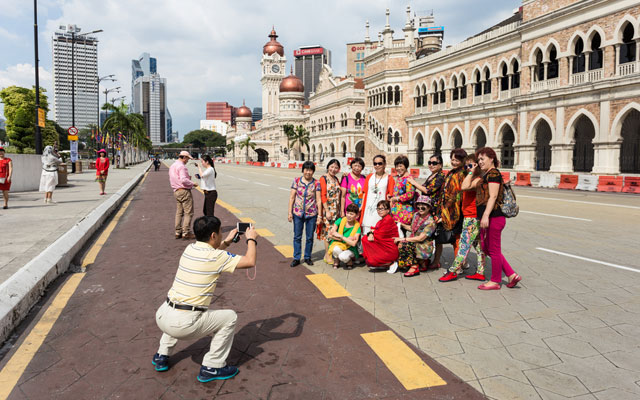
Tourists posing in front of the Sultan Abdul Samad building in Kuala Lumpur
“We believe that with higher accessibility, we will be able to get more people from Chongqing to Malaysia… Tier-two cities are very important, as they probably know very little about Malaysia, so we have to go and deliver information to them,” shared Zulkefli Sharif, CEO of MyCEB.
He continued: “The government will also have another Visit Malaysia (campaign) in 2020, so the process for getting people to visit Malaysia starts now. We are hoping that with all the incentives and promotions carried out by our DMC partners, we can attract more attention for Malaysia.
“We are hoping that the number of Chinese outbound to Malaysia will increase significantly.”
During the roadshows, MyCEB and its 27 partners will promote the Malaysia Twin Deal XP incentive programme to attract more organisers, of which they hope to attract 100 per city.
Cebu is one of the other destinations in the country suitable for business events
Both business events and tourism stakeholders in the Philippines are taking pre-emptive steps to mitigate the impact of the possible closure of popular tourist hotspot Boracay.
Speaking at the recently-concluded IT&CM China, Rene Reyes, tourism attache, Philippine Department of Tourism in Shanghai, shared: “We are speaking to private sector stakeholders to draw MICE business to other areas of the Philippines that can offer the same attractions as Boracay, such as the sand and the sea.”
Cebu (pictured above) is one of the other destinations in the country suitable for business events
Boracay is famed for its talcum-sand beaches and clear sea, which have recently been threatened by pollution from untreated wastewater. If not cleaned up within six months, the island faces a possible shutdown by Philippine president Rodrigo Duterte.
In response to Duterte’s instruction, environment secretary Roy Cimatuhas announced that the Department of Environment and Natural Resources will address Boracay’s wastewater and garbage problems.
While awaiting “official instructions”, the Philippine Department of Tourism will have dialogues with private sector operators to promote the country’s other destinations, said Reyes.
The country is expecting some 3,700 new hotel rooms this year, with most hotels opening across Manila, as well as upcoming areas of Ilo Ilo and Baguio. Come 2019, Clark and Cebu will receive one new convention centre each.
Gloria Hotels & Resorts is currently concentrating on further expanding and building two of its brands in its portfolio – four-star Gloria Plaza and boutique chain G-LUXE by Gloria – in light of the growing number of domestic business travellers in China.
Explaining the expansion push in the four-star and boutique product range, Thomas Jouan, corporate director of branding, Gloria Hotels & Resorts, told TTGmice that many domestic and international companies are turning to “nice four-star hotels” as these properties are more affordable and offer upscale facilities and services oriented towards business travellers. As well, big cities are now “saturated” with five-star hotels.
Jouan: concentrate on two brands, as well as expansion outside of China
Jouan pointed out that Gloria’s four-star properties could well be worth five stars, although they are not classified as such because they do not meet the strict five-star criteria. In a number of second-, third-, and fourth-tier city, upscale four-star properties are the best hotel choices in the destination.
“It’s because we choose to have different elements within the property. For example, instead of choosing to have a speciality French or Italian restaurant – which is crucial for a five-star – we opt to have (hotel facilities like) a large Chinese restaurant and 25 private meeting rooms to better fit the local market demand. Four-star hotels offer more flexibility,” he explained.
Currently, there are around 22 Gloria Plaza properties in main Chinese cities such as Beijing, Shanghai and Guangzhou. In the near future, there will be another Gloria Plaza in Shanghai and Xi’an. Expansion will not be limited to tier-one Chinese cities, as the company enjoys good corporate business for secondary and third-tier cities.
“A good number of these properties have complete meeting facilities. Smaller hotels may have large meeting venues too. For example, a hotel in a third- or fourth-tier city may only have 150 rooms, but it may have a ballroom that can cater up to 1,000 people, a response to local meetings and F&B demands,” he said.
He added that four-star hotels also offer more affordable meeting options and packages, allowing Gloria to host a wider range of meetings.
Currently, room keys for Gloria Plazas are around 180 to 400, and would appeal to medium-sized corporate groups. Moreover, most Gloria Plazas are conveniently situated in the city centre or in a new business district.
As for the G-LUXE by Gloria brand, Jouan shared that these properties are apt for smaller business meetings. For instance, the G-Luxe Hongqiao Shanghai by Gloria stands next to the new Shanghai International Convention Centre, and after an event, smaller board meetings can take place in one of the meeting rooms on the property.
When asked what the group’s future plans were, he said: “Moving forward, we want to focus more on growing the Gloria name outside of China. We are using Malaysia as a point to expand our presence in South-east Asia.”
New properties upcoming in Malaysia include a residence in Lumut, and a resort in Melaka. Gloria Hotels & Resorts has also signed three new properties in Genting Highlands. The company will be adding a new serviced apartment brand to its portfolio once the Gloria Residence Shangrao opens in August 2018.
The second Gloria Residence will be located within the Ion Delemen complex in Genting Highlands, and has an opening date set for December. Aside from the residence, the complex will also have a G-LUXE-branded boutique property, set to open in mid-2019. Both residences will share the complex’s meeting facilities.
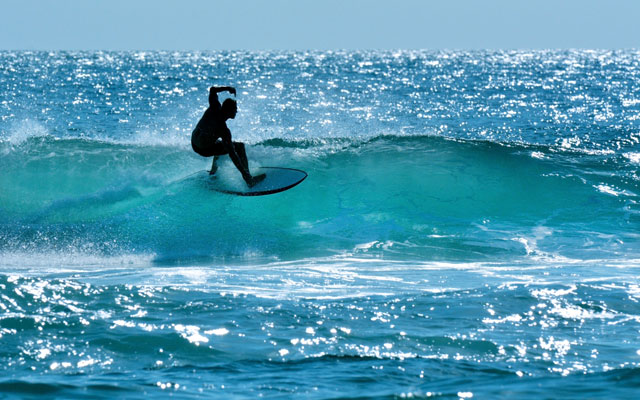
A surfer catching some waves in Gold Coast, Queensland
Australia’s Gold Coast will play host to the Global Wave Conference (GWC) in 2020, a bi-annual major surfing event that is set to attract 400 experts from around the world.
The GWC will be attended by surfing academics, marine scientists, ocean conservationist, industry leaders, legends and champions of the sport to address issues and concerns facing surfing as a whole and how to seek solutions and outcomes for its sustainable future.
A surfer catching some waves in Gold Coast, Queensland
Gold Coast Tourism estimates the five-day conference will generate more than A$1.2 million (US$0.93 million) directly for the local economy.
The 2020 Gold Coast GWC bid was supported by the Queensland State Government, City of Gold Coast, Tourism and Events Queensland, Destination Gold Coast, World Surfing League, Surfing Australia, Tim Bonython Movie Festival, and The Drop Live Music Festival.
GWC executive director Nik Strong Cvetich said: “We are thrilled to see the Global Wave Conference go to Gold Coast in 2020 as it is the 8th World Surfing Reserve. The Global Wave Conference was established in the Canary Islands, followed by Biarritz, Mexico, UK and Santa Cruz.
“Gold Coast will be such an exciting venue for the 6th biannual held the week before the World Surfing League world tour event at Snapper Rocks, and in the year that surfing is introduced into the Olympics for the first time.”
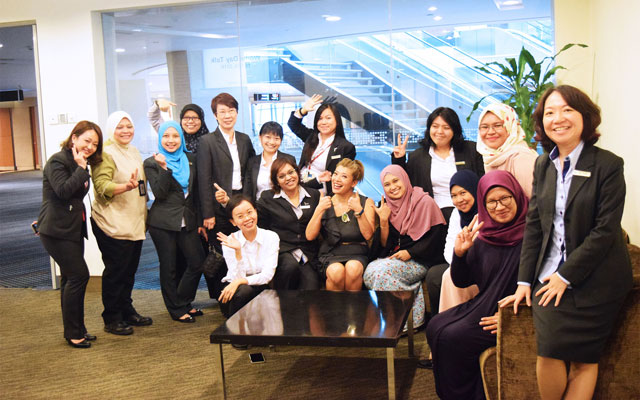
The Kuala Lumpur Convention Centre’s (the Centre) recently celebrated International Women’s Day, where one of the organised activities included a Work–Life Integration Talk with BFM Radio Host, Freda Liu (seated, fourth from right).
Currently, 52 per cent of the Centre’s managers are women. In total, the Centre employs 145 women, of which 79 hold executive to senior managerial positions.
Langham Hospitality Group has brought back the No Strings Attached Plus offer that gives event planners and organisers more flexibility, as well as added rewards and privileges.
Highlights include spa credits; one round-trip airport transfer; one 30-minute cocktail reception for a meeting or event; waived cancellation terms; room upgrades; and no minimum spend on F&B.
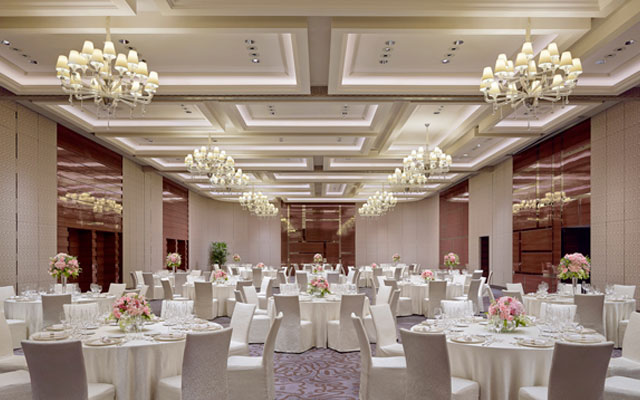
The Langham Xintiandi’s Grand Ballroom
The offer may be booked from April 1 to August 31, 2018 for events taking place from April 1 to December 31, 2018 at all participating Langham and Cordis hotels.
Added benefits are also applicable to reward event planners and organisers. With a minimum spend of US$6,500, all takethelead members can also qualify for hotel rewards or miles from any of our selected frequent flyer/travel and lifestyle rewards programme partners.
Just 10 minutes from Phuket International Airport on the serene northern coast, this 178-key, Bill Bensley-designed resort offers delegates a quiet, tropical paradise steeped in Phuket’s tin-mining heritage
The newly-opened Ritz-Carlton, Bangkok anchors the One Bangkok development with cosmopolitan elegance. Featuring the city's largest ballroom and a spectacular new penthouse suite, it delivers exceptional hardware and deeply authentic, soulful service for business and leisure travellers alike
Behind the imposing, Brutalist concrete that defines Zurich’s Oerlikon district lies a surprising secret. While its exterior honours the neighbourhood’s industrial roots, stepping inside Mama Shelter reveals a vibrant, neon-soaked world that is a far cry from its rigid shell