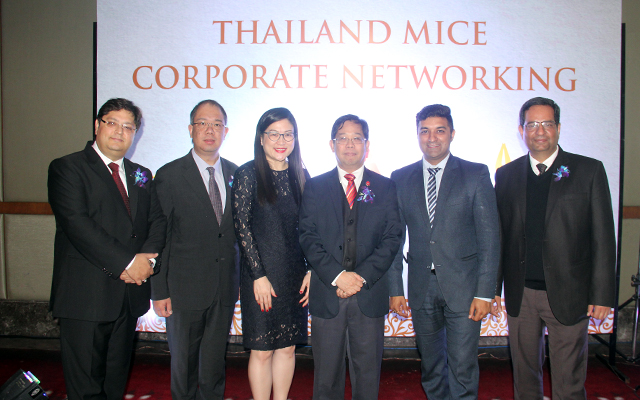
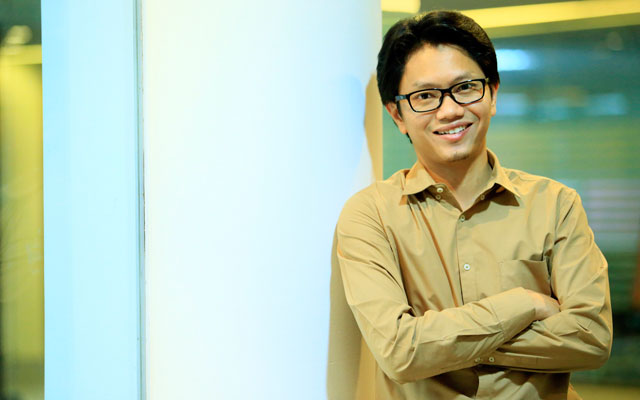
Nooch Homrossukhon (third from left) on moving beyond incentive market and bringing Indian meetings to Thailand
The Thailand Convention and Exhibition Bureau (TCEB) will run a series of roadshows in India this year in a bid to grow Thailand’s popularity among Indian business event planners, with the first for 2018 concluded recently in New Delhi.
The Thailand MICE Corporate Networking event in New Delhi was attended by 35 corporate clients, mainly from insurance, pharmaceutical, direct selling, automotive, electronics and FMCG segments. At the event TCEB introduced its new campaign, Meet By Design, which offers a tailored menu of perks and support for groups bound for Thailand.
Nooch (third from left) on moving beyond incentive market and bringing Indian meetings to Thailand
Nooch Homrossukhon, director of Meetings and Incentives, TCEB, told TTGmice: “The corporate incentive segment is the most dominant (contributor) of overall Indian MICE arrivals to Thailand. Now we want to (get more) meetings from India. To do this, we plan to focus on the new industry segments as per the Thailand government’s new economic model, Thailand 4.0.”
Thailand 4.0 aims to develop the nation as a knowledge-based economy, and in line with this, TCEB will target new high-growth industry verticals like medical technology, bio technology, robotics and embedded technology in India to driving up meeting numbers.
Last year Thailand recorded a 36 per cent increase in Indian business events. These events brought with them 32,428 Indian delegates.
“Apart from reaching out to corporate clients, we plan to engage with media planners especially in tier-two cities where we think there is a need to showcase what Thailand offers for meetings. We also want Indian corporates to meet in Thailand’s Eastern Economic Corridor,” Nooch added.
Following the New Delhi showcase, TCEB will return to India in July with a roadshow covering Mumbai and Bengaluru. It will also host seminars across India and fam trips for Indian planners.
Rohit Khanna, CEO of Travel Clinic, told TTGmice that Thailand has risen in demand for his corporate clients. “Meetings from India to Thailand are growing annually at a rate of 30 per cent. At present the demand is being driven by insurance, automobile and FMCG verticals,” he explained.
Calleja: getting the message out that JTB Philippines' MICE department also serves non-Japanese companies, and offers destinations beyond Japan too
To more effectively capture business events demand, JTB Philippines has rejigged its sector-dedicated department into two teams, one handling Japanese companies and the other non-Japanese and international companies.
While business events is top priority in JTB Philippines’ business and budget, the agency remains better known among Japanese companies in the country than non-Japanese ones, according to Maria Claribel Calleja, JTB Philippines’ MICE manager for non-Japanese companies.
Calleja: getting the message out that JTB Philippines also services non-Japanese companies, and offers destinations beyond Japan
Calleja told TTGmice that the agency wants to be better recognised in both local and international markets, as well as make known that it sells destinations beyond Japan, including South Africa and those in Europe.
Another challenge is the company’s image of being expensive due to its Japanese origins. Calleja said her team counters these associations by emphasising quality service, JTB’s 105 years of history and the reputation of its 500 offices around the world.
The Japan National Tourist Oganization is also helping JTB Philippines by endorsing it to Japanese companies and including it in marketing and promotional sorties, she added.
It seems JTB Philippines’ efforts have been paying off, as recent outbound bookings already include other countries compared with 2015-2016, when most bookings were mainly to Japan. There is also a growing clientele of non-Japanese companies.
Indonesia’s city of Solo will soon welcome a new cultural centre and events venue, named De Tjolomadoe, and buzz is building around its March 24 launch after Canadian musician and songwriter David Foster christened its concert hall with a performance earlier this week.
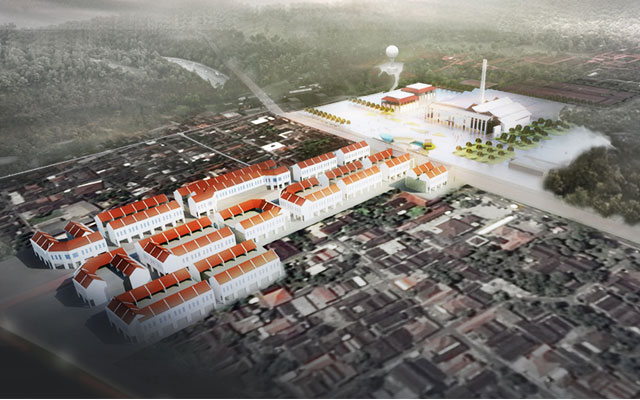
Standing on 6.4ha of land in Colomadu, Karanganyar Regency, the main building houses a concert hall, multi-purpose hall, cultural centre and commercial area. The site also has two outdoor venues for open air events such as carnivals, music and dance performances.
Concept art depicting the full development
This would be the first of six stages of the De Tjolomadu project, which covers a total area of 21ha. Later phases will include construction of a convention and exhibition centre, themed shopping mall, and four-star hotel.
De Tjolomadoe was reborn from a building previously occupied by a sugar factory by the same name. The factory, which was built in 1861, had been abandoned since its closure in 1998.
The development has taken up 200 billion rupiah (US$15.4 million) in investment on a 30-year BOT term with the land owner, National Plantation 9.
Linda Gustina, director of commercial and hospitality of developer PP Properti, a consortium member of Sinergi Colomadu, said: “Solo is well known for its culture and De Tjolomadoe will become a (new) cultural centre. We are inviting artists and art curators to take a role in (bringing this) attraction (to life).”
“With an international standard concert hall, Solo now not only can attract major Indonesian performers but also international artists of David Foster’s calibre, who will in turn draw visitors, at least from the neighbouring countries,” Linda said.
Preserved elements from the old factory preserved include machines, the chimney tower and even part of an old banyan tree, which serve as exhibits and windows into the past for visitors to the new attraction.
Edison Suardi, general manager construction of Sinergi Colomadu, said: “The whole building serves as a Sugar Factory Museum, where travellers can walk around and learn about its history. Although each room now has a different function, visitors can still find traces of the past. The steel planks in the repair room, for example, now become the base of the restaurant’s tables.”
Exhibitions & Trade Fairs (ETF) is launching the National Construction Equipment Convention (NCEC), said to be Australia’s first industry-owned, multi disciplinary, multi-event platform for the earth moving and infrastructure construction sector.
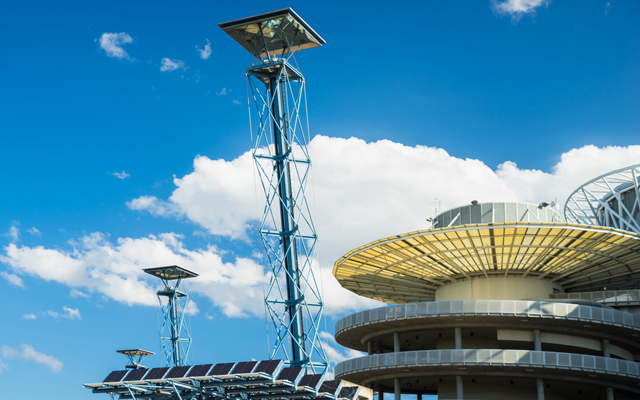
The result of years of development between the Construction Mining and Equipment Industry Group (CMEIG) and ETF, the inaugural NCEC will run from November 15 to 17 at Sydney Showground, Sydney Olympic Park.
The inaugural show will take place at the Sydney Olympic Park
NCEC will occupy 6,000m2 of exhibition space and feature dynamic formats, including the Demonstration Pit, with live demonstrations and hands-on interactivity outdoors; International Pavilion, which will showcase the latest heavy equipment and technology; Tech Zone, where avant-garde technology will be showcased in an immersive and futuristic space; and a presentation theatre for collaborative audience discussions on the latest developments in industry technology.
ETF’s managing director Gary Daly added that with face-to-face business still beneficial, the mega hub will have a social programme, offering networking opportunities through an opening ceremony, business leaders breakfast and networking drinks.
Multiple association events will also be held concurrently with NCEC.
“Already we have several major brands on board, and exhibitors can look forward to meeting industry decision makers from right across Australia,” Daly shared.
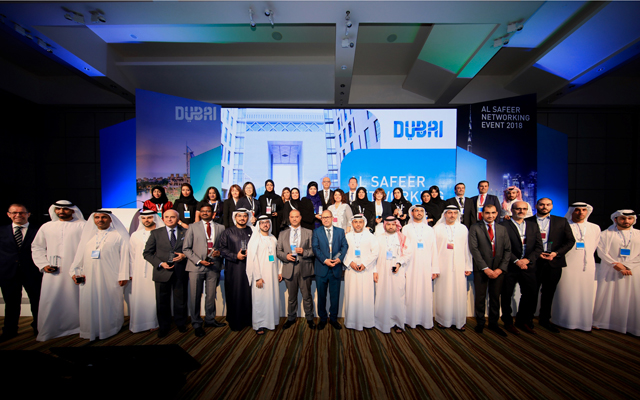
Dubai Business Events (DBE) this week recognised 26 member organisations of the Al Safeer Congress Programme for their contributions in attracting international conferences to the city.
Awards were presented at the programme’s annual appreciation ceremony held on February 27 at Park Hyatt, Dubai, which saw a gathering of over 150 ambassadors – including doctors, scientists, industry experts, business leaders and government officials from across the UAE.
Helal Saeed Almarri, director general of Dubai Tourism, said the programme has driven “tremendous results”, and expects the growing network of ambassadors to continue propelling Dubai forward as a knowledge economy.
Come August, Angie Stephen – currently Royal Caribbean Cruises’ associate vice president, market development, China – will replace Sean Treacy as managing director, Asia-Pacific.
Angie Stephen
From his current base in Singapore, Treacy will relocate back to Miami, where he will take up the new role of associate vice president strategic planning for international.
Stephen will relocate to Singapore to take on Treacy’s role, bringing with her almost 20 years of experience in the company, including in her current position as associate vice president, market development, China.
In her new role, she will take on the management of the Singapore source market for the Royal Caribbean International and Azamara Club Cruises brands.
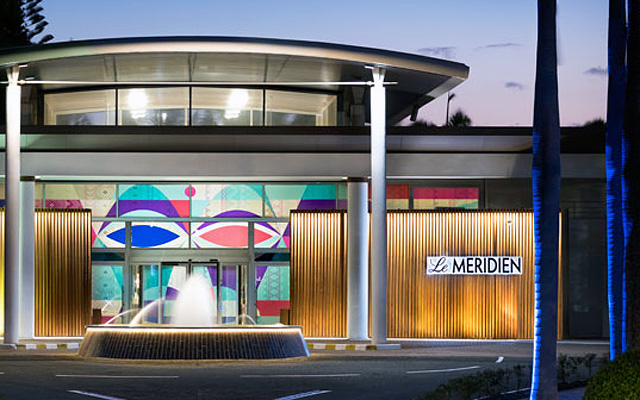
Marriott International has signed its first Le Méridien in Australia, with the brand scheduled to launch in Melbourne come 2020.
Converted from a low-rise building, the 12-storey, 235-room Le Méridien Melbourne will feature facilities such as a 210m2 function space, three breakout rooms, a heated swimming pool and fitness centre.
The Melbourne property will join the current four Le Méridien hotels in the Pacific; Le Méridien Nouméa pictured
The traditional lobby space will be reimagined into the brand’s signature Le Méridien Hub, which evolves from a coffee house by day to a cocktail bar by night. Other F&B concepts include the 70-seat M Salon bar; the 50-seat Latitude Bar, which will offer light bites and illy coffee; and Cuisines, a 90-seat all day dining restaurant.
The hotel sits amid art galleries, boutiques and bistros, with the city’s cultural centre close by. It fronts the Bourke/Spring Street tram stop and is located a stone’s throw from Victoria’s Parliament Square.
Commenting on the brand’s launch in Australia, Richard Crawford, senior director development, Australia, New Zealand and Pacific, Marriott International, said: “It comes at a perfect time. Alongside Melbourne’s growing demand from domestic travellers, new international direct routes from the US, Asia-Pacific and South America are driving continued growth in international visitation.”
Upon opening, Le Méridien Melbourne will join Marriott International’s growing portfolio in the Pacific, with 29 hotels in operation, including four existing Le Méridien hotels: Le Méridien Tahiti, Le Méridien Bora Bora, Le Méridien Isle of Pines and Le Méridien Nouméa.
The signing comes as part of Marriott International’s plan to open 50 hotels in Australia, New Zealand and the Pacific by the end of 2021.
Osaka is busy expanding its appeal as a destination for incentive travellers, with an added focus on big-spending groups at the luxury end of the spectrum.
“Up until 2010, MICE in general for us was mainly international conferences and conventions associated with the universities in and around Osaka, many of which were major global events in the medical sector,” said Yasunori Fukuda, head of the MICE promotion division at the Osaka Convention and Tourism Bureau.
“That was the sector that we were chasing and we had a range of financial supports available for those events.
“That market is stable today, but there has been a rapid increase in incentive travel to Osaka since 2012, for a variety of reasons,” he told TTGmice.
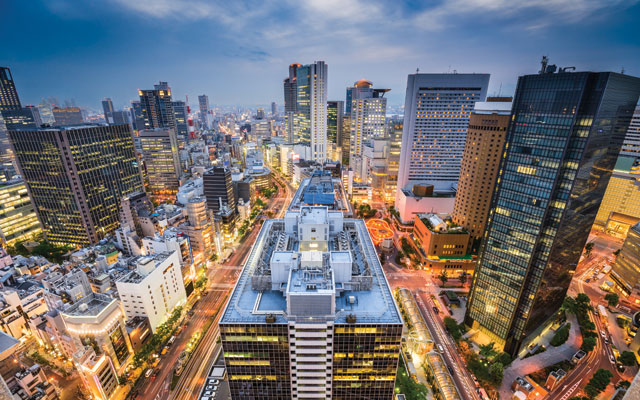
Osaka’s Umeda district cityscape at twilight
Those factors include a sharp increase in incentive arrivals from other parts of Asia after the Japanese government relaxed visa requirements for a number of nations; more affordable flights thanks to the growth of low-cost carriers flying into Kansai International Airport; and more tax-free shopping to reel in those with cash burning holes in their pockets.
Seventy per cent of incentive travellers arriving in Osaka are from Asia, with Taiwan, China, South Korea and Hong Kong heading the list, followed by Thailand and Singapore. More recently, according to Fukuda, arrivals from Malaysia, Vietnam and Indonesia are challenging those market-leaders.
“In 2017, we had some very large corporate incentive groups coming to Osaka, such as insurance firms or networked businesses based in China or Taiwan, with as many as 5,000 visitors,” he said.
“That sector is stable, but we really want to build on the smaller but very high quality groups of around 200 people or so,” Fukuda said.
He added that the aim is to attract major corporations in the region looking to hold their board meetings in a new city that also has plenty for executives to do on the fringes of meetings.
“These are big-budget meetings, they want to stay in five-star hotels and have unique experiences as well,” said Fukuda. “In the past, we might have targeted large incentive groups, but our strategy is now shifting to smaller groups with larger budgets at the higher end of the market.”
Aoi Samata, head of international sales at the Hilton Osaka, said inbound incentive travel in 2017 flattened since peaking in 2015 – but expects a more positive performance in 2018.
“I think 2017 has been the calm before the storm of the major events that are coming to Osaka and Japan more generally in the next few years,” she said.
“Osaka and Kobe will host eight games in the 2019 Rugby World Cup, and we also expect a positive impact the following year, when Tokyo hosts the Olympic Games.”
The 527-room Osaka Hilton is already fielding requests from agencies putting together packages for the rugby tournament that will go on sale early in the New Year.
Meanwhile, Osaka, traditionally seen as “Japan’s kitchen,” is building on that reputation for its overseas incentive travellers with a number of new attractions, including courses on how to create the city’s unique cuisine, such as takoyaki (balls of batter with octopus meat fillings) and okonomiyaki (savoury pancakes).
The city is also emphasising its night culture, with its tourism bureau drawing up a list of the top 50 night clubs, bars and live performance venues that would appeal to foreign visitors.
The bureau and companies in the city are active in promoting Osaka at business-event-related travel shows around the world, with some pointing out that Japan’s second city is also able to take advantage of its proximity to Kyoto – just 30 minutes away by train. It also helps that Kyoto continues to suffer from a chronic shortage of hotel rooms throughout the year.
Yet Jim Watanabe, of the MICE section of Kinki Nippon Tourist Kansai, believes that more needs to be done to extricate Osaka from the shadow of Tokyo for incentive travellers.
He said: “In comparison to Tokyo, we are still not so well known. To win more MICE visitors, we need to be able to provide more high-quality events and facilities.
“We need to do something different to what is available elsewhere in Japan – more hands-on experiences and unique venues – and we need to communicate that,” he said, adding that continuous communications is key.
“But I believe there is a lot of variety in and around Osaka and that makes us a very attractive destination.”
The 2018 Winter Olympics in Pyeongchang, South Korea may have drawn to a close on Sunday, but work to leverage the games to raise the country’s profile for business events is still going on at full speed.
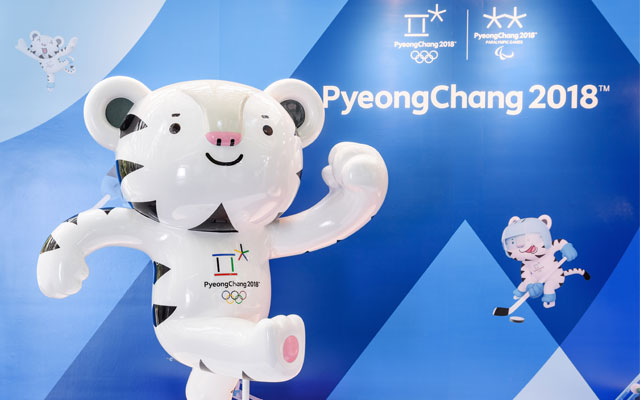
The 2018 Winter Olympics in Pyeongchang has given planners good vibes about South Korea
“The world now knows more about Pyeongchang and South Korea, so we have set up more infrastructure in the Gangwon province as valuable tourism assets,” said Jung Jiman, deputy director, Korea Tourism Organisation (KTO).
He added that greater awareness of Pyeongchang’s winter resorts and facilities among domestic and international planners will draw in more business events as well as spark developments in other provinces of South Korea.
The Games has also helped to dispel perceptions of “danger” that the market may hold regarding South Korea as a result of news surrounding a provocative North, noted Jung, who explained that potential visitors are now more aware of the “peaceful” relations between the two Koreas.
Jung observed at the recent AIME that “demand is growing” for incentive and meeting groups to South Korea, thanks to the Games.
Tricia Mikolai, managing director, BI Worldwide, observed: “There is not much fear from our clients in Australia. South Korea has been overlooked but now it’s the next destination for people to go.”
What it can benefit from is more information and awareness about its offerings, said Mikolai. She continued: “When we think of South Korea, we think of Seoul and the Olympics, but there’s so much more to it.”
Event planners in the region are opening up to facial recognition technology which allows delegates to register, print their badges, chat with each other and participate in live polls at events and conferences.
Launched last week at AIME, the facial recognition check-in suite by Malaysia-based Evenesis has already racked up interest among Asia’s event planners, said Yusno Yunos, CEO, founder of the company.
Yusno: Australian planners are still “shy” about facial recognition technology
“After we first spoke about this solution in Penang, we’ve gotten interest from parties in Indonesia, Singapore and Malaysia,” revealed Yusno. Clients include several Malaysian PCO such as Place Borneo and Crystal Edge, and Singapore DMC like CWT Events.
The suite is slated to debut at the end of this year with enhanced uses, such as entry into the event building itself.
Such technology is able to contribute to a better event experience for attendees, opined Yusno. Besides automatic check-in and badge-printing, the facial recognition suite also allows organisers to detect and analyse delegate emotions in order to craft a more effective event.
Moreover, the machine is able to recognise a more diverse range of facial features, a capability that Yusno observed not many solution companies in South-east Asia can offer.
As the product kicks off, data protection and privacy is an emerging concern, noted Yusno. He asserted that delegates’ pictures will not be stored, and are instead processed as “data points” or pixels.
He shared that while the technology has “really bright potential in South-east Asia”, it received “shy” reception from Australian organisers at AIME.
He said: “Australian planners I met have heard about facial recognition, but they’ve not actually experienced it at an event. However, technology adoption here is very fast as compared to in South-east Asia, so I’m confident that if we push this here, it will take off faster.”
Just 10 minutes from Phuket International Airport on the serene northern coast, this 178-key, Bill Bensley-designed resort offers delegates a quiet, tropical paradise steeped in Phuket’s tin-mining heritage
The newly-opened Ritz-Carlton, Bangkok anchors the One Bangkok development with cosmopolitan elegance. Featuring the city's largest ballroom and a spectacular new penthouse suite, it delivers exceptional hardware and deeply authentic, soulful service for business and leisure travellers alike
Behind the imposing, Brutalist concrete that defines Zurich’s Oerlikon district lies a surprising secret. While its exterior honours the neighbourhood’s industrial roots, stepping inside Mama Shelter reveals a vibrant, neon-soaked world that is a far cry from its rigid shell