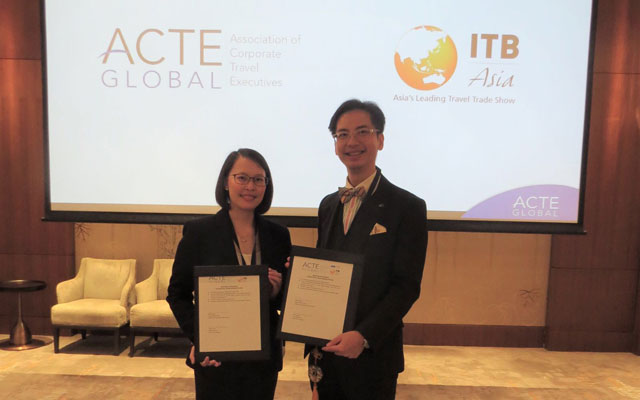
Having gained Cisco as its new President’s Circle Sponsor, the Association of Corporate Travel Executives (ACTE) is hoping to leverage Cisco calling, meeting and video technology to transform how it operates, trains and runs events.
ACTE Global
Through the sponsorship, Cisco collaboration technologies such as WebEx Event Center are expected to play a more strategic role in ACTE’s virtual events to provide members and non-members the tools and capabilities to enhance their education, with lesser constraints of physical location, time zone and traditional organisational boundaries.
ACTE will use Cisco’s collaboration products to power upcoming webinars, including the 2018 Corporate Travel Industry Forecast today; Virtual Card Strategy: The Value Chain on September 27; How to Give a Great Virtual Presentation (And Why This Matters in Corporate Travel) on October 2; Simplifying Managed Travel on October 18; and Taking Control of Your Hotel Spend on October 31.
According to ACTE, virtual collaboration tools are key at a time when one training a year is no longer enough to help corporate travel professions stay up-to-date with the latest information, pointing to rapid geopolitical changes, economic pressure and human resource challenges.
ACTE will also use Cisco technologies such as Cisco Spark internally to streamline their communication process in-house to lessen the amount of emails sent daily.
The ACTE membership will be introduced to further technology information at the London Aviation and Corporate Summit October 11-13.
The Exhibition and Event Association of Australasia’s (EEAA) Young Stars Program recently celebrated five years of mentoring with the leaders of the global exhibition and event industry at Luna Park Sydney.
Guests that evening were UFI – The Global Association of the Exhibition Industry CEO Kai Hattendorf and regional manager for Asia/Pacific Mark Cochrane.
The EEAA community of young leaders gathered to learn about global trends, opportunities and issues and their impact on the Australasian business event industry, and discuss their particular challenges and perspectives with Hattendorf and Cochrane.
EEAA chief executive, Joyce DiMascio, said: “The EEAA and UFI share a commitment to developing our future exhibition and event industry leaders and promoting the diverse and exciting career opportunities in our sector. We are very committed to promoting careers in our sector and showing the range of career paths that can be pursued.”
Hattendorf further reinforced the importance of programmes such as this to helping to build a sustainable future for the industry.
“Initiatives like the Young Stars Program are key to ensuring we identify, nurture and retain talent that will drive the future of our industry, and we at UFI are always happy to support these,” Hattendorf said.
Cooper: help for new meeting planners or planners of small meetings
IACC, an international association for convention centres, has published a Guide to Conference & Meetings Internet, aimed at helping those new to meeting and events management through the often technically-overwhelming task of arranging and buying internet and broadband services from a venue.
Cooper: help for new meeting planners or planners of small meetings
Mark Cooper, CEO of IACC, said in a statement: “As the industry continues to grow at a rapid pace, we’re seeing a greater number of Internet-reliant technologies enter the meetings and conference world. In order to support those tasked with organising smaller business events, we felt there was a need to provide some entry-level guidance on meetings Internet.”
The guide is also a reference and educational tool for venue sales and planning team members, ensuring they have the knowledge required to match Internet related services to the needs of their clients.
Cooper added: “The guide helps to break down the barriers faced by many in the industry; it includes a helpful and comprehensive summary section on basic terminology, which equips everyone with day-to-day jargon associated with meetings Internet, so it’s ideally suited for both event organisers and venues.”
The guide was designed by IACC volunteers in Australia, Europe and America; with the project led by Clotilde Gay, director of sales for Dolce Hotels and Resorts, an IACC certified venue.
The complexity of today’s world has compelled us to reevaluate the way we live, rethink our priorities and reflect on the complicated balance between freedom and security in our personal and professional lives.
Fifteen years ago, I was involved in the organisation of the G8 summit in Italy. At the time I would have never thought that all of the training and the protocols established for managing that event would someday be applicable in a daily work setting.
The constant security personnel presence would help attendees feel safer
In the past, problems that could arise included strikes, sudden schedule changes for the arrival of a head of state, the cancellation of flights, or natural disasters. You only had to think about hiring reliable vendors, making sure they were appropriately insured and checking that all updates were implemented correctly. Today, it is critical that event planners know how to organise and coordinate security, particularly for phenomena that are more complicated and global in scope such as a hypothetical terrorist attack in a city or an airport.
So, how do event planners best address the needs of clients who may directly or indirectly suffer the consequences of these phenomena?
Here are some basic considerations.
Have a plan in place for all staff members and suppliers that serves as a blueprint on how to handle any type of crisis. Provide training so that everyone knows what to do in any type of emergency. Information sharing and raising awareness of security standards will help mitigate material damages and the impact on participants.
Over the last two years, my company worked hard to organise an international conference that brought together executives of the world’s largest insurance companies. The goal was to provide exclusive and prestigious venues that would allow the program to be conducted with utmost discretion. The venues were chosen on the basis of aesthetics, exclusivity and confidentiality and the choices turned out to be crucial for managing event security.
Working closely with local security personnel, we communicated the details of each day’s schedule to the national police and continually provided the client with updates regarding the importance of security personnel presence during all phases of the event. Security was managed discreetly, requiring significant work behind the scenes so that the attendees felt safe and the overall tone of the event was unaltered. Choosing experienced, discreet and professional event vendors and using the client’s own staff and internal security helped ensure that the event was operated successfully, from start to finish.
Cybersecurity is another consideration. It is extremely important to safeguard information and sensitive data communicated via email or on an event website. In the case of the insurance conference, none of the schedules or event reminders contained any specific details that could be intercepted and used in ways that would endanger the safety and security of the participants.
For events abroad, I always recommend relying on local suppliers who know the destination and, in the case of a problem or a sudden risky situation, are in a position to resolve it quickly with an innovative solution. Based on more than 25 years of experience, I could choose to work directly with the facilities and infrastructure in the host country.
However, it is precisely because of my experience that I always choose to collaborate with colleagues at the event site and rely on local experts to provide enhanced security to ensure the event’s success.
We have been often challenged by clients who preferred to save money on safety in favour of investing in other aspects that would impress attendees such as staging, speciality entertainment, etc. Although security can be costly and can affect an overall budget, I always say to my clients, “It’s always preferable to have fewer oysters rather than hold an unsafe event.”
___
Annamaria Ruffini is SITE president-elect and president & CEO of Events In & Out based in Rome, Italy. This opinion was first published on motivate.siteglobal.com.
IMEX America's Ray Bloom announces new venue for the show
IMEX America’s Ray Bloom announces new venue for the show
IMEX America exits Las Vegas from 2021 The IMEX Group will move its IMEX America show from Las Vegas to Mandalay Bay from 2021 through to 2025.
IMEX Group chairman Ray Bloom acknowledged the support the team at Sands Expo Las Vegas had given the show since well before its launch in 2011, and said he was looking forward to four more successful shows with venue until 2020.
Bloom explained that the move was necessary as IMEX America was unable to “lock in space from 2021 onward” at the Sands Expo Las Vegas.
“We look forward to establishing successful partnerships with the Mandalay Bay and MGM Resorts International teams, and we know that their world-class facilities will be an equally fitting home for the show,” he concluded.
Convention Centre Dublin pulls in parasitology congress The Convention Centre Dublin will host the 28th International Conference of the World Association for the Advancement of Veterinary Parasitology in 2021.
The conference is expected to attract 1,000 international participants and generate in the region of €1.6 million (US$1.9 million) for the local Irish economy.
The venue had worked closely with conference ambassador professor Grace Mulcahy to initiate the bid for Dublin, which was put together by the local committee in partnership with Keynote PCO, and supported by national tourism board Fáilte Ireland, Meet in Ireland and Dublin Convention Bureau through the Conference Ambassador Programme.
Norwegian’s non-stop Orlando-Paris service takes off Low-cost airline Norwegian has launched its first flight from Orlando International Airport to Paris’ Charles De Gaulle Airport, allowing it to hold claims to being the airline with the most European connections from Orlando.
Flights are operated once per week on Mondays, with a Boeing 787 Dreamliner aircraft.
Seven years ago in 2010 was the last time an official dollar figure on the contribution of the events industry was published.
The WTTC (World Travel and Tourism Council) reported it was worth more than US$650 billion out of the total tourism industry contribution of US$5.7 trillion, which accounts for more than nine per cent of global GDP. Is it an accurate figure and what is the dollar figure today?
Karen Bolinger
“Nobody knows,” Oscar Cerezales, chief operating officer, MCI Group replied. “There are reports and stats but the direct value is difficult to measure and the indirect is almost impossible. That said, if you need a number, US$650 billion is ‘accurate’.”
Cerezales supported his estimate based on a recent PricewaterhouseCoopers study, which put travel and tourism at US$865 billion in the US, with US$280 billion accounting for meetings direct spend. With world meetings contributing three to four times more, he put the events ballpark figure at around US$700 billion.
Primarily, Cerezales said, it is because there is no global agreement in methodologies like ISO, and calculations in most countries are based on tourism KPIs.
Figures aside, Joint Meetings Industry Council (JMIC)’s executive director, Rod Cameron, pointed out that it was only in the last few years that there has been a growing appreciation of the value events create in terms of knowledge transfer, innovation, and business stimulation.
But these values, he noted, are difficult to measure with any precision, and methodologies are just being developed. However, the meetings industry is fragmented, has limited collective resources and progress has been slow.
Earlier this year in January, JMIC launched The Iceberg, not only as a vehicle for industry advocacy, but also specifically to showcase the content of its Case Study Program.
Cameron said JMIC, in collaboration with an international academic panel coordinated by the University of Technology Sydney, is publishing academically rigorous studies of the outcomes and legacies of business and professional events.
The aim is to convince the government, and individuals involved in a destination’s economic development, of the sector’s true value, and to identify the range of output values from particular events to serve as examples of the broader benefits generated by the meetings industry as a whole.
Cameron continued: “In most parts of the world the meetings industry is heavily reliant on government support and investment. Major event facilities like convention centres, for example, are almost always supported by public investment and government policies – such as taxation, immigration and access – can have huge implications for industry success.
“In order to see the real return on that investment, governments and communities must go beyond the spending-based value measurement and recognise the much broader role they play in advancing a wide range of policy priorities and community aspirations.
“We need to make the arguments and back them up with solid data – so this is why broader value measurement needs to be a top priority for the meetings industry today.”
Karen Bolinger, CEO, Melbourne Convention Bureau, opined “we are not good at promoting ourselves”.
“Business events are a crucial part of the visitor economy, and the value of the sector extends beyond tourism expenditure. Conferences provide opportunities to build international networks, open trade and investment opportunities, profile a region’s sectors of strength, and bring focus to a government’s areas of policy leadership.”
Bolinger added: “To truly understand the impact of the sector, we need to understand the legacies that were left behind, such as knowledge dispersal, community initiatives, research opportunities and business development.
“However, there are real challenges in sourcing this data. There are also challenges around collecting the right data that will educate government, stakeholders and partners on the value of the business events industry.”
Melissa Ow, deputy chief executive, Singapore Tourism Board (STB), said the board is nurturing understanding of the business events industry by promoting the growth and development of SACEOS (Singapore Association of Convention and Exhibition Organisers of Singapore), a local business events industry association.
Ow commented: “With STB’s support, SACEOS developed a curated MICE Week with the Singapore MICE Forum as a key feature, where players in the business events ecosystem collaborate to share knowledge and network, thus profiling the business events industry.”
InterContinental Hotels Group (IHG) has announced a new operating region that combines Europe, Middle East, Asia & Africa (EMEAA) to be based in the UK, effectively relegating the current regional office in Singapore which covers AMEA (Asia, Middle East and Africa) to a sub-regional division.
A second shock is the resignation of Jan Smits, the current AMEA CEO who is widely respected by Asian owners and hospitality professionals as running a tight ship and sealing long-lasting, trustworthy relationships.
Smits will be with the chain until the end of the year
The restructure is the first major move made by IHG’s new group CEO, Keith Barr, who rose to the top on July 1 after making a mark as IHG’s CEO of Greater China, then as its chief commercial officer. The new CEO Barr picked to run EMEAA, Kenneth Macpherson, is currently IHG’s CEO of Greater China. Replacing Macpherson as CEO of Greater China, which remains as a regional office, is Jolyon Bulley, currently COO of Americas and was COO of Greater China.
The changes will take effect at the start of 2018. Smits will remain with IHG until the end of this year.
Some in the industry are pondering the logic of IHG moving farther away instead of staying close to the fastest-growing hotel market, Asia-Pacific. An EMEAA region is also atypical for the industry, raising eyebrows if such a “mega” region and one so diverse is do-able.
Just running Middle East and Asia is a challenge, pointed out Robert Williams, partner and head of hotels & hospitality Asia-Pacific, Withers Worldwide, based in Singapore. “So this is bold. And, trying to manage Asia from Europe – not many have succeeded there. Strong senior and empowered management on the ground in Asia and a clear mandate for them to execute strategy will be key.”
Asked how he thinks this will affect the current regional office in Singapore, Williams said: “Asia-Pacific is a key growth engine for the industry. That often gets overlooked by management teams in Europe and the US, who point to its smaller current size. Those sitting in Singapore may feel disenfranchised initially, and will miss Jan’s great leadership. But Kenneth has long been identified as a superstar and will no doubt represent Asia strongly in Denham.”
Asian owners and owner-representatives that let IHG manage their hotels are concerned. Said a shocked Choe Peng Sum, CEO, Frasers Hospitality Group: “First of all, the two major regions are so diverse, and to lump all operations under the UK? Just spells a little to owners like us that Asia is not that important anymore! I am indeed concerned whether we will get the attention for our properties in Asia out of Europe. There are so many opportunities both in Europe as well as Asia, two major distinct regions – it doesn’t quite figure to me.
“Secondly I am shocked and sad to see Jan leave the group as I have seen how he has led AMEA with passion and dedication, and the tremendous growth the group has seen under his watch. The attention to detail and the approachability whenever we need help or attention is always there. I hope things are not going to change with this major reshuffle. If so, we will certainly make our own plans for a reshuffle as well.”
On the flip side, Withers’ Williams thinks the move may give Barr more direct visibility into and control of Asia. “Arguably, it improves Asia’s representation in the head office too. Hopefully this feeds into the overall imperative for IHG, which must be to become the global operator that makes a difference quickly and much more aggressively.
“IHG has a track record of putting through a very deliberate reshuffle every four years or so. With a new group CEO at the helm, this is an early move to shape the management team and regions in a way that aligns with the vision the board is asking Keith Barr to deliver on,” said Williams.
He agrees with the sentiments being expressed on Smits’ sterling leadership. “Jan has built a great management team in Singapore and steered the region to record growth during a period in which two IHG legends Anthony South and Paul Logan (IHG’s development chiefs in AMEA) retired, and in which IHG has not been as aggressive with capital as some of its competitors. That is a legacy he can be very proud of.”
In a statement, IHG assured that the UK-based EMEAA region will operate through “strong” sub-regional divisions based in a number of locations, including Singapore, “to ensure the business remains close to hotel owners, guests and colleagues”.
“By bringing two strong, established regions together as one, the company will focus on further growth through increased agility and effectiveness,” it said.
Barr said in the statement: “The success of our current AMEA and Europe regions has put us in great shape. Our clear and focused strategy that remains unchanged, along with the investments we have made, has seen our business grow significantly in these markets. We are now ready to take the next step, which will continue to drive operational performance and accelerate the growth of our brands.
“The EMEAA region will be hugely diverse with tremendous opportunity. With Kenneth’s experience in our fastest-growing region, sharp focus on operational excellence and strong background in consumer brands, he has both the experience and passion to take our new region forward.”
InterContinental Hotels Group (IHG) CEO Keith Barr said he is not de-prioritising AMEA with his move to create a new mega region that combines AMEA with Europe based in the UK.
In fact, he wants to bring resources closer to the markets, Barr said in a phone interview from London.
Barr wants to enable markets be more independent when it comes to making decisions, in order to drive performance
The intention, according to Barr, is not to have a big office in Europe running the business but “to have more resources going into the markets close to the hotels and owners (and) to enable the markets have more autonomy and be a bit more entrepreneurial to drive performance. So we’re moving resources around while maintaining centres of excellence on development, luxury, F&B, operations, in Asia.”
Barr recounted that was how he ran Australia/New Zealand/South Pacific years ago. “I was a fairly independent business; I wasn’t dependent on Singapore. I had development, sales & marketing, revenue management, I ran my own business, and I had the ability to make decisions on how we partner, how we negotiate a deal, and that’s what I want to see. I want to empower southern Asia, India, and so forth. Sure there are some things we can’t do from a back office perspective such as finance or HR which are more process-related.”
He’s looking at how best to structure EMEAA on a market basis, he said. Macpherson will have accountability for the overall strategy of EMEAA, and there will be leadership in each of the markets who will be accountable for operating the hotels, opening hotels, growing the business. “We’ll work through who should be in those roles going forward. We have a number of people in place and we have to look at which other leaders we want to have in place going forward,” he explained.
He reiterated: “There’re going to be resources in Singapore, it’s a huge important part of the world for us. There will be resources in other important markets for us and we’ll be more focused on putting resources in markets that have the highest potential, based on pipeline, relationships with have with owners and our competitive positions too.”
Asked why this model is relevant for IHG today, Barr said: “The business has got scale now. Where we didn’t have scale in many of those markets in the years past, it did make sense to do everything out of Singapore. But now that we have scale in those markets, the best way to drive performance for owners is to grow more resources in those markets.”
Each market, he reminds, is fundamentally different. Australia/New Zealand has lots of institutional funds compared with southern Asia, which has lots of high net worth individuals, managed luxury and upscale business, he points out. “So no one size fits all,” he said. “I want to make sure we’ve got the right go-to-market strategy.”
Regions are just constructs that companies make, says Barr. What’s important is “how to ensure we have the right operating model in the markets and not be constrained (by traditional ways), how we look at using technology, new ways of working and leveraging our scale”.
Thailand Convention and Exhibition Bureau (TCEB) is extending its Meet Double Cities package – offered under its wider Thailand Connect campaign – through 2018, as demand for it picks up this year on the back of a recovering European business events market.
The Meet Double Cities package was launched last year to encourage corporate groups to stay on longer in Thailand through multi-city itineraries. It dishes out 100,000 baht (US$3,014) for each qualified group with 200 attendees and more staying in Thailand for at least four nights in more than one destination.
Supawan: Meet Double Cities package is heavily dependent on longhaul markets
According to Supawan Teerarat, TCEB vice president of strategic and business development, the package had a rocky start as its launch coincided with a shaky European economy that saw groups holding on tighter to their finances, and shrinking travel and event budgets.
Supawan explained that the success of the Meet Double Cities package was more dependant on longhaul markets as their travellers were more likely than Asian ones to take up a multi-city itinerary, having travelled a long distance to Thailand and would want to make the most of their trip.
“European groups that (did come) to Asia for business events were very careful with their expenses, and tended not to feature too many cities in one destination,” she said.
But things are looking up this year.
“We saw more demand for events and more requests (for the package) since early this year, just as the European market rebounded,” she told TTGmice.
Among the multi-city corporate events held in Thailand this year is a 280-pax incentive programme for a company in Belgium. The group visited Bangkok and Hua Hin from March 7-23, and the organisers were supported by the Meet Double Cities package.
Encouraged, TCEB has decided to extend the Meet Double Cities package to 2018, which otherwise would have closed its application on September 30 this year.
On September 14, the Malaysian Society of Association Executives (MSAE) was officially launched during the Malaysia Association neXt (MyNext) 2017 conference in Kuala Lumpur.
Headed by Zaliha Omar, MSAE’s mission is to advance the stature and professionalism of associations in Malaysia through advocacy, education and advisory services.
Malaysia Convention & Exhibition Bureau’s Zulkefli Sharif (third from left); MSAE’s Zaliha Omar (fourth from right); and MSAE committee members
Zaliha said in a statement: “Among our objectives are to promote the profession of association management, to accord networking platform for our members, and to conduct educational and training courses to uplift our members’ knowledge, skills and standards.”
She also urged fellow association members to become MSAE members, so as to connect with other like-minded professionals in the industry.
Malaysia Convention & Exhibition Bureau CEO, Zulkefli Sharif, expressed his support, saying that the establishment of MSAE “complements our efforts in positioning Malaysia as Asia’s business events hub”.
On the setting up of MSAE, regional director Asia Pacific, International Congress and Convention Association (ICCA), Noor Ahmad Hamid commented: “The initiatives to set up the MSAE are indeed a significant move for Malaysia to capitalise on the power of association. More importantly, it represents a platform where local association leaders and executives can exchange knowledge and know-how to build efficient and sustainable associations. ”
The MyNext 2017 conference which saw the presence of 124 local association experts and thought leaders, was jointly hosted by Malaysia Convention & Exhibition Bureau and MSAE.
The newly-opened Ritz-Carlton, Bangkok anchors the One Bangkok development with cosmopolitan elegance. Featuring the city's largest ballroom and a spectacular new penthouse suite, it delivers exceptional hardware and deeply authentic, soulful service for business and leisure travellers alike
Behind the imposing, Brutalist concrete that defines Zurich’s Oerlikon district lies a surprising secret. While its exterior honours the neighbourhood’s industrial roots, stepping inside Mama Shelter reveals a vibrant, neon-soaked world that is a far cry from its rigid shell
A polished urban retreat designed for business travellers, Hyatt Regency Kuala Lumpur at KL Midtown combines thoughtful design, seamless service, and exceptional facilities.