Malaysia has launched its first food waste management and responsible sourcing guidebook, positioning sustainability as a core strategy for its business events and hospitality sectors.
Titled Best Practices on Waste Management and Responsible Sourcing Guidebook, the resource was developed over three years by the Kuala Lumpur Convention Centre Business Events Alliance together with WWF-Malaysia, Taylor’s University and UCSI University.
The guidebook emphasises responsible food sourcing, using seafood as a case study to demonstrate how procurement impacts ecosystems. It offers practical frameworks for evaluating suppliers and embedding sustainability into purchasing policies.
Additionally, the resource tackles food waste using local case studies and a Behavior-Centred Design approach –merging behavioural science with design thinking to identify root causes and implement scalable solutions.
Taylor’s University is integrating the guidebook into hospitality modules, with UCSI University set to follow, aligning industry standards with talent development.
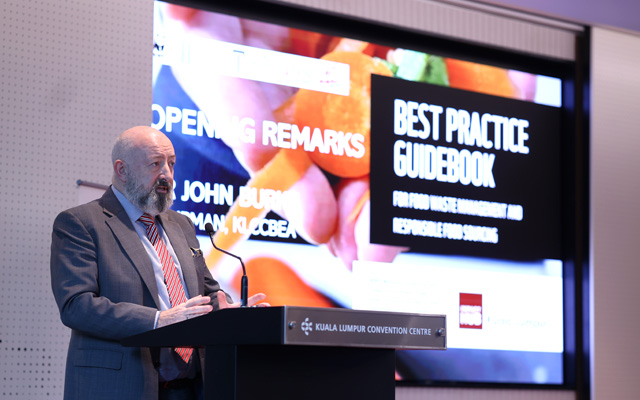
John Burke, general manager of Kuala Lumpur Convention Centre, said: “These two challenges of what we waste, and where we source, are deeply connected. This is not simply an environmental issue. It is an operational issue, a sourcing issue, and ultimately, a responsibility issue for our industry.”
Malaysia generates approximately 16,688 tonnes of food waste daily, with nearly 60 per cent considered avoidable. At the same time, unsustainable sourcing practices are placing increasing pressure on natural resources.
Sophia Lim, CEO and executive director of WWF-Malaysia, said: “Food waste accounts for an estimated eight to 10 per cent of global greenhouse gas emissions thus making it a serious climate and environmental challenge.
“How we source food has direct implications on biodiversity, marine ecosystems and resource security. This guidebook equips both industry practitioners and future talent with the knowledge and practical tools needed to drive meaningful change.
This collaboration represents the systemic, multi-sector approach needed to move the needle on Malaysia’s sustainable food systems as the country works toward its 2030 United Nationals Sustainable Development Goal of halving food waste, she added.