At the 10th MICE City Summit, the Thailand Convention and Exhibition Bureau (TCEB) united government, academia, and vocational education in a landmark partnership to tackle Asia-Pacific’s workforce shortages and drive sustainable growth in secondary cities.
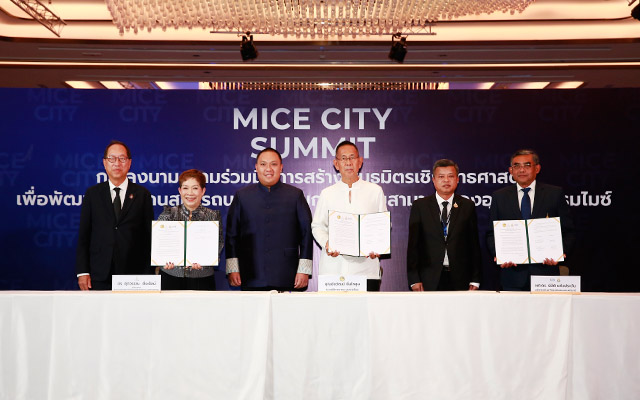
Signed on April 28, 2026, the Memorandums of Understanding align TCEB and Prince of Songkla University (PSU) with the Ministry of Interior and Office of the Vocational Education Commission (OVEC). The partnership aims to establish a City Data Intelligence ecosystem and develop high-performance human capital, shifting Thailand’s business events strategy from focusing solely on business events to driving long-term urban development.
Supawan Teerarat, president of TCEB, noted: “This collaboration across policy, operations, and education reinforces the foundation of Thailand’s MICE ecosystem. It reflects our commitment to expanding MICE from Business Events to Development Events – delivering high-value impact and strengthening Thailand’s credibility in the global market.”
“This collaboration will build on past successes, turning concepts into practice, particularly regarding sustainable city development systems. This is a core focus for city administrators and those overseeing local areas. When local administrators have a vision and understand the potential of their cities, they can enhance capabilities,” she stated.
To support this, the alliance will develop structured programmes to clarify goals and joint efforts across all provinces nationwide.
A major facet of the agreement involves the Ministry of Interior, the principal body overseeing Thailand’s nationwide urban administration. The Ministry plans to utilise the business events industry to distribute wealth, empower local entrepreneurs, and elevate local governance. The partnership will focus on developing “high-performance city managers” equipped with deep socio-cultural understanding and backed by intelligent data systems that enable real-time policy decisions.
Chaiwat Chuenkosum, deputy permanent secretary of the Ministry of Interior, explained: “If MICE City development is not fully integrated, we won’t fully realise its potential. MICE Cities require various factors – from infrastructure to local businesses. When the city is ready, and evaluations show a high-quality MICE City, the city itself improves, which aligns with our core mission of developing our cities.”
This knowledge will be embedded into the Ministry of Interior’s training programmes for district chiefs, provincial governors, and local administration executives to build a resilient and developed nation.
To address the business events talent shortage, TCEB, PSU, and OVEC are leveraging the Songkhla Model – a successful “Living Lab” that made Songkhla Thailand’s top sustainable MICE city for three years. This partnership integrates vocational education with industry insights to transform educators into innovation leaders capable of rapidly developing a high-performance workforce.
PSU’s president Niwat Keawpradub highlighted that these achievements have yielded innovations like a Credit Bank system, noting the curriculum will move beyond classroom learning to “practical application, joint learning, and real-world development”.
He stated that the goal is “to create a network of collaboration to elevate city development through MICE”, ensuring visitors experience a shared picture.
Niwat concluded: “We are not merely teaching – we are building an ecosystem to develop high-performance MICE city leaders who can think, act, and deliver effectively.”