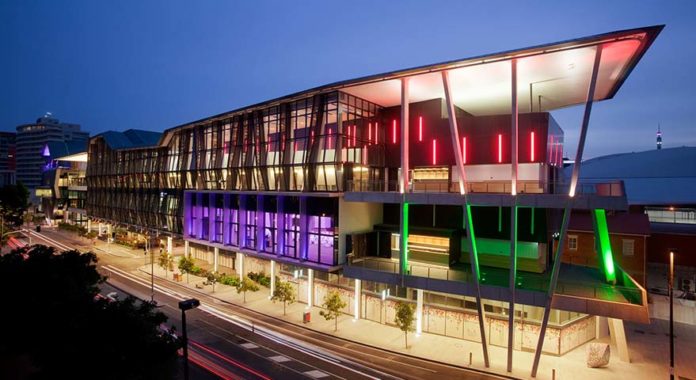
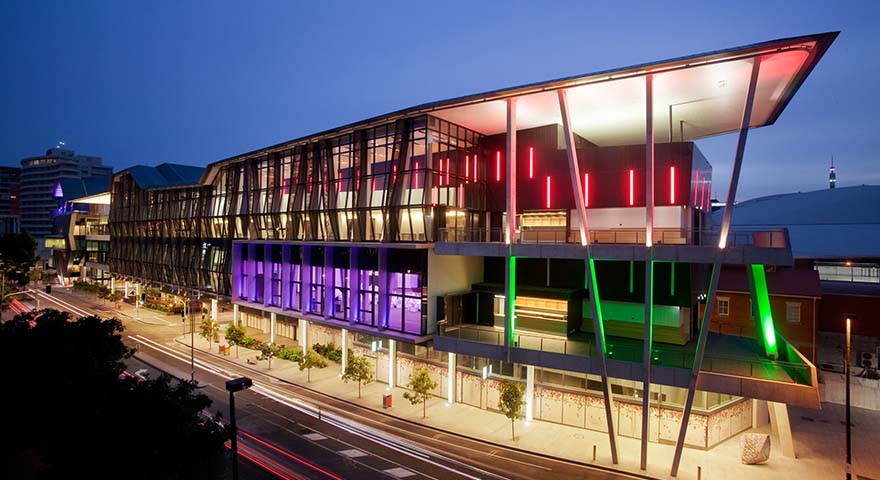
The event will be held at the Brisbane Convention & Exhibition Centre
COME July 2018, the Brisbane Convention & Exhibition Centre (BCEC) will host the International Political Science Association (IPSA) World Congress, an international gathering of political science scholars.
The six-day congress is expected to attract 3,000 delegates to Brisbane and bring about an economic value of more than A$10 million (US$7.6 million).
Lord mayor Graham Quirk said: “Luring this World Congress to our city will… boost the local economy and demonstrate the success of our collaborative Team Brisbane approach to securing major business events and jobs for our hotels, venues and services.”
He added: “Major conferences of this nature also showcase our New World City as an important knowledge, innovation and research hub with world-class institutions.”
Professor Kath Gelber, deputy head, School of International Studies at the University of Queensland, said the Brisbane congress, which will be the 25th congress and a milestone for the international association, will provide a global platform to showcase the world leading research currently being conducted by political science, governance, public policy and international relations scholars in Australia.
It is the first time the IPSA World Congress will be in Australia since the congress’ inception in 1950 in Zurich, Switzerland.
PARIS, Jakarta, Istanbul – terror is no longer limited to cities like Kabul or Aleppo. Environmental events such as floods, earthquakes or volcanic eruptions are also part of daily risks. These can happen anywhere, 24/7/365. While individuals are primarily responsible for their own safety, companies have a fiduciary responsibility, especially towards corporate travellers, who are exposed to constantly changing risks.
In emergencies, TMC data is used to determine what travellers are in risk areas, however, this only provides departure/arrival airport. Direct bookings and use of OTA’s exacerbate this problem and fragment data even more.
Looking at Brussels for example: Were travellers at the airport or the downtown subway station during the attacks? Did they use public transport? Were they even in Brussels or outside the city? Can travellers be contacted to verify they’re safe? Can emergency information be sent instantaneously? Can travellers advise of emergencies, seek help or allow for notification to others?
Current data sources are woefully inadequate, however, there are new, reliable and supplier-neutral options – traveller/geo-tracking. These systems centre around the ability to locate travellers based on their mobile phone signal. With the full knowledge and consent of the traveller, an app is installed that can then transmit its location. This not only provides the true location of the traveller but allows to warn them of dangers in their vicinity, organise assistance or obtain live, on-the-ground information. This technology can revolutionise traveller safety and security.
But it also raises questions on rights to privacy and data privacy.
Geo-tracking is the most efficient method to determine the true location of travellers and solve the issue of fragmented data. Obviously these systems are not free-of-charge and putting together a business case can be tricky. The ROI is difficult to determine as, if the system is used properly and efficiently, there will be no “savings” or “return on investment” as such.
Duty of care and safety and security are not topics that can be won with a cost argument, however, the potential price tag of only one incident, one injured employee, one death, one abduction can exceed any system cost by far.
Legally, collecting personal data through geo-tracking falls under the heading of individuals’ right to privacy and data privacy, and is subject to the relevant national laws. In the past geo-tracking had a bad reputation as companies frequently used it to monitor employees and (ab)use the data to make conclusions on employee behaviour, efficiency, etc. This has caused many governments to limit or even prohibit the use of geo-tracking by corporations. However, the beneficial, non “big brother” use of this technology in the field of traveller safety and security is too new to be clearly defined by law.
An exact set of rules that companies can use worldwide does not exist. Generally the location of the traveller’s employment contract determines which national law applies. All this appears to be truly challenging, however, a detailed analysis of the different rules and regulation does allow us to draft an overarching set of rules.
Explain employees the advantages of emergency apps and geo-tracking, who will have access to the data and under what circumstances and when data is erased
Advise that use is voluntary and that employee can decline and/or withdraw consent at any time and without reason
No consequences or travel ban if employee declines
Explicitly consent in writing to track – not as part of employment contract or travel-policy
Never limited use to just one group of travellers e.g. management
Allow traveller to disable the software, however, advise of risks in doing so
Irretrievably delete all date once trip is completed
Limiting the tracking feature through a privacy mode is an effective alternative if the use of full-time/permanent tracking is not a suitable option.
This feature was recently introduced by Vismo, a UK global tracking solutions provider. In an emergency, the traveller can turn off the privacy mode and the exact geo-location is immediately transmitted to the company. Additionally, in the event of a crisis the privacy mode can be switched off remotely by the system administrator and the traveller is notified.
Geo-tracking can be the panacea for the safety and security concerns of our business travellers and solve many of the problems that have limited duty of care. Granted, not every employee may consent to take part in the programme and implementation may be time consuming. On the other hand, the ever increasing security threats around the world require an all encompassing duty of care programme that does not rely of fragmented booking information alone.
By Andreas J G Wellauer
***
Andreas J G Wellauer is a leading expert, author and speaker on corporate travel management. His global background includes working for UBS Hong Kong, ADB Manila, Woolworth Australia and the UN in New York. Wellauer is CEO of German based GALIANT Consulting, a company focusing on strategic, innovative and emerging travel-trend consulting.
In a city that is better known for ultra-modern venues in sleek steel-and-glass skyscrapers, The Mitsubishi Ichigokan Museum transports guests back to a more genteel time.
Concept Originally constructed in 1894 as the first Western-style office in Tokyo, the Mitsubishi Ichigokan building was rebuilt to the original plans in 2010 to exhibit art from the late 19th and early 20th centuries. Situated in the swanky Marunouchi business district, just a five-minute walk from both Tokyo Station and the Imperial Palace, the museum displays art from its own collection and hosts visiting exhibitions of works by Renoir, Gaugin, Pierre Bonnard and others.
MICE application The museum has recently introduced programmes for private events on site.
The Museum in the Morning option, for groups of 60 to 200 pax, costs 3,000 yen (US$27) per person. The Museum in at Night option enables groups of up to 300 pax to stroll among the exhibits and then have refreshments at Cafe 1894. This is priced at 3,500 yen per head. Private viewings with either a buffet lunch or dinner cost from 13,500 yen per pax.
Service Swift, precise and hassle-free. English-speaking staff are a major plus, and the location is ideal.
Opened in March 2016, Tokyu Stay Ginza is a well-furnished yet affordable hotel in the posh Ginza retail, entertainment and business district. It scores high marks in my books for providing basic comforts and its excellent location – mere minutes on foot from both Ginza Station and Higashi-Ginza Station, and within easy walking distance of landmark attractions such as Kabuki-za Theatre and Tsukiji Fish Market.
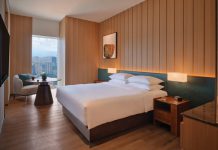
Rooms Various room types are on offer, from the smallest Moderate room at 15m2 to the largest Executive Double at 32m2. All are equipped with complimentary LAN and Wi-Fi access and a microwave, and most come with a washer/dryer. I imagine these amenities will be appreciated by frequent business travellers on lengthy assignments in the city.
The Residential Double where I spent three nights, came with a well-equipped kitchenette that allowed me to make quick meals when I finally got tired of dining out. At 25m2, the room, dressed in crisp white and comforting beige, felt more spacious than it really was, thanks to its smart layout.
The deep western-style bath was a welcome amenity in chilly springtime.
MICE facilities There are no function rooms at this hotel, but its facilities and stellar location make it a great option for business travellers or teambuilding/incentive groups keen on exploring Tokyo.
Other facilities I discovered an impressive daily breakfast spread with seasonal Japanese and popular Western dishes at The Stay Gold Ginza restaurant on the second floor. The 24-hour front desk can help guests dispatch and accept parcel delivery, and acquire dry-cleaning services. Hotel guests can also pick up a variety of complimentary products, such as bath salts and teabags, from a counter in the lobby to enhance their stay.
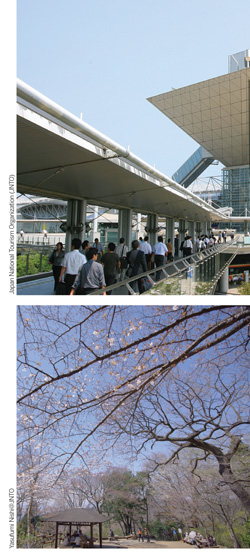
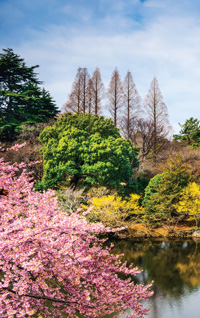
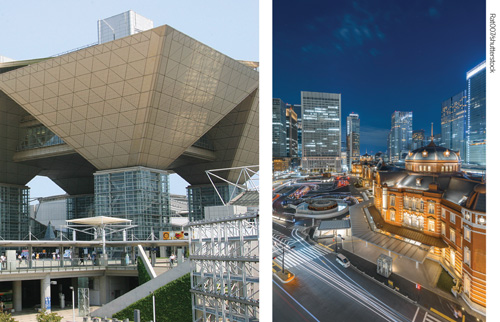
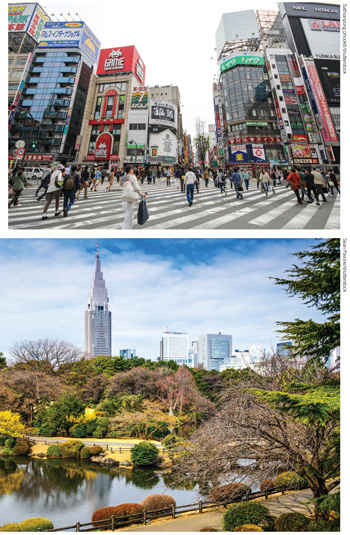
Tokyo offers a mix of modern architecture and scenic natural spaces; clockwise from above: Mount Takao, Tokyo Big Sight, Tokyo Station, Shinjuku and Shinjuku Gyoen National Garden
The 2020 Olympic Games hardware boost will make MICE players big winners when the event is over, writes Julian Ryall
With less than four years to go until the world’s largest sporting jamboree arrives in Tokyo, the city is making plans to ensure the 2020 Olympic Games is an efficient, attractive and unforgettable event. And business event players are delighted at the enhancements that are being planned as they know that once the show is over, they will be in prime position to take advantage.
“There will be a great deal of work done to the infrastructure of the city and the surrounding region, which will undoubtedly make life easier for MICE providers,” said Katsuaki Suzuki, executive director of the Japan Convention Bureau, the division of the Japan National Tourism Organisation tasked with developing the business events sector.
Among the new sporting facilities that are to be constructed, Suzuki pointed out a number are being designed to have dual uses after the Games, such as the 15,000-seat Ariake Arena where the volleyball competition will be held, and the new gymnastics stadium in the Ariake district of Tokyo, which will have seating for 12,000 people.
The Japanese government has also announced plans to enlarge both Haneda and Narita airports, adding runways and lifting annual arrival and departure slots by 79,000 flights a year by 2020. Meanwhile, the transport ministry is looking into ways to speed up immigration procedures.
Within Tokyo, a state-of-the-art terminal for long-distance buses opened in Shinjuku this April, while plans are also afoot for a new cruise terminal on Tokyo Bay.
The operator of the monorail that presently links Haneda airport with Hamamatsucho Station has announced that it will extend the line all the way to Tokyo Station.
“We believe the Games – and the run-up to the Games in Tokyo – will also help raise our profile as a destination for MICE,” remarked Suzuki. “We already have many conferences, exhibitions and so on, but we’re expecting more related to sporting themes as we get closer to 2020.”
An early promotion drive is planned for the Rio de Janeiro Olympic Games this summer, with Japan opening an online media centre providing easy access to detailed information on options in Tokyo over the next four years.
These broader developments mesh with a number of MICE-specific measures, Suzuki pointed out, such as the opening in early 2020 of a new 20,000m2 facility alongside the existing Pacific Convention Plaza Yokohama (commonly known as Pacifico Yokohama).
Similarly, the Japan Tourism Agency has started accepting applications for companies seeking financial support to use some of the city’s unique venues for events.
One of the locations being put forward under the programme is the Geihinkan State Guest House, which was until recently only open to the public on a limited number of days each year. Now, the venue can be used for private events, giving more people access to a building that is officially listed as a national treasure.
That’s exactly the sort of thing that would appeal to clients, according to Lucky Morimoto, president of Tokyo-based Event Services, Inc.
“Many of the firms that come to us do not want a generic location for their gala dinners or major events; they want something that is unique, traditionally Japanese and able to cater for up to 1,000 people,” explained Morimoto.
“Tokyo lacks something like that at the moment and I believe that if such a facility was built then it would be in great demand,” he added.
Morimoto believes that the new-found focus placed on Tokyo means that DMCs will “need to elevate their standards of service and their offerings”.
He said: “That is the main reason why I organised a group called The DMC Club, which meets once every two months to exchange information on unique venues or services that would be welcomed by our corporate event buyers.
“We do need to elevate our standards to be ready to welcome all the corporate buyers that we expect in the year of the Olympics.”
James Kent, sales and marketing manager for Tokyo-based The J Team DMC Co., also called for venues that have previously been declared off-limits to now be made accessible.
“I’m talking about temples, parks, special properties that today say they are not interested in hosting events, but need to realise that they have a very important role to play for the city,” he told TTGmice.
Unable to find a sufficiently large venue for one huge group recently, Kent’s company had to resort to using one of the exhibition halls at the Tokyo Big Sight convention centre for the gala dinner.
Management of the centre had never previously considered the space for such an event and it “was like watching a light bulb go on when they realised what was possible,” Kent added.
Another legacy that Kent hopes that the industry gains from the global spotlight in the lead up to and during the Games, will be that more DMCs attract a new influx of young people into their ranks. Too often, he said, event companies take on older workers seeking a “second life” job after they retire from another firm.
“One legacy that I hope we have beyond the Olympics is people looking at joining DMCs and looking at what they can achieve over the next 20 years rather than the five years until they finally stop working,” he said. “That would give the business a more sustainable boost.”
{Taking Numbers}
25 The number of years since Japan hosted the annual meeting
and general assembly of the International Association of Professional Congress Organisers. The event will be staged in Tokyo in 2018
355 The number of international association meetings held in Japan in 2015, a record annual high which places the nation seventh in the global rankings of host countries by ICCA
3,000 The size, in square metres, of the new TOC Gotanda Messe event space, which opened in January this year
{Developments to Watch}
In June 2014, the 52-storey Toranomon Hills skyscraper changed the profile of the previously rather unremarkable district sandwiched between the more desirable Azabu and Roppongi districts. The eye-catching tower has office space, 25 restaurants, conference facilities and the Andaz Tokyo, the first boutique hotel by Hyatt Corporation in Japan. By 2020, Mori Building Co. plans to open a further three new tower complexes with facilities designed to turn the district into Tokyo’s newest global business hub.
Toranomon Hills
Picture by Mori Building
With an eye on the growing outbound travel demand from the Muslim nations in South-east Asia, the Tokyo Muslim Travellers’ Guide was published in April 2016. The English-language pamphlet provides details of hotels and dining establishments that are especially accommodating to Muslim visitors, and will benefit both leisure travellers and corporate groups with Muslim delegates. The project is part of the broader omotenashi long-term vision for Tokyo, to roll out a warm welcome to all international visitors.
The Tama district of western Tokyo has emerged as a hot-spot for incentive groups. Even though it is within the metropolitan area and a mere hour from central Tokyo, the region has some of the best green spaces in Kanto. Top of that list is Mount Takao, which was designated as a three-star destination on France’s famous Michelin Green Guide to Japan. Hiking up Mount Takao makes an execellent teambuilding activity. Chair lifts and cable cars are available to make the journey much easier. Other attractions in the area include a tour of a sake brewery and soba noodle-making.
WHILE the number of events globally will continue to grow by a dramatic 75 per cent year-on-year, the average size of these events will shrink by half, predicted MCI Group COO for Asia-Pacific, Oscar Cerezales at the Singapore MICE Forum last week.
“There is nothing wrong with that because events are becoming more market- and niche-driven, (which has implications on) the traditional business model,” he added.
Speaking to TTGmice e-Weekly on the sidelines of the forum last Friday, Cerezales explained: “One of the reasons for the growth in smaller events is the diversity of people present in an event, (which makes it) hard to meet their exact needs.”
Attendance for each event has to be controlled in order for content to be “compelling” and “cohesive”, he continued.
Cerezales forecasted that associations, which traditionally hold events for up to thousands, will go on to do smaller events. He explained: “Associations need new revenue channels and they need to test new events. When you test, you will start small.”
In light of this trend which he said is “already happening”, he cautioned the industry to “be prepared with the right business model”.
Anticipating the rise of small events, he said: “There would perhaps be (the need) for more technology and more outsourcing, and for (organisers) to relook at services we are doing today that are not adding value.”
Located at Mumbai-Pune Expressway, Imagica is one of India’s leading theme park destinations, offering entertainment, dining and shopping under one roof. It comprises a theme park, a water park and a newly added snow park.
Concept Built at the cost of 11 billion rupees (US$) and using world-class technology, Imagica boasts some 21 attractions and rides, five themed restaurants and the country’s first theme park hotel, the Novotel Imagica Khapoli.
The latest draw is the Imagica Snow Park, said to be the largest of its kind in India, at 2,787m2. It brings visitors to winter wonderland with 100 per cent natural snow that is created at sub-zero temperatures.
MICE application Imagica is perfect for pre/post-meeting extensions for pleasure or teambuilding and incentive trips.
Event packages can be tailored according to group size and budget, and planners can utilise one or all of three banquet halls. The halls can accommodate 100 pax to 450 pax. Outdoor functions are possible too, complete with a stage and audio video setup.
A two- to three-hour teambuilding programme for 20 pax is also available. The programme promises to build team morale through unique and experiential learning activities that incorporate Imagica’s rides and attractions.
More event venues can be found within Novotel Imagica Khapoli, specifically four meeting rooms with capacity for 300 pax and a terrace that can be rented.
Service Imagica – in my opinion – is one of the best holiday destinations in India. My favourite is the waterpark, which is the best place to beat the heat. Plus, there are three restaurants to satisfy fussy diners. I recommend Sunbeatz where one can dig into oven-fresh pizzas.
Overall, I appreciate the convenience of adequate restrooms throughout Imagica, as well as well-placed information booths and guest relations counters at the entrance to assist visitors who are unfamiliar with the sprawling attraction.
Both the Pullman and Novotel hotels sit together in the hospitality district of New Delhi Aerocity, close to the international airport and the business hubs of Gurgaon and New Delhi. A station on the Delhi metro line is located a stone’s throw away.
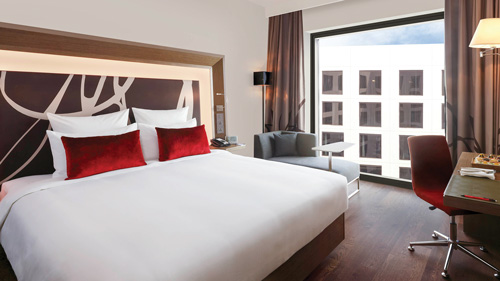
Rooms The hotel complex contains 670 rooms and suites. At the Pullman New Delhi Aerocity where I stayed, guestroom sizes begin from 36m2. My room came with modern amenities to make my stay a comfortable one. I was also offered a good view of the swimming pool. I like that the housekeeping staff was efficient and friendly.
MICE facilities Both hotels are well positioned to cater to business events, and boast one of Delhi National Capital Region’s largest convention spaces, spread over more than 3,716m2.
Pullman New Delhi Aerocity alone offers 17 meeting rooms, each with state-of-the-art technology and flexible seating. Here, the largest meeting room can take 1,500 pax. I love the peacock design theme that is employed in the ballrooms.
The property also provides an event manager to assist clients.
Sister hotel Novotel New Delhi Aerocity offers 11 meeting rooms and five boardrooms with flexible layouts. These are supported by a business centre. I find the chill-out space next to the meeting rooms a great idea, as it offered meeting delegates some privacy should they require it during coffee breaks.
Other facilities There is a total of five restaurants across both hotels, a spa, and heated and unheated swimming pools.
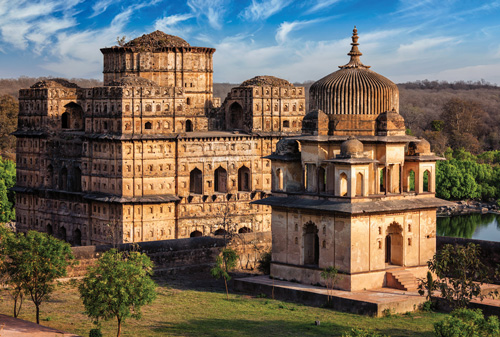
The state of Madhya Pradesh are among those that have shown interest in joining ICPB; the Orchha Palace in Madhya Pradesh pictured here Picture by f9photos/shutterstock
The Indian CVB has drawn up a lengthy to-do list that will see it boost its ability to market the destination, writes Rohit Kaul
The India Convention Promotion Bureau (ICPB) is undertaking a much welcomed major restructuring to allow it to better promote India as a preferred destination for international business events.
And the highlight of this exercise is ICPB’s new ability to bid for international association events.
ICPB had been battered in the past by Indian MICE players who were disappointed that the bureau was not involved in conference bids, unlike its more aggressive peers in other countries, causing India to lose out on business.
India’s Ministry of Tourism has now decided to offer financial support to ICPB for the bidding of international association events, but on one condition: the state tourism board has to contribute half of that monetary commitment.
Suman Billa, joint secretary with the Ministry of Tourism, Government of India, and chairman of ICPB, said: “We understand the importance of attracting international MICE events to the country. We will support states looking to host such events on a sharing basis (because) revenues generated through event hosting will largely benefit the states.”
Billa added that a “focused marketing strategy” will be employed to tap major source markets.
Chander Mansharamani, ICPB vice chairman, expects the entire process of restructuring to be completed in a year’s time.
“To begin, we are gathering information on conferences coming into Asia-Pacific that we can bid for. We are approaching the local chapter of international associations in India and telling them that we can support their bid for business events.”
ICPB is looking to set up chapters in different Indian states to raise awareness about the economic benefits of hosting an international business event. Each state chapter will have at least 10 members.
“We are initially targeting 11 or 12 Indian states with existing infrastructure for business events,” shared Mansharamani, who added that Maharashtra has become a member of ICPB while other states like Madhya Pradesh and Rajasthan have shown interest.
Detailing ICPB’s plans further, Mansharamani shared that the bureau aims to first break into ICCA’s top 20 global destination rankings and then improve on its position.
Commenting on ICPB’s new responsibility, Amaresh Tiwari, managing director of AT Seasons & Vacations Travel, said ICPB’s involvement in an event bid would “carry more weight than an individual entity” and pointed out that “most of the bids are won by (CVBs)”.
Going forward ICPB will organise roadshows in cities such as Geneva, Paris and Amsterdam where many global associations have headquaters, starting from this September. It will also participate in international MICE tradeshows such as IMEX America and AIME.
“Associations (in Europe and Australia) representing sectors like IT, science and medicine looking to organise their events in Asia-Pacific will be our target when we are ready to bid because India is a knowledge powerhouse in these fields,” shared Mansharamani.
Trade partnerships also feature strongly in ICPB’s restructure. It is working closely with major Indian industry bodies like the Federation of Indian Chambers of Commerce and Industry (FICCI) to organise events that highlight the importance of MICE in the pursuit of tourism industry growth. The Ministry of Tourism and FICCI co-organised the inaugural Global MICE Travel Mart in New Delhi recently.
Soon to come in the third quarter is a new planner, published by ICPB, to highlight the various MICE venues across the country.
Local tourism players are eager to share suggestions on what ICPB needs to do in order to achieve its goal sooner.
Saurabh Bhargava, associate vice president-sales, North India with Taj Hotels & Resorts, opined that besides shouting about India’s MICE hardware, destination maketing must also “spread the message that India is about experiences”.
“We also need to move beyond the famed Golden Triangle (of Dehli, Agra and Jaipur) and promote India as a 365-day destination,” he urged.
Ananya Sinha, director, sales & marketing with JW Marrriott New Delhi Aerocity, added that the general perception of India held by international markets must also be corrected.
Sinha explained: “There is still a perception internationally that India is a land of snake charmers. We need to dispel such notions. If we are able to bring a major global sporting event into India, it will help spread a positive message about our country.”
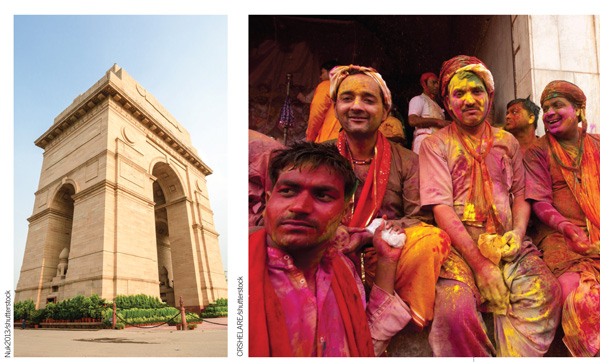
India’s historical architecture and rich culture can add a unique touch to business events; India Gate war memorial and revellers during the Holi festival of colours pictured here
{Taking Numbers}
31 India’s position in ICCA’s 2015 ranking of countries for global association meetings. It rose from its 35th position in 2014
30,000 The total exhibition area, in square metres, available for use at the new Jaipur Exhibition & Convention Centre
40,000 The attendance at IMTEX 2016, a flagship event for the Indian metal cutting industry that draws a global audience. It is one of the largest events to be held at Bangalore International Exhibition Centre
{Developments to Watch}
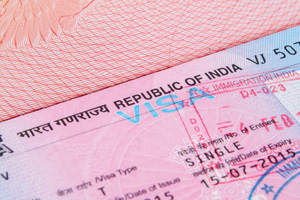
India’s current tough stance on visas for conference delegates will soon be a thing of the past, as the Ministry of Tourism has put forth a proposal to the home ministry to include conferences in the list of travel segments that can utilise the e-visa facility. An announcement in this regard is expected in the near future.
India-US relations are rosy today, thanks to the Indian prime minister’s frequent visits to the US in recent times – prime minister Narendra Modi has called at the US four times since assuming office in May 2014. Apart from strengthening defence ties, such visits are expected to boost US investments in India, which will herald good business for inbound tourism and events from the US.
Work on the new convention and exhibition centre near the Indira Gandhi International Airport in New Delhi is finally making progress. The project was delayed by the reluctance of the Delhi Development Authority (DDA) to transfer land directly to the body responsible for putting the project out to tender. This has changed, with DDA agreeing last year to transfer 100 hectares for the project. The entire complex will comprise of more than the convention and exhibition centre; it will have 3,500 hotel rooms and an entertainment arena that can host a large-scale concerts.
Pan Pacific Hotels Group wants to make a name for itself in the MICE arena with a promise of flexibility and ease in getting things done as well as strengthening a property portfolio. The group’s senior vice-president, sales and revenue performance shares details with Karen Yue
PPHG has properties that are events-ready but why are we not hearing enough from the group about its MICE prowess? Is this set to change?
Exceptional Meetings was introduced this March as part of our strategy to drive MICE business in recognition of its potential contribution to total RevPAR.
While we have properties in key MICE destinations such as Singapore, Kuala Lumpur and Sydney, location alone is not sufficient to land the MICE pie on our plate. In this competitive environment, it is critical for us to understand and effectively meet the needs of planners.
Our MICE strategy revolves around an offer which is backed by our PPHG promise for meetings and events. Through this promise, we demonstrate to our customers the ease of working with PPHG because we can provide flexibility and customisation to the last detail, from the point of enquiry to the site inspection and final billing. We offer an extensive menu with items which planners can pick to create their own personalised package, and that allows us to provide value across a spectrum of needs.
How will these efforts stand out from what other international hotel chains are already doing to attract MICE clients?
Our hotels have creative ideas to enhance the meeting experience, such as providing a wide selection of benefits including themed coffee breaks. We have seen a positive response since the launch of Exceptional Meetings and riding on this success, we will roll out the second phase for bookings from July 1 to September 30 this year for events held till mid-2017.
Of all your properties, which would you say are the strongest for MICE and why?
Pan Pacific Singapore has close to 2,500m2 of function space and can accommodate up to 800 guests, theatre-style, at its Pacific Ballroom. With 27 meeting rooms, it is also ideal for smaller meetings.
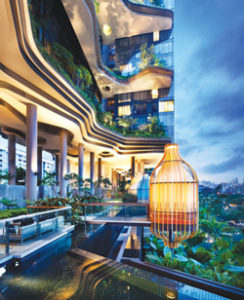
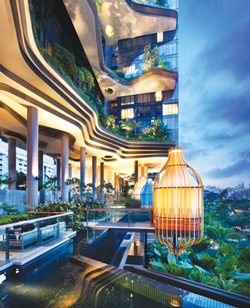
Parkroyal on Pickering is a multiple award-winning green hotel known for its iconic architecture, and has done very well with business meetings. Being named the Business Event Venue of the Year – at the Singapore Experience Awards 2015 – is testament to the team’s ability to deliver distinctive experiences using versatile venues such as the poolside terrace on level five, which I say is perfect for elegant cocktail receptions!
Then there is Parkroyal on Beach Road. Not many people know that we invested S$20 million (US$14.8 million) to build The Ballrooms adjacent to the hotel. Besides being connected to the hotel via a skywalk, The Ballrooms has direct street access and its own dedicated driveway, which lends an exclusive and elevated sense of arrival for VIP events. Built for flexibility, the Grand Ballroom and Sky Ballroom can be divided into six smaller venues for events.
Are there any hidden treasures in your collection that would work splendidly for business events but aren’t getting enough attention from planners?
Pan Pacific Perth and Pan Pacific Suzhou are two understated gems in our fold. A little known fact about Pan Pacific Perth, which sits on the spectacular Swan River, is how spacious its meeting facilities are – the hotel offers almost 2,600m2 which makes it ideal for large conferences.
Pan Pacific Suzhou’s meeting facilities were refurbished recently and now features a dedicated driveway and foyer to the meeting rooms. Set against a backdrop of traditional gardens, the tranquil sanctuary of our hotel makes it perfect for corporate retreats. With 16 meeting rooms spread across almost 2,000m2, it is a great alternative to hotels in Shanghai, which is a mere hour’s drive away.
Does PPHG study how venue usage has evolved before designing the meeting spaces in properties that it owns and manages?
Hotel infrastructure is critical in the bid for event business, and properties are developed with the specific needs of the area in mind.
We research the market thoroughly and take into consideration present and future needs when designing new properties.
Pan Pacific London, for instance, is in Bishopsgate, London’s central financial district, and is ideally located to meet the need for both short- and long-term accommodation with its hotel and serviced apartments. Hotels in London also tend to have smaller function spaces, so Pan Pacific London will (plug the gap by) offering spacious meeting facilities. We have received plenty of interest and enquiries from clients although Pan Pacific London will debut only in 2019.
PPHG has several new hotels coming up over the next few years. Tell me more about them.
Sofitel Plaza Hanoi will be rebranded to Pan Pacific Hanoi this October after refurbishments to its lobby, lobby bar, all-day dining restaurant and meeting spaces – all 1,300m2 of it – are done.
We will also debut the Pan Pacific brand in Myanmar next year with the opening of Pan Pacific Yangon, which features six flexible meeting rooms and a seven metre-high pillarless ballroom which spans almost 600m2.
Also in the pipeline are Parkroyal Resort Langkawi in 2018 and Parkroyal Melbourne in 2019.
Located on Pantai Tengah, the longest and most popular stretch of beach in Langkawi, Parkroyal Resort Langkawi will appeal to meeting planners with its luxury resort setting complemented by a 680m2ballroom and seven meeting rooms. Parkroyal Melbourne will sit within a 37-storey hotel and apartment complex in the Digital Harbour Precinct of Melbourne Docklands, which is part of an ongoing project to rejuvenate the central business district.
These brand-defining properties will showcase the quality of our products and enhance PPHG’s visibility as a hotel group, which in turn strengthens our MICE proposition.
Parkroyal on Pickering has won awards for its architecture and business event capabilities
The newly-opened Ritz-Carlton, Bangkok anchors the One Bangkok development with cosmopolitan elegance. Featuring the city's largest ballroom and a spectacular new penthouse suite, it delivers exceptional hardware and deeply authentic, soulful service for business and leisure travellers alike
Behind the imposing, Brutalist concrete that defines Zurich’s Oerlikon district lies a surprising secret. While its exterior honours the neighbourhood’s industrial roots, stepping inside Mama Shelter reveals a vibrant, neon-soaked world that is a far cry from its rigid shell
A polished urban retreat designed for business travellers, Hyatt Regency Kuala Lumpur at KL Midtown combines thoughtful design, seamless service, and exceptional facilities.







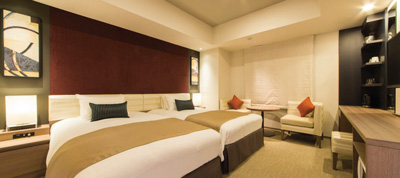

 Ginza is a well-furnished yet affordable hotel in the posh Ginza retail, entertainment and business district. It scores high marks in my books for providing basic comforts and its excellent location – mere minutes on foot from both Ginza Station and Higashi-Ginza Station, and within easy walking distance of landmark attractions such as Kabuki-za Theatre and Tsukiji Fish Market.
 seating for 12,000 people.

 I
I
 With an eye on the growing outbound travel demand from the Muslim nations in South-east Asia, the Tokyo Muslim Travellers’ Guide was published in April 2016. The English-language pamphlet provides details of hotels and dining establishments that are especially accommodating to Muslim visitors, and will benefit both leisure travellers and corporate groups with Muslim delegates. The project is part of the broader omotenashi long-term vision for Tokyo, to roll out a warm welcome to all international visitors.
 The Tama district of western Tokyo has emerged as a hot-spot for incentive groups. Even though it is within the metropolitan area and a mere hour from central Tokyo, the region has some of the best green spaces in Kanto. Top of that list is Mount Takao, which was designated as a three-star destination on France’s famous Michelin Green Guide to Japan. Hiking up Mount Takao makes an execellent teambuilding activity. Chair lifts and cable cars are available to make the journey much easier. Other attractions in the area include a tour of a sake brewery and soba noodle-making.



 Novotel hotels sit together in the hospitality district of New Delhi Aerocity, close to the international airport and the business hubs of Gurgaon and New Delhi. A station on the Delhi metro line is located a stone’s throw away.
 PPHG has properties that are events-ready but why are we not hearing enough from the group about its MICE prowess? Is this set to change?