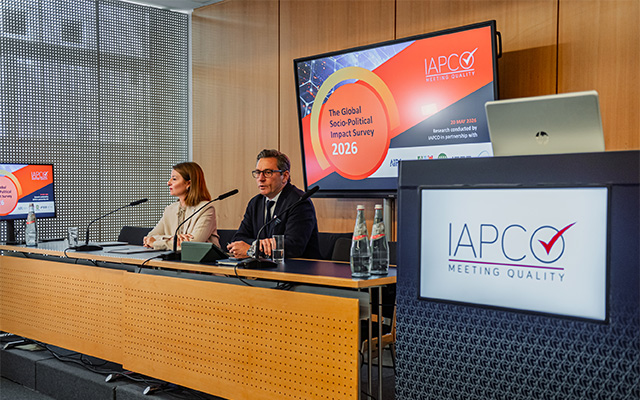
Global conflict and socio-political instability have surged from background concerns to major operational disruptors for the international business events industry, according to the recently-released 2026 Global Socio-Political Impact Survey by the International Association of Professional Congress Organisers (IAPCO).
The report, unveiled at IMEX Frankfurt, revealed that 73.8% of respondents have seen their ability to plan or host international meetings impacted by global conflicts; a sharp rise from 53.9% in 2025.
The study, conducted with five industry bodies including AIPC, ICCA, and PCMA, surveyed 130 global organisations. It tracks a steep year-on-year increase across all major disruption metrics, with travel disruptions for clients and delegates jumping to 65.4% (up from 41.7% in 2025), and 58.5% of respondents now reporting reduced international attendance. Almost half reported increased costs to their teams, and 48.5% said costs had increased for clients and/or participants.
The fallout is shifting where and how events take place. More than 42% of respondents reported actively moving events away from areas perceived as politically or regionally unstable, while 33.1% have frequently or occasionally cancelled, postponed, or relocated events due to safety concerns.
The research also highlighted the escalating drag of government legislation. Nearly 60% of respondents stated that US policies enacted over the past two years are actively disrupting event execution through 2028. Key policy hurdles include visa and immigration logjams, alongside deep funding cuts restricting travel for academic and scientific experts.
Geopolitical instability is no longer a peripheral challenge for the sector, said IAPCO’s president Sissi Lignou. “Conferences and meetings are where knowledge is shared, research is advanced, relationships are built and industries move forward. These findings show that global socio-political instability is now directly affecting essential knowledge exchange.”
The impact is already being felt across the event lifecycle: 33.1% of respondents said they had frequently or occasionally had to cancel, postpone or relocate events, or withdraw planned participation due to safety concerns or regional instability. A further 42.3% reported a shift away from destinations perceived as politically or regionally unstable, with respondents avoiding conflict-prone regions.
The survey also highlights the growing influence of government policy on future event planning. Around 59.3% of respondents said US government policies enacted in 2025 and 2026 had affected their ability to plan and execute events for 2026, 2027 and 2028. Funding cuts affecting academic and scientific experts’ ability to travel, alongside visa and immigration policies affecting international participants, staff and speakers, were identified as the most significant policy-related challenges.
IAPCO’s CEO Martin Boyle noted: “The global meetings industry exists to bring people together around issues that matter: science, medicine, education, business, policy and progress. When conflict, policy and instability restrict participation, the impact reaches far beyond individual events. It affects research visibility, the exchange of ideas, and the ability of communities and industries to progress collectively.”