Since launching in 2022, Cathay’s Corporate Sustainable Aviation Fuel (SAF) Programme has achieved substantial growth and is becoming one of the biggest initiatives of its kind globally, marked by new global partnerships and a record commitment to SAF usage.
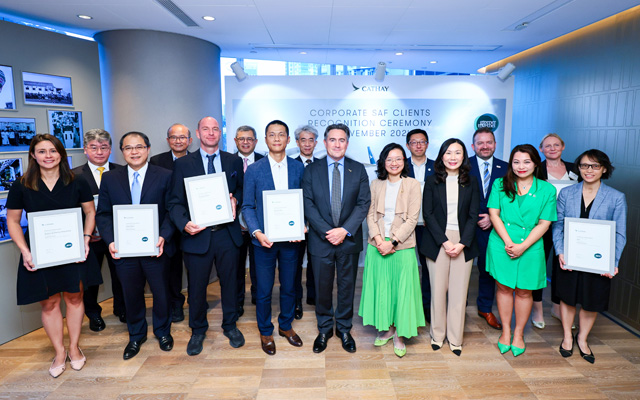
The Corporate SAF Programme has introduced a tiered structure, allowing customers to participate based on their SAF demand and business needs. It has the support of 15 corporate partners, with DB Schenker being the biggest contributor to the programme to date while Kuehne+Nagel is a Diamond partner; EQT, a Gold partner; Julius Baer and Lenton Group are Silver partners.
Notably, this year has seen multi-year commitments from partners as they view SAF as a long-term solution to their decarbonisation journey, reinforcing Cathay’s 2030 SAF target.
Cathay also recognises the continued commitment of some of its longstanding partners, including Airport Authority Hong Kong, AIA, Dimerco Express Group, Kintetsu World Express, Standard Chartered Bank, Swire Pacific, Yusen Logistics, and the Business Environment Council. This diverse partnership base reflects a strong commitment to reducing the climate impact from both business travel and airfreight services, and across different sectors in our community.
Programme partners in 2024 have committed to using 2,650 tonnes of SAF – equivalent to a reduction of approximately 8,060 tonnes of carbon emissions, three times the reduction achieved last year.
SAF remains the most crucial lever for decarbonising airline operations before alternatively powered aircraft can be widely deployed in commercial operations. Compared to conventional jet fuel, SAF can reduce over 80 per cent of carbon emissions on a lifecycle basis, depending on the SAF technology and feedstock used.
Cathay Pacific was among the first airlines in the world and the first in Asia to announce a target of 10 per cent SAF for its total fuel use by 2030. Since then, the airline has successfully conducted SAF uplifts at both Hong Kong International Airport and other airports overseas.
In addition to scaling up SAF adoption, Cathay also relies on fleet modernisation, operational efficiency improvements, leveraging on emerging technology breakthroughs to decarbonise aviation, and high-quality carbon offsets and removals to achieve the long-term net-zero carbon emissions goal by 2050.