As global volatility rises and international crises reshape the landscape, event organisers are reprioritising their strategies, placing a premium on rigorous contingency planning and increasingly looking to Asia for long-term stability.
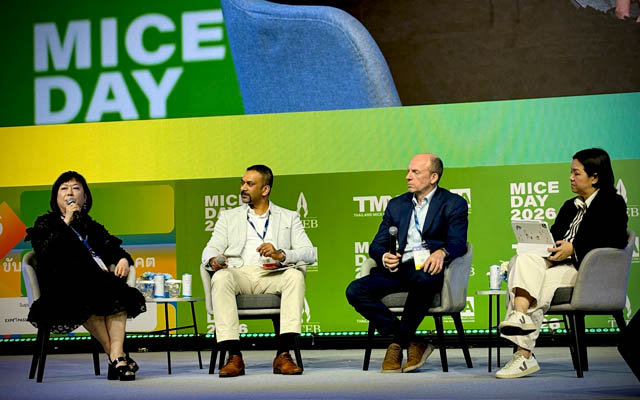
This topic took centrestage during the recent MICE Day panel, The Future of MICE: Global Trends & Leadership Insights. Hosted by the Thailand Convention and Exhibition Bureau (TCEB) at Bangkok’s Queen Sirikit National Convention Center and moderated by Jaruwan Suwannasat, senior vice president of TCEB, the session brought into focus how leadership is navigating these immediate global impacts.
Ian Roberts, senior vice president Asia, at Informa Markets – which operates over 70 tradeshows – noted that current disruptions in the Middle East have forced organisers into a familiar, pandemic-era pivot.
“It’s similar to Covid. What we’ve done for our April and May shows is moved them to the back end of the year. We’re also seeing a lot of cancelled shows,” Roberts explained, citing compounding challenges like higher costs, inflation, and logistical bottlenecks.
Consequently, crisis management is no longer an afterthought.
Enid Low, chief strategy officer at AsiaWorld-Expo in Hong Kong, revealed that venues are now actively stepping in to help organisers design robust contingency plans.
“It’s not easy for an organiser to plan an event ahead in a crisis zone. As a venue partner, we always try to think about how we can accommodate the organiser to relocate events. Asia has become the first priority for contingency plans,” Low said.
While global disruptions pose immense logistical hurdles, they have simultaneously accelerated Asia’s rise as a reliable business events destination.
“We’re seeing multiple crises all at once; you really have to think out of the box,” observed Prakash Ramajillu, general manager at Koelnmesse.
He added: “It was a very strategic decision to enter Asia when we did, and now South-east Asia is becoming an anchor. We don’t need to expand everywhere; we just need to be more relevant in the places we are right now.”
Roberts echoed this sentiment, highlighting South-east Asia geopolitical position as a “friend to all countries”, making it an attractive stage for global players from the US, China, India, and Europe.
“We bounced back straight after Covid in this part of the world. South-east Asia certainly, but also Hong Kong, China, the rest of Asia, is really in demand at the moment,” he said.
However, capitalising on this influx requires strong local ecosystems. When asked by Suwannasat about the role of government support in making business events a good long-term investment, Roberts was candid.
He noted that while organisers consistently ask for more funding and cheaper rent, the ultimate goal is delivering events that are sustainable in the long run. He lauded the proactive backing from regional authorities, specifically pointing out that destinations like Hong Kong and Thailand are leading by example with exceptional government support.
Ultimately, the panel agreed that the region should not just serve as a backup plan.
“Nowadays, Asia is quite different. Asia has become a major market for MICE events, and we already have a lot of good venues. But the most important thing is that we (continue to be) efficient and stable,” Low emphasised.
“In the long run, we are not just talking about short-term substitutions. We want organisers to develop their events in Asia, especially in Thailand and Hong Kong,” she concluded.