China’s younger corporate procurement leaders are evaluating event proposals on business outcomes rather than off-the-shelf venue packages and standard sightseeing.
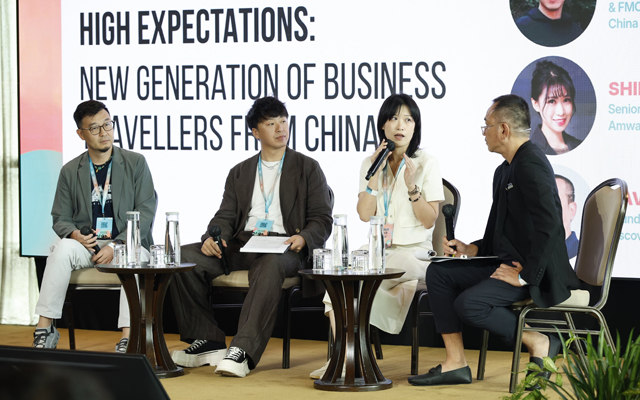
Panellists at the Thailand Innovative Meetings Exchange (TIME) 2026 session Young and Rich with High Expectations: The New Generation of Business Travellers from China urged suppliers to shift from service vendors to solution partners who build proposals around a client’s internal KPIs.
Quincy Luo, director of the direct selling and FMCG account department at China CYTS M.I.C.E. (Shanghai) Service, said: “To win deals with the new generation of corporate buyers, suppliers must change their starting approach. Many Thai suppliers lead with the hotel and the food package straight away, and that misses the point. These decision-makers are judged on internal KPIs – whether the trip motivates staff or builds the team – and they need material for their internal reports.”
“Do not show your product first. Ask targeted questions that uncover the client’s internal performance metrics and business objectives, then build the proposal around those goals. We are not merely selling travel, we are solving internal corporate challenges,” Luo advised.
Shirley Chen, senior special events supervisor at Amway China, offered her company’s recent Bangkok seminar as a case in point. The event brought more than 12,000 Amway Business Owners from mainland China to Bangkok in 10 waves between March and April 2026, generating an estimated 858 million baht (US$26.1 million) in direct revenue for Thailand.
“Corporate delegates want meaningful experiences that they can shape around their people, rather than standard sightseeing,” Chen said.
Beyond flexible daytime activities such as luxury spa sessions and Muay Thai, Chen cited securing private, after-hours access to the Grand Palace for a group of 1,000 delegates as a destination highlight.
Local transport and dining were also restructured into experience components. Amway ferried delegates in a custom-branded fleet of electric tuk tuks fitted with illuminated Amway LED logos, aligning the operation with the company’s environmental goals.
“We did not serve lunch and dinner, because Bangkok has so many good restaurants, and we wanted delegates to find their own food,” Chen said. “The tuk-tuk shuttle took them to the night markets, and everyone was excited to take local transport to eat local food.”
The buyer relationship is also changing shape. Luo noted that younger Chinese buyers increasingly approach destinations and hotels directly rather than routing everything through a Chinese business events planner, researching options before opening a formal request for information.
“The younger buyers do much of the research themselves, so suppliers have to be ready. Put China-focused staff or a bidding specialist on the account, and have your Chinese-language material prepared to answer every question,” advised Luo.
Eric Zhu, the Thailand Convention and Exhibition Bureau’s representative in China, said Thai suppliers led on venue quality and value but faced sharpening competition from Korea and Bali for the same high-value Chinese groups.
“Thailand has all-round advantages, from venues and MICE facilities to service and food, and suppliers need more confidence to tell that story when a client compares us with another country,” Zhu said. “Try to focus more on social media where your future business partners are, because they’re spending a lot of time on social media.”
The traffic runs both ways. Amway showcased the seminar to the public itself, publishing 28 video clips across its corporate WeChat channels to amplify the event.
“From the buyer side, those clips are a quick way to see what a corporate wants its participants to experience, and what it wants to show the public from an event like this,” Chen stated.