ICTM 2025 will be a fabulous cultural event for Wellington and a historical undertaking for New Zealand
Te Whanganui a Tara Wellington will welcome music and dance scholars from around the globe in 2025, as the World Conference of the International Council for Traditional Music (ICTM) comes to New Zealand for the first time.
The conference will take place at Tākina Wellington Convention & Exhibition Centre in January 2025 and is expected to attract at least 800 delegates to the city for a programme of scholarly papers, workshops and concerts. Conference themes will include a focus on Indigenous music and dance.
ICTM 2025 will be a fabulous cultural event for Wellington and a historical undertaking for New Zealand
The conference bid was led by Brian Diettrich, senior lecturer in Ethnomusicology at the New Zealand School of Music, of Te Herenga Waka – Victoria University of Wellington, with support from Business Events Wellington and Tourism New Zealand.
Diettrich, who is also an executive board member of ICTM and a member of the Wellington Advocate Network, will be the local arrangements chair for ICTM 2025.
Business Events Wellington’s manager Irette Ferreira said: “Partnering with Victoria University is crucial to our strategy in attracting conferences, especially conferences that align with the city’s reputation and strength as New Zealand’s vibrant cultural capital.
“This conference, taking place in January 2025, is also a great example of business events boosting the city’s hospitality sector during what would traditionally be its off-peak season.”
New Zealand’s capital was announced as the host of the 48th ICTM World Conference in 2025 at the 47th World Conference held in Ghana last month.
FIFA aims to further boost the sport, and ensure the tournament inspires a new generation of female footballers, and empowers a new generation of leaders.
Sydney has secured the second edition of the FIFA Women’s Football Convention from August 18-19, 2023, to conclude the FIFA Women’s World Cup 2023 which ends with the final in Sydney.
Held at the International Convention Centre Sydney, the FIFA Women’s Football Convention will host 1,000 delegates over two days in Sydney with an estimate value to the NSW economy of A$1.2 million (US$775,444). This Convention follows the inaugural edition in France in 2019.
FIFA aims to further boost the sport, and ensure the tournament inspires a new generation of female footballers, and empowers a new generation of leaders.
FIFA has invited 211 member associations, as well as key global stakeholders, to attend the second Women’s Football Convention, the inaugural event held in 2019. The focus of the Convention will centre around the development of the women’s game, the social benefits of football for women and girls, and the positive impact it can have on female empowerment.
The event will host a variety of international speakers who are influential and successful in their field, chosen because they are playing their part in giving women and girls the chance to fulfil their potential – whether that be in football, sport or society.
BESydney CEO Lyn Lewis-Smith said: “While the FIFA Women’s World Cup has been an incredible event to entertain global audiences and showcase women’s sporting excellence, the FIFA Women’s Football Convention 2023 in Sydney is where advances in the business and the human sides of the world game will be made, creating a legacy to embrace, educate and empower women around the world through football. It also provides Sydney with the opportunity to promote and profile NSW’s sporting excellence and capabilities in hosting the FIFA Women’s World Cup 2023 and the FIFA Women’s Football Convention.”
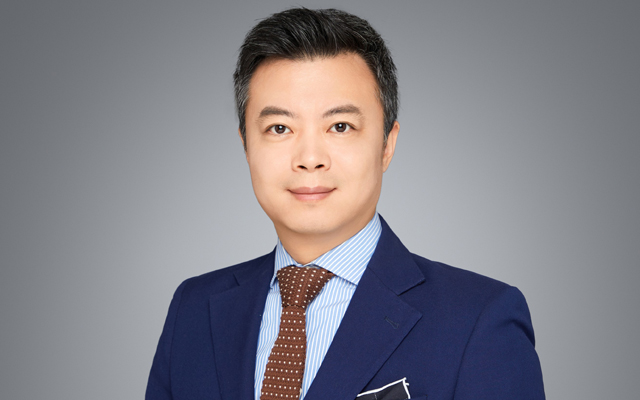
Global business travel management company FCM has appointed Kevin Yang Wen Xuan as China’s commercial director.
Yang has nearly 10 years of experience in the industry and has held several business development positions. He has a deep understanding of the ecology of China’s travel industry. Before joining FCM, Yang worked for Ctrip Business Travel as the East China regional director of the customer success department.
Yang previously served as the sales director of FCM China from 2017 to 2019.
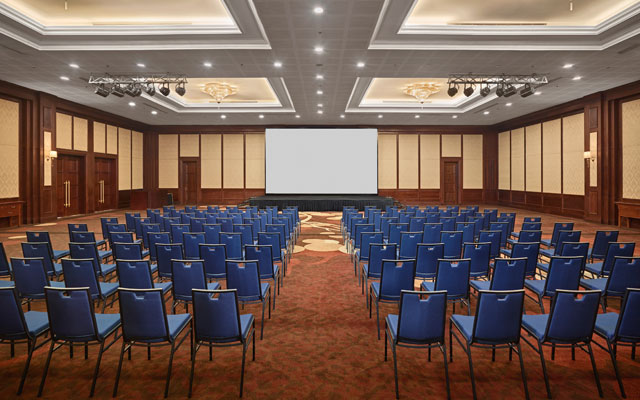
Danang Marriott Resort & Spa's Grand Ballroom in theatre setup
Danang Marriott Resort & Spa is inviting meeting planners to create unforgettable get-togethers on the shores of Vietnam’s central coast.
Their recently-launched Spark This Moment package includes one complimentary room night for every 20 room nights booked, a 60-minute welcome reception with free-flow soft drinks or local beer, and double Marriott Bonvoy points.
Danang Marriott Resort & Spa’s Grand Ballroom in theatre setup
This promotion is valid for bookings made until September 30, 2023, where events must be hosted before December 31, 2023.
Danang Marriott Resort & Spa offers event planners a choice of six indoor spaces and 1,055m2 of flexible function space. Venues include a 741m2 pillarfree Grand Ballroom for up to 500 delegates, which can be divided into two spaces. There are also several function rooms that can cater to events of between 10 and 60 guests.
The beachfront property also offers several outdoor spaces for teambuilding activities and social gatherings.
Collinson has named Rishi Kapoor as chief transformation officer, who joins the company from British Airways.
Based in London, his appointment will strengthen Collinson’s transformation capability, with responsibility for driving a cohesive approach to overall business change, including supporting on existing transformation programmes across product, data and technology.
He has over twenty-five years’ experience of leading business transformation teams, and recently concluded a four-year secondment at the oneworld Alliance as chief transformation officer.
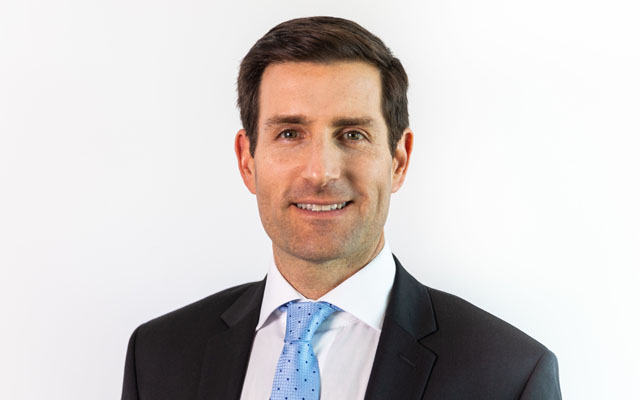
Oceania Cruises has appointed Jason Worth to the newly-created role of vice president, international sales.
Worth, currently vice president, sales & general manager, Asia Pacific, will assume the role with immediate effect, and will oversee sales teams in the UK, Europe, Latin America and Brazil, as well as Asia-Pacific.
He has held various positions with the company since joining in 2011, including vice president, sales, Australia & New Zealand, Oceania Cruises, from 2019 through to 2022, and vice president, finance & accounting – Asia Pacific at Norwegian Cruise Line Holdings.
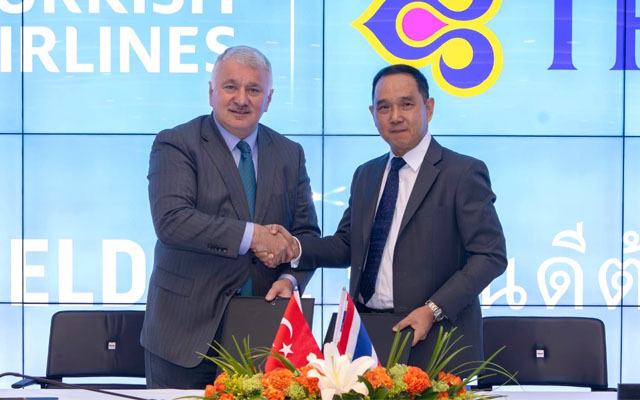
From left: Turkish Airlines' Bilal Ekşi; and THAI's Chai Eamsiri
Thai Airways International Public Company (THAI) and Turkish Airlines have signed a memorandum of understanding to move towards a joint venture operations agreement between the two airlines in Istanbul.
The collaboration will enhance connectivity between the two regions as well as provide seamless travel experiences to passengers of THAI and Turkish Airlines.
From left: Turkish Airlines’ Bilal Ekşi; and THAI’s Chai Eamsiri
THAI will introduce daily services to Istanbul from its hub of Bangkok in December.
With the extensive networks offered by both carriers, passengers can then travel between Thailand and Turkey as well as on to Europe and other points in Asia.
Marked as one of Indonesia’s five Super Priority Destinations, Labuan Bajo, has already established itself as a leisure hotspot, but it is working towards positioning itself as an ideal destination for business events as well.
Located in East Nusa Tenggara, the harbour city stepped confidently into the limelight when it recently played host to the ASEAN Summit, a gathering of heads of state from member countries earlier in May.
Labuan Bajo successfully hosted the ASEAN Summit in May
Wiwin Kurniawan, director of marketing and operations at Pacto Convex, expressed that while there were some limitations when considering Labuan Bajo as an events destination, the successful hosting of the Summit demonstrated the city’s ability as a prime business events hub.
One such limitation was the lack of accommodations and meeting spaces suited for large-scale or high-profile events.
According to data from the Ministry of Tourism and Creative Economy, Labuan Bajo currently has 38 hotels offering over 1,500 rooms. Among these properties, only five are classified as upscale accommodations, such as the Ayana Komodo Waecicu Beach Hotel, Meruorah Komodo Labuan Bajo, and Plataran Komodo Resort & Spa.
For the 145-key Meruorah Komodo Labuan Bajo and 205-key Ayana Komodo Waecicu Beach Hotel, hosting national and international business events is not new.
Rizal Kasim, president director of Hotel Indonesia Group, the holding company of Meruorah Komodo Labuan Bajo, stated: “In fact, Meruorah was purposefully designed to target business events. Our meeting facilities are currently the largest on the island. Since its launch in 2019, we have successfully hosted several national and international events, including last year’s G20 meetings.”
The hotel ballroom can accommodate up to 375 people theatre-style and be further divided into three meeting rooms.
Golo Mori Convention Centre is ready to host business events (Photo by HIG)
Christian Hoechtl, general manager of Ayana Hospitality Group as well as Ayana Midplaza Jakarta, said: “MICE bookings accounted for 35 per cent of Ayana’s revenue in 2019. For 2023, MICE business has contributed 25 per cent thus far, and we are optimistic that our participation in this year’s ASEAN Summit will significantly boost revenue.”
Ayana Komodo Waecicu Beach Hotel’s function spaces include a ballroom with up to 220 people for reception and sits 150 theatre-style, as well as five breakout rooms amnd several outdoor venues.
Hochtl added that the Summit will enhance the promotion of local tourist destinations and domestic industries, showcasing Indonesia’s competitive advantage.
In a boost to Labuan Bajo’s event capability beyond five-star hotels’ ballrooms and venues, the Golo Mori Convention Centre (GMCC) was recently completed.
A standalone facility, GMCC is located a 30-minute drive away from the city centre on a 26-km long newly built road. The venue features an amphitheatre with a capacity of up to 1,500 people, a convention centre that can accommodate up to 500 people, and several boardrooms.
Ari Respati, president director of the Indonesia Tourism Development Corporation, also revealed plans for an integrated resort complex spanning 200 hectares around GMCC. A beach club and small dock have already been built, while several hotels and attractions are in the pipeline.
Rizal also pointed out that Labuan Bajo has several upscale hotels currently under development, and are set to come online this year and next.
As such, Pacto’s Wiwin is immensely confident in Labuan Bajo’s business events potential, because aside from having suitable business events spaces, the area’s natural beauty is something that would appeal to many.
She stated: “Labuan Bajo has stunning and alluring natural surroundings, which will captivate visitors from the moment they step off the plane. Although the destination may not be suitable for large conventions due to current facility limitations, it will appeal to small and medium-sized corporate meetings and incentives.”
Possible additions to corporate itineraries include island hopping, sunset cruising, one-day trips to Komodo Island, diving, and enjoying the scenic views from Puncak Waringin Peak.
Terence Lee, general manager of Meruorah Komodo Labuan Bajo, agreed: “Labuan Bajo is good for combining meetings and incentives. You arrive in Labuan Bajo for meetings (on the first day), then go island hopping on the second and third days.”
Wiwin further pointed out that as demand for business events increases, investors will be keen to explore the further development of facilities and equipment, thereby reducing logistical costs.
To sustain the momentum of high demand for both leisure and business events, Lee expects an increase in seat capacity to the Labuan Bajo, which could lead to the expansion of Komodo Airport.
Currently, the airport is equipped with a 2,650m-long runway capable of accommodating A320 and B738 aircraft.
Hochtl is also optimistic, sharing that the government’s plans to establish Labuan Bajo as an international hub in the near future will further solidify the region’s position as a preferred business events destination.
With enhanced infrastructure and convenient access to Komodo National Park, Labuan Bajo would attract event planners seeking new and different experiences for their meetings and incentive travel, he said.
The Workshop Agreement (WA) 4 Sustainable MICE – Guidelines for carbon emissions management was launched by SACEOS (Singapore Association of Convention & Exhibition Organisers & Suppliers) and the Singapore Standards Council (SSC; overseen by Enterprise Singapore), at the Singapore MICE Forum (SMF) at Sands Expo & Convention on July 27.
This set of standards will support the Singapore MICE Sustainability Roadmap and the Singapore Green Plan 2030 by providing guidelines for the industry to better manage its carbon emissions.
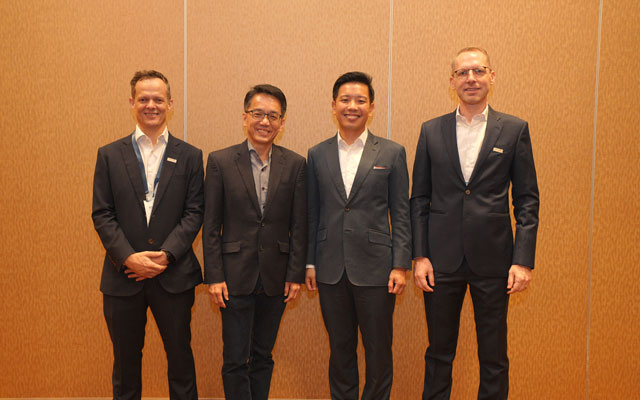
From left: SACEOS’ Richard Ireland; NTUC LearningHub’s Jeremy Ong; Singapore minister of state for trade and industry and culture, community and youth, Alvin Tan; and SACEOS’ Mathias Kuepper
WA 4 covers guidelines and best practices for the measurement, reduction, calculation, verification and offset of carbon emissions for business events. It also provides an emissions-reporting template for reference.
Yap Chin Siang, deputy chief executive of STB, said: “The launch of the new guidelines for carbon management is a critical step in our collective effort with SACEOS to raise sustainability standards across the MICE industry and reinforces STB’s commitment in working with the industry to build a more sustainable tourism sector.”
SACEOS will be running its first MICE Carbon Management Guidelines workshop based on WA 4 in the coming months. The workshop will promote awareness and provide guidance to reduce carbon footprint by each stakeholder.
WA 4 also complements the WA 3 – Guidelines for waste management, which provides guidance and best practices to the industry in reducing waste at business events.
To showcase and drive innovation in sustainability within the business events sector, SMF also featured the inaugural MICE Sustainability Innovation Marketplace. The Marketplace explored various solutions to improve the sustainability performance of organisations, as well as innovative ways to host sustainable events. Attendees discovered solutions in leveraging data and analytics, robotics, energy optimisation, sustainable materials and food & beverage from the Marketplace.
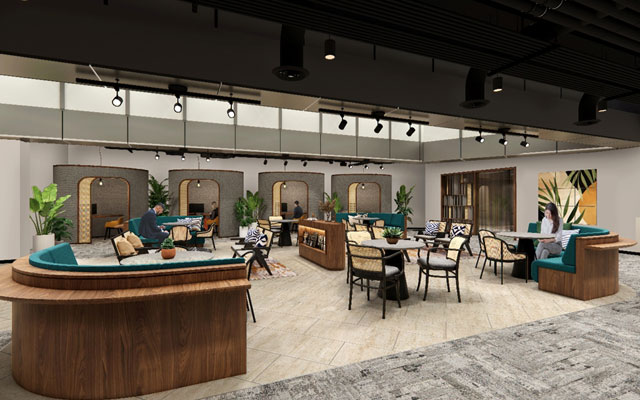
JustCo Changi Airport T3 will feature purpose-built workspaces to support different work modalities. Photo credit: JustCo
Flexible workspace provider JustCo has partnered with Changi Airport Group (CAG) to launch and manage Asia’s first pay-per-minute co-working centre in an airport.
Located at Changi Airport Terminal 3, the new co-working centre will adopt a pay-per-minute pricing model, and feature close to 50 hot-desk workstations. Aside from the hot-desk workstations, the centre will also be equipped with private office suites, a work lounge, meeting rooms with video conferencing tools, and collaboration areas. The space is scheduled to open in 4Q2023.
JustCo Changi Airport T3 will feature purpose-built workspaces to support different work modalities. Photo credit: JustCo
JustCo Changi Airport T3 will also feature a nap zone fitted with partitions and a pantry with food vending machines.
“JustCo’s new partnership with CAG will reinvent the work-life harmony experience for frequent business travellers and digital nomads. We are offering a convenient and cost-effective workspace solution to travellers and patrons of Changi Airport, regardless of their length of stay.
“Round-the-clock access, as well as amenities such as nap zone, food vending machines, and meeting rooms with video conferencing tools, will reshape the work experience for business travellers who need a conducive space to work in between flight transits, or for digital nomads looking for a relaxing work environment,” said Kong Wan Long, co-founder and chief commercial officer, JustCo.
Just 10 minutes from Phuket International Airport on the serene northern coast, this 178-key, Bill Bensley-designed resort offers delegates a quiet, tropical paradise steeped in Phuket’s tin-mining heritage
The newly-opened Ritz-Carlton, Bangkok anchors the One Bangkok development with cosmopolitan elegance. Featuring the city's largest ballroom and a spectacular new penthouse suite, it delivers exceptional hardware and deeply authentic, soulful service for business and leisure travellers alike
Behind the imposing, Brutalist concrete that defines Zurich’s Oerlikon district lies a surprising secret. While its exterior honours the neighbourhood’s industrial roots, stepping inside Mama Shelter reveals a vibrant, neon-soaked world that is a far cry from its rigid shell





 He has over twenty-five years’ experience of leading business transformation teams, and recently concluded a four-year secondment at the oneworld Alliance as chief transformation officer.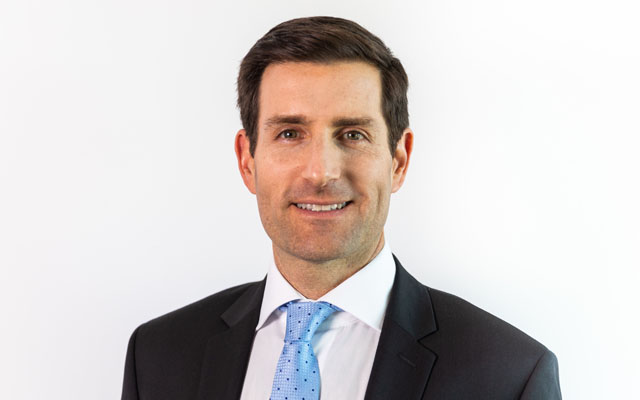
 He has held various positions with the company since joining in 2011, including vice president, sales, Australia & New Zealand, Oceania Cruises, from 2019 through to 2022, and vice president, finance & accounting – Asia Pacific at Norwegian Cruise Line Holdings.