Japan may be forced to endure a longer pandemic-induced state of emergency beyond May 31, as current measures fail to show sufficient decline in Covid-19 infections.
The country recorded 4,045 new cases on May 22, down from 7,521 new cases on May 12, the peak number recorded this spring. The average daily rate, however, is not significantly below that recorded before the state of emergency declaration on April 23, when 5,014 new cases were recorded.
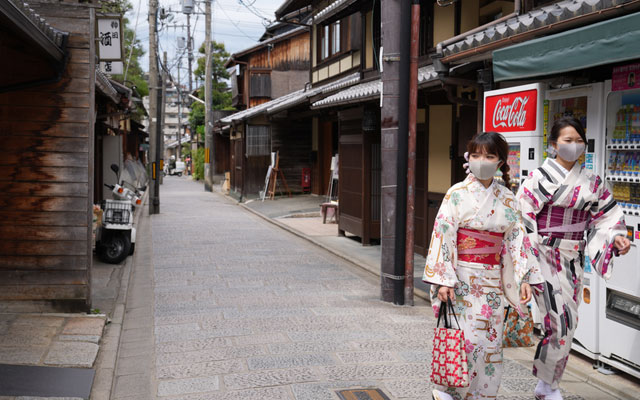
Japan’s government may extend current state of emergency from May 31 to June 20; local tourists walking along a street in Kyoto, Japan amid Covid-19 lockdown pictured
Initiated to curb a Covid-19 surge related to Golden Week, a series of consecutive national holidays in early May, the emergency measures at first covered Tokyo, Osaka, Kyoto and Hyogo: four prefectures home to one quarter of Japan’s 126 million people. Large events were banned, commercial facilities covering more than 1,000m² were asked to shut, teleworking was encouraged and eateries were required to close by 20.00.
Now, the Japanese government is considering a longer state of emergency, which has already been expanded in scale (to include seven more prefectures), accounting for 40 per cent of Japan’s prefectures and 70 per cent of its population.
According to a top government spokesperson speaking Sunday, the government is considering either extending the state of emergency from May 31 to June 20 or scaling back emergency measures in only some areas to quasi-emergency measures.
Government Covid-19 advisory panel member Keiichiro Kobayashi told NHK: “If the government hastily lifts the declarations, that would lead to a rebound (in the number of cases) and put a major brake on the economy.”
In addition to placing anti-infection measures on residents, the Japanese government has tightened its already rigorous travel bans, increasing the number of countries and regions covered by travel restrictions to 159.
In the past week, Japan banned entry to foreign nationals who have recently travelled to India, Pakistan, Nepal, Bangladesh, the Maldives, Thailand, Cambodia, Sri Lanka, the Seychelles, Saint Lucia, East Timor and Mongolia.
The Philippine Department of Tourism (DOT) has proposed to the government the possibility of setting up a green lane that will facilitate the entry of foreign visitors who are fully vaccinated against Covid-19.
The green lane will make it easier for fully vaccinated travellers to visit the country for leisure as quarantine rules are being relaxed with the progress of the vaccination worldwide.
The Philippines may soon allow entry to fully-vaccinated travellers as the government looks to reopen the economy; a quiet Boracay amid the Covid pandemic pictured
Tourism secretary Bernadette Romulo-Puyat said: “The green lane will pave the way for the reopening of our tourist destinations to leisure travellers who are now fully vaccinated. It will give the jobs back to many of our tourism workers and gradually revive the tourism industry under safe conditions.”
DOT’s proposal follows the move by several countries to open up their major destinations to fully vaccinated foreign travellers.
Romulo-Puyat said: “We must keep pace with our neighbours and the rest of the world in slowly reopening our tourist destinations. We must be ready for the visitors when the whole world is ready to safely travel again.”
The Inter-Agency Task Force for the Management of Emerging Infectious Diseases (IATF-EID) has tasked the DOT and several other agencies of the government to explore protocols for inbound international travel for fully vaccinated individuals.
Headed by the DOT and the Department of Foreign Affairs, a small working group has been formed to evaluate the possibility of implementing green lanes and formulate protocols therefor.
The group also includes the Bureau of Quarantine under the Department of Health, the Bureau of Immigration under the Department of Justice, the Department of Information and Communications Technology, the Department of Transportation, the Office of the Presidential Adviser on the Peace Process, the Overseas Workers Welfare Administration under the Department of Labor and Employment, and the Department of Trade and Industry.
Te Pae Christchurch Convention Centre is on track to open this year
Tākina Convention and Exhibition Centre in Wellington
New Zealand International Convention Centre
The new purpose-built venues in Christchurch, Wellington and Auckland will showcase the capability and increase the capacity of New Zealand to host exceptional business events.
Tourism NZ general manager domestic & business events Bjoern Spreitzer says: “This growth in business events infrastructure underlines both the importance of this industry to New Zealand’s economy, and recognises the networking and business benefits which international conferences and events will bring.”
The first new venue, Te Pae Christchurch Convention Centre, will open its doors later this year.
Its name, ‘Te Pae’ draws inspiration from several phrases in New Zealand’s indigenous language, te reo Māori. Te Pae Maunga means our mountain views, and Te Pae Whenua means the vast plains we inhabit. These iconic elements of the region’s landscape are echoed in the building’s design, where shapes and lines represent the contours of the Southern Alps and braided rivers of Canterbury. Te Pae Tangata means a place to meet and converse, highlighting Te Pae Christchurch’s role as a gathering place for the city.
Managed by international venue management company ASM Global, Te Pae combines the manaakitanga (warm welcome), culture and knowledge of Christchurch with world-class infrastructure, technology, and connections.
Its 28,000m2 of flexible space includes: a 1,400-seat tiered auditorium, divisible into two 700-seat venues; a 1,000-seat banquet space overlooking the beautiful Avon River; plus extensive meeting space and expandable exhibition halls.
The venue will be built to a New Zealand Green Building Council (NZGBC) Green Star 5-star rating, representing New Zealand excellence for environmental sustainability.
Next in the pipeline is Tākina, the new Wellington Convention and Exhibition Centre, opening in 2023 in the middle of New Zealand’s capital city.
Tākina means ‘to invoke, to summon, to connect, to bring forth’ in te reo Māori. The building’s concept draws on the summoning of Wellington’s wind as a means of expressing the shift of knowledge, moving things forward, and carrying ideas. It will be a place of welcoming, thinking, learning, and sharing, with its sculptural exterior housing modern, light-filled, flexible event spaces.
Tākina can be customised to accommodate a plenary of up to 1,600 delegates, with two divisible plenary halls on separate levels which can be easily combined; plus a 1,800m2 exhibition hall with adjacent space to boost capacity; stand-alone meeting rooms; and fully integrated best-in-class AV and ICT systems.
It will also be built to achieve a 5-star certification in accordance to NZGBC’s guidelines.
Meanwhile, work continues on the New Zealand International Convention Centre (NZICC) in the heart of Auckland city, scheduled for completion in 2024.
This vertically stacked, modern building will be a hub of innovation and positive exchange. A glazed facade and adjacent laneways will provide delegates with a connection to the vibrancy of the city, while allowing views of Auckland’s natural beauty, from the Waitakere Ranges to the Waitematā Harbour.
Its flexible convention and event space can cater for up to 4,000 people across 32,500m2. The configurable spaces over 4 levels present opportunities for a wide range of events including theatre capacity for 2,850 and up to 33 meeting rooms.
The NZICC will operate as a carbon neutral venue, the only one of its kind in Asia-Pacific.
Spreitzer adds: “We look forward to welcoming international conference delegates back to New Zealand, with new venues and new opportunities for learning and collaboration.”
The extinction of one-day business trips, technology investments, and sustainable corporate travel were some of the topics discussed in the panel session
Growing reliance on hybrid meetings, as well as greater awareness of the impact of travel on the environment throughout the pandemic, will likely result in the extinction of one-day business trips, say industry players at the virtual UFI Asia Pacific Conference 2021 last week.
Speaking at the Corporate Travel & Meetings: Which Way Forward? session, panellists agreed that the substitution of business travel by technology – such as virtual meetings – was inevitable, and because of this, one-day business trips might be a thing of the past.
The extinction of one-day business trips, technology investments, and sustainable corporate travel were some of the topics discussed at the panel session
Johnny Thorsen, vice president, strategy & innovation– American Express, Digital Labs, stated: “(Technology) will not eliminate everything, but it’s looking to be a very strong (replacement) for one- or two-day business trips.”
He further predicted that there would be a “substantial reduction of 50 per cent or more” in one-day trips in large organisations, the largest category in their corporate programmes.
More organisations are expected to clearly define essential business trips, opined Benjamin Concepcion, global head of travel operations – Novartis, who listed trainings as an example of an activity that would not be essential and could be conducted virtually.
Along with this change in attitudes towards business trips, Kerry Healy, Accor’s chief commercial officer, South-east Asia, Japan and South Korea, said more thought would go into quick turnaround trips, as the metrics on the return of investment will take centrestage before any in-person meeting goes ahead.
Agreeing with fellow panellists that one- or two-day business trips would cease to exist in the near future, Healy shared that Accor is already seeing increased lengths of stay occurring with corporate accounts.
As companies look to cut down on corporate travel, meetings that are 100 per cent in-person will also be impacted. Such events will be replaced by hybrid versions, due also to capacity limitation amid a pandemic.
Thorsen said the shift to hybrid events would bring greater commercial value, as the total attendance could be tripled or even increased tenfold through remote access.
“I think providing that remote attendance opportunity is really important for future successful events,” elaborated Thorsen.
In addition to hybrid events, investing in technology has also become a necessity.
Concepcion shared how Novartis created a portal for its meeting planners to make virtual events between teams interactive and collaborative through digital whiteboards and active polling. The company also built studios in their offices in several locations around the world for this purpose.
Sharing a hotelier’s perspective, Healy said Accor was committed to deploying technology in their operations even though the decline in physical meetings is “challenging and there is no business”.
“It’s our role to be adaptable for whatever the customer wants to do in the hotel and work with them on their programmes, either with our own hybrid solution or with theirs,” Healy said. She added that Accor created a digital lab to look at the “immediate pain points that this crisis has raised for our owners and customers”, and how the company is addressing them.
Last month, the Fairmont Singapore converted its VIP lounge into a broadcast studio, shared Healy as an example of how Accor’s hotels are adapting.
With the reduction in non-essential business trips, panellists hope that the future of corporate travel would be more sustainable.
Thorsen said: “I made my own sustainable travel policy, where I will not be doing any more one-day trips. If I go longhaul, I’m setting the limit at eight hours, and only if the longhaul trips are for a week or longer. I will not be doing those crazy two- or three-day longhaul trips, primarily for sustainability reasons.”
He hoped to see travel emissions fall by 50 per cent or more post-pandemic, and for corporate travellers to accept greater costs in order to support green travels.
There are signs that the industry is moving in the appropriate direction. Concepcion opined that the future of corporate travel will be “very traveller-specific driven” as individuals are more aware of sustainability due to the pandemic, and seek compliance.
Concepcion said: “What we do when we meet with suppliers is we review with them Novartis’ green expectations, and provide a document that tracks how they are contributing to (Novartis’ goal of being carbon neutral by 2030.”
Meanwhile, Healy shared that Accor has also appointed a chief sustainability officer who will work on bolstering the company’s green credentials, which will in turn boost the hotels’ standing when pitching for a corporate travel programme.
These events deliver significant direct revenue to the Victorian business events supply chain
The Victorian Government has committed a long-term investment worth A$42.9 million (US$33.1 million) over four years to Victoria’s Business Events Program, to support the Melbourne Convention Bureau (MCB) and Business Events Victoria in acquiring business events for the state.
MCB’s CEO Julia Swanson said: “This commitment recognises the essential role business events play in the Victorian visitor economy, and their contribution to innovation, job creation, trade and investment opportunities, for the benefit of the whole community.”
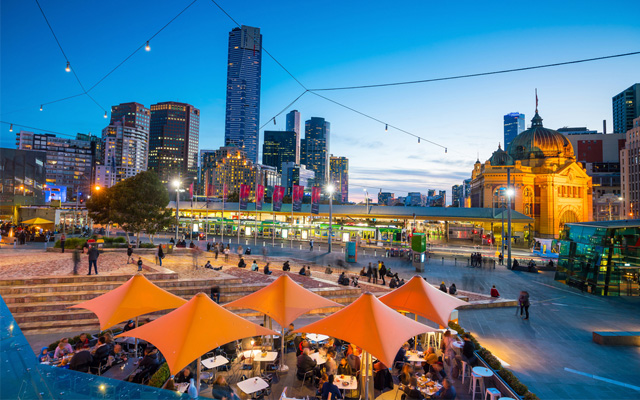
Victoria gets a fresh boost in its MICE coffers; Melbourne pictured
“The business events sector has been one of the hardest hit by the Covid-19 pandemic and these measures not only support the business events sector now, they also ensure we can sustain and grow the sector for the future.”
This investment will also boost MCB’s presence in the national business event space and allows for a greater focus targeting short lead-time business events. The National Business Events Program, a new funding initiative announced last month, will continue to provide eligible business event organisers cash grants to offset costs for hosting business events in Greater Melbourne.
Despite the pandemic, MCB’s work in international markets has continued to secure high yield events for the city until 2028. The buereau is currently managing A$547 million worth of bids that have the potential to contribute 254,000 room nights for the hotel and accommodation sector.
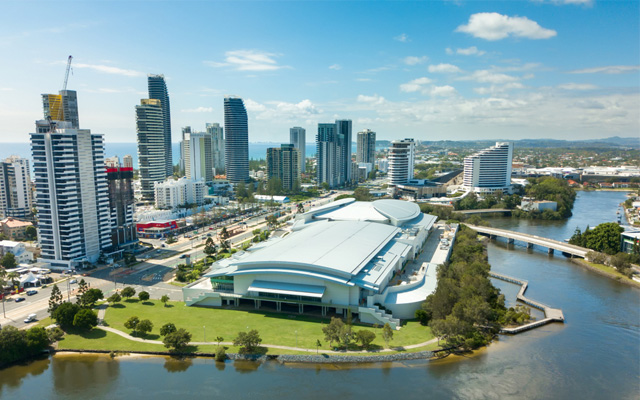
An aerial view of the Gold Coast Convention and Exhibition Centre (GCCEC) and Broadbeach skyline
Some 7,000 delegates will make their way to the Gold Coast over the next few weeks, injecting A$11 million (US$8.5 million) into the destination’s visitor economy.
This month will see the return of the Australasian Real Estate Convention from May 30-31 with 3,000 delegates expected to attend, in addition to the Australian Pharmacy Professional Conference from May 20-23 with up to 4,000 delegates. Gold Coast Convention and Exhibition Centre will host the two large-scale business events.
An aerial view of the Gold Coast Convention and Exhibition Centre and Broadbeach skyline
The Gold Coast has seen a welcome return of domestic business events since capacity and social distancing restrictions were eased for venues. A pipeline of more than 160 meetings and conferences has also been secured – worth A$184 million – in partnership with the local industry despite the challenging Covid-19 environment.
Destination Gold Coast’s CEO Patricia O’Callaghan said the Gold Coast was looking forward to the return of these events after a challenging year, and opined that the industry was headed for a “strong recovery”.
O’Callaghan shared that the Gold Coast has continued to engage with international and domestic conference organisers throughout the global pandemic to lock in these high yielding events for the city. She added that there is a “compelling desire to meet face-to-face”, hence the “pent-up demand for business events will be very strong”.
“We are also actively working with event organisers to confirm an additional A$143 million of conferences and meetings through strategic marketing activities and bid opportunities,” she added.
The Gold Coast attracted almost half of all business events hosted in Queensland in 2019, injecting A$570 million into the economy.
Exhibitions its ability to expand marketplaces by bringing buyers and sellers together and offering a platform for launching innovation and new product
How exhibitions drive economic recovery by enabling growth and recovery is the key theme for this year’s Global Exhibitions Day (#GED21; June 2, 2021), which will be marked by a hybrid seminar organised by the Exhibition and Event Association of Australasia (EEAA).
After the success of #GED2020 in which an online webinar attracted over 800 people from Australia and internationally, this year’s event will be hybrid, with a welcomed return to in-person element for those who can attend, at International Convention Centre Sydney.
Exhibitions bring buyers and sellers together and offer a platform for launching new products
The seminar will feature leading thinkers in the sector and offer a local and international perspective and experiences. Delegates will hear from the likes of individuals such as ASM Global’s (Asia Pacific) chairman and chief executive Harvey Lister; Adelaide Convention Centre’s general manager Simon Burgess; and Chris Kilbee, executive director, ASEAN, at Informa Markets.
Claudia Sagripanti, EEAA’s chief executive said in a statement: “Exhibitions and business events are key to rebuilding economies, and we will be aiming to highlight the sector’s capability to propel the economy forward particularly at this time.
“We will be showcasing the power of exhibitions and why a focus the work of the sector should be a top priority for business and governments in the current climate.”
Just before Covid-19 happened, the business events sector contributed more than A$35 billion (US$27 billion) to Australia’s GDP, derived from over 430,000 events annually, and employed more than 229,000 people.
Global Exhibitions Day is an annual world-wide campaign that was established by UFI, the Global Association for the Exhibition Industry and is supported by more than 40 partner associations and industry bodies from 90 countries and regions.
Optimism and momentum for business travel is growing
The Global Business Travel Association’s (GBTA) latest poll has revealed that three in four GBTA buyer and procurement respondents feel their employees are ‘willing’ or ‘very willing’ to travel for business in the current environment, continuing the month-on-month positive trend for a return to travel.
The results from the 19th poll in the series are the most positive yet, with increasing optimism, growing momentum for a return to business travel and an increase in bookings – largely due to the success of the vaccine roll-out and introduction of vaccine passports.
Optimism and momentum for business travel is growing
“It’s reassuring to see so much momentum for a return to business travel, with more optimism, willingness to travel and an increase in bookings. Government policies remain the greatest obstacle to opening travel, particularly in the UK, Europe and Canada. Our advocacy teams continue to lobby on behalf of members, in London, Brussels, Ottawa, Washington and around the world for the responsive and safe re-opening of international travel,” said Suzanne Neufang, CEO of GBTA.
Optimism and momentum for a return to travel
Three in four (74%) GBTA buyer and procurement respondents feel their employees are ‘willing’ or ‘very willing’ to travel for business in the current environment. The remaining buyer and/or procurement respondents feel their employees are ‘not willing’ (10%) or ‘neutral’ (11%) in terms of their employee’s willingness to travel for business. In addition, one in 10 (6%) are ‘unsure’.
Three in four (78%) GBTA member and stakeholder respondents think issuing government-issued digital health verification (or digital green certificates and/or vaccination passports) is either ‘very effective’ or ‘effective’ in terms of resuming business travel. Only one in 10 think it is ‘ineffective’ (8%), ‘very ineffective’(8%) or are ‘unsure’ (8%).
Respondents from Europe (86%), the UK (90%) and Canada (89%) are a bit more likely than respondents from the United States (73%) to say issuing digital health verification or vaccination passports is effective in terms of resuming business travel.
When asked to describe the single greatest barrier to business travel in the current environment, over half (55%) cite government policies that restrict travel or make it difficult (e.g. entry restrictions or mandatory quarantines), followed by company policies restricting employees from travelling (23%) and travel budget freeze/cost savings (11%). Few cite employee unwillingness to travel (7%), other reasons (4%) or are unsure (1%).
Respondents based in the UK (80%), Europe (70%) and Canada (77%) are much more likely to cite government policies as a key barrier to the resumption of business travel compared to those based in the US (44%).
Optimism among suppliers and travel management respondents concerning the financial prospects of companies in the business travel sector continues on a positive trajectory, as half report they are ‘very optimistic’ (3%) or ‘optimistic’ (47%) about the industry’s financial prospects.
One in four (26%) report they are ‘pessimistic’ or ‘more pessimistic,’ and one in four (23%) are ‘neither pessimistic nor optimistic.’ Only 4% report they are ‘unsure’ about the financial prospects of companies in the business travel sector.
Among those who say their employees are ‘unwilling’ to travel for business in the current environment (or are ‘unsure’ or ‘neutral’), safety concerns (79%) and the lack of vaccinations (74%) are the primary reasons for their hesitancy. Other reasons include lack of interest (16%) and hesitancy to travel to unfamiliar locations (9%).
Over half (54%) of supplier respondents report an increase in bookings from corporate customers within the past week compared to just 40% in the April poll. Two in five (36%) report their bookings have increased from the previous week. Only one in 10 report their bookings have decreased (10%).
Over half (52%) of supplier and travel management company respondents report that they feel more optimistic about the industry’s path to recovery compared to a month ago. Two in five (41%) say they feel the same and only 7% say they feel more pessimistic about the industry’s path to recovery compared to a month ago.
Managing the return to non-essential business travel
Almost half (46%) of GBTA members and stakeholder respondents expect their company will resume non-essential travel for all employees equally, regardless of their vaccination status.
However, one in four (38%) are unsure as to what their company’s policy will allow concerning vaccination status and the resumption of non-essential business travel. Only one in six (16%) say their company will allow fully vaccinated employees to resume non-essential trips while continuing to limit travel for those who have not been vaccinated.
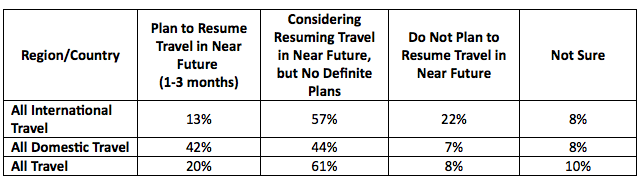
Eight in 10 (81%) GBTA member company respondents who reported cancelling or suspending most or all trips to a specific region/country are considering resuming travel in the near future or are considering resuming travel but do not have definite plans. Less than one in ten do not have plans to resume business travel in the near future.
Staffing up to meet demand
Three in four (77%) suppliers and travel management respondents say their staff size is ‘much less’ or ‘less’ today compared to before the pandemic. Less than one in 10 (6%) say their staff size is larger today and one in seven (15%) say their company is the same size today.
Almost half of supplier and travel management employee respondents agree their company will likely face difficulties hiring staff due to a shortage of qualified candidates (47%) or hesitancy among prospective employees to work in the travel industry (46%). Other anticipated obstacles of note include candidates wanting to work remotely (35%) or vaccination verification (15%).
Thinking ahead to the next six months, the majority of supplier and travel management respondents (62%) expect staffing at their company to increase moderately or significantly. One in four (27%) expect staffing to remain the same, while only 8% expect staffing to decrease.
Among suppliers and travel management respondents who expect their staff will increase in the next six months, approximately half (48%) are concerned it will be difficult to find qualified candidates as many have left the travel industry. In addition, more than half (54%) feel it will be difficult to hire qualified candidates due to competition with other companies who are also re-staffing.
Trend for ‘bleisure’ or ‘workcations’ – not a priority
Only one in five (19%) GBTA member and stakeholder respondents are ‘much more likely’ or ‘more likely’ to combine leisure travel in combination with business travel; equally, about one in six (17%) say they are either ‘less likely’ or ‘much less likely’ to do so.
Almost three in five (56%) say that that the pandemic has not changed their plans to extend business trips to incorporate some leisure time. Only 8% are ‘unsure’ whether they will combine business travel with leisure travel.
View the entire poll results here and key highlights here.
ASM Global APAC has promoted Mark Jan Kar to the new role of General Manager of Coca-Cola Arena, following the recent resignation of current CEO Guy Ngata.
Jan Kar is currently the Arena’s director – commercial & live, and brings a wealth of experience in the sports and events industries. He has lived in Dubai since 2008, and is familiar with the characteristics of the destination.
His vision for the Coca-Cola Arena is to consolidate its position as the region’s premier entertainment and sports venue, and will be working closely with key stakeholders including the Dubai Government and commercial partners to expedite the return of live events.
Bruce Ryde has been appointed as the general manager and brand strategist at Kamalaya Wellness Sanctuary and Holistic Spa in Thailand.
Among his new responsibilities, Ryde will work with the hotel’s founders to grow the brand through an online platform, Kamalaya Connect, and a retail arm, Kamalaya Essentials.
Ryde has a long hotel history both operating hotels and leading global brands in Asia-Pacific. The Australian was most recently managing the luxury brand strategy for Marriott International’s brands, as vice-president Asia Pacific.
Prior to that, Ryde held the same position with IHG, overseeing the InterContinental brand as well as the launch of the Hotel Indigo and Kimpton brands in Asia-Pacific.
Just 10 minutes from Phuket International Airport on the serene northern coast, this 178-key, Bill Bensley-designed resort offers delegates a quiet, tropical paradise steeped in Phuket’s tin-mining heritage
The newly-opened Ritz-Carlton, Bangkok anchors the One Bangkok development with cosmopolitan elegance. Featuring the city's largest ballroom and a spectacular new penthouse suite, it delivers exceptional hardware and deeply authentic, soulful service for business and leisure travellers alike
Behind the imposing, Brutalist concrete that defines Zurich’s Oerlikon district lies a surprising secret. While its exterior honours the neighbourhood’s industrial roots, stepping inside Mama Shelter reveals a vibrant, neon-soaked world that is a far cry from its rigid shell


















The Philippine Department of Tourism (DOT) has proposed to the government the possibility of setting up a green lane that will facilitate the entry of foreign visitors who are fully vaccinated against Covid-19.
The green lane will make it easier for fully vaccinated travellers to visit the country for leisure as quarantine rules are being relaxed with the progress of the vaccination worldwide.
Tourism secretary Bernadette Romulo-Puyat said: “The green lane will pave the way for the reopening of our tourist destinations to leisure travellers who are now fully vaccinated. It will give the jobs back to many of our tourism workers and gradually revive the tourism industry under safe conditions.”
DOT’s proposal follows the move by several countries to open up their major destinations to fully vaccinated foreign travellers.
Romulo-Puyat said: “We must keep pace with our neighbours and the rest of the world in slowly reopening our tourist destinations. We must be ready for the visitors when the whole world is ready to safely travel again.”
The Inter-Agency Task Force for the Management of Emerging Infectious Diseases (IATF-EID) has tasked the DOT and several other agencies of the government to explore protocols for inbound international travel for fully vaccinated individuals.
Headed by the DOT and the Department of Foreign Affairs, a small working group has been formed to evaluate the possibility of implementing green lanes and formulate protocols therefor.
The group also includes the Bureau of Quarantine under the Department of Health, the Bureau of Immigration under the Department of Justice, the Department of Information and Communications Technology, the Department of Transportation, the Office of the Presidential Adviser on the Peace Process, the Overseas Workers Welfare Administration under the Department of Labor and Employment, and the Department of Trade and Industry.