EarthCheck Research Institute and Constellar, the venue management group of Singapore Expo, have entered a new research collaboration that will define how meaningful impact looks like in sustainable events, and how that can be measured consistently.
The outcome of the project will include a discussion paper examining why measurable impact matters now; a flagship whitepaper, From Legacy to Measurable Impact in Sustainable Events, featuring real-world application of the framework through the Singapore case study; and a practical guidance for organisers, destinations and policymakers seeking to strengthen event outcomes.
Both parties expressed in a press statement that while sustainability commitments continue to grow across the events industry, measurement frameworks have not always kept pace, making it harder to compare performance, demonstrate progress, and guide future investment.
David Simmons, chair of the EarthCheck Research Institute, said the next stage of progress requires stronger evidence and more consistent ways to assess outcomes.
“The business events sector has made genuine progress in sustainability, but progress needs to be matched by credible measurement. If we want to understand what works, where value is being created, and how positive outcomes can be strengthened over time, we need frameworks grounded in evidence. This collaboration is about helping the industry move from aspiration to accountability, with practical tools that support better decisions.”
At the same time, the journey to achieving event legacy is often without a shared set of indicators or evidence-based benchmarks, noted the statement. It is hoped that the shared research will address this gap by combining the International Congress and Convention Association’s (ICCA) leadership in legacy and long-term impact with EarthCheck’s globally recognised expertise in benchmarking, certification and sustainability performance measurement.
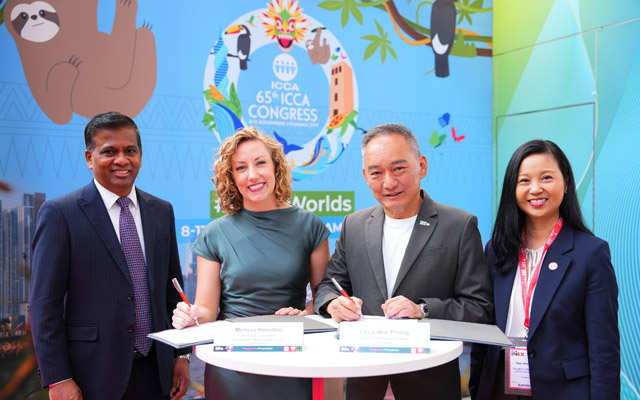
ICCA supports the research collaboration, which was marked with a signing ceremony at IMEX 2026 in Frankfurt on May 19.
Together, the partners will develop a practical framework that helps destinations, venues and organisers better assess, report and improve the outcomes created by business events.
The research will be grounded in Singapore as a destination-level case study, reflecting the nation’s mature business events ecosystem, strong policy alignment and track record in advancing sustainable business events.
Ong Huey Hong, assistant chief executive, Industry Development Group of Singapore Tourism Board, said the collaboration reflects Singapore’s broader approach to strengthening the competitiveness and relevance of its business events sector.
The research will look into Singapore Expo’s ongoing efforts in demonstrating how legacy and impact indicators are practically measured, reported and strengthened, thus enabling stronger accountability and more informed decision-making.
The massive venue in Singapore’s eastern region makes an outstanding case study for this new research project, opined Chua Wee Phong, group CEO of Constellar.
Singapore Expo has a 11.4 MWp onsite solar photovoltaic system, which meets up to 95 per cent of the venue’s annual electricity demand. In 2025, the venue achieved an 86 per cent reduction in Scope 1 and 2 emissions. Supported by a range of sustainability initiatives and efficient building operations, these efforts strengthen Singapore Expo’s position as Asia’s most sustainable events venue.
Chua told TTGmice that the decision to harvest solar energy pays off through sustainability and self-sufficiency achievements.
He added that Singapore Expo has been able to avoid the energy crisis that burdens many businesses around the world due to its own electricity supply.
Chua noted that “sustainability is not separate from commercial performance – it is part of how we create long-term value for our organisers, partners and the destination”. Measuring sustainability outcomes is also increasingly crucial, as governments seek stronger returns on investment, clients expect greater transparency, and more organisations work toward ambitious sustainability targets.
Constellar’s part in the joint research will also fulfil Chua’s hope that his organisation’s sustainability journey can inspire others in the global business events industry, especially those in Asia, to do the same.
“It is important to broadcast sustainable initiatives more aggressively, and for all in the industry to move forward together so that the next generation will not have to inherit a carbon-heavy world,” he remarked.
Beyond the generation of clean energy, Constellar is now working on wide-ranging waste measurement, including food waste and stand-building waste.