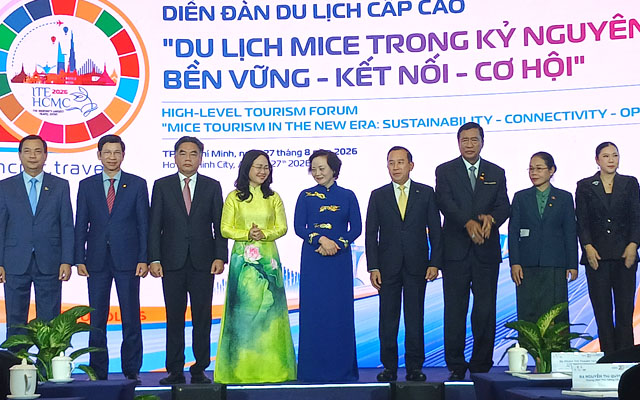
Vietnam is actively positioning itself as a leading business events destination in South-east Asia as part of its 2030 vision, with plans to create a competitive regional “MICE Circuit” to strengthen the region’s business event offerings.
During a high-level meeting at the 20th ITE HCMC, Lam Thi Phuong Thanh, Vietnam’s minister of culture, sports and tourism, noted that business event attendees and corporate travellers spend more and stay longer than leisure tourists. With the global business events market predicted to reach US$2.4 trillion by 2031, Vietnam is seeking to boost its offerings to increase the current US$6 billion generated by the sector.
“MICE not only generates tourism revenue, but also creates opportunities, strengthens connections, and contributes to the positioning and enhancement of destination brands. Therefore, MICE is increasingly recognised as an important driver for raising the added value, quality, and international competitiveness of the tourism sector,” she said.
Thanh stated that in December, Ho Chi Minh City authorities passed a policy outlining support mechanisms and incentives to attract large-scale business event delegations through 2030. In the first seven months of 2026, this initiative contributed to city tourism revenue exceeding VND 237 trillion (US$9.1 billion), marking a year-on-year increase of more than 55 per cent.
In addition, the government has pledged to improve legal and policy frameworks for business events, simplify entry and exit procedures, develop event-specific visa mechanisms, and launch incentives to attract international PCOs and DMCs.
Vietnam’s deputy prime minister Pham Thi Thanh Tra also called on South-east Asian nations to collaborate on a regional “MICE Ecosystem” by developing multi-country itineraries and joint destination promotions.
“The South-east Asia region benefits from connectivity and synergy that create strength. We need to shift towards developing a competitive regional MICE network. We must connect destinations, air services, and tourism products, develop multi-country MICE routes, and transition from competing for markets to strengthening regional connections,” she said.
This sentiment was echoed by Cambodia’s tourism minister Huot Hak, who cited the example of hosting a conference in Ho Chi Minh City followed by an incentive trip to Siem Reap.
“Instead of viewing neighboring countries as competitors, we should act as complementary destinations and partners. One destination provides the conference, another offers a cultural experience, and another delivers an incentive programme. Together, we can offer highly competitive regional experiences,” he elaborated.