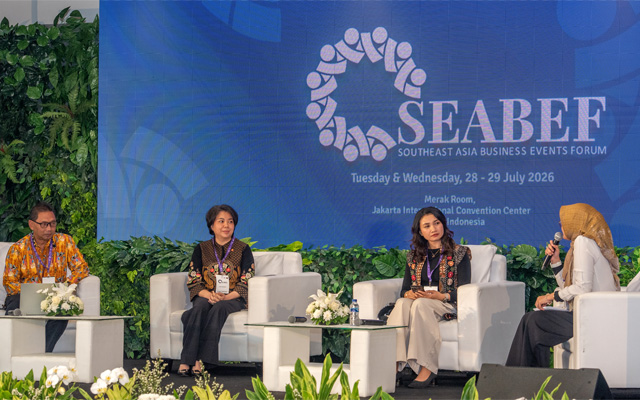
As the South-east Asian business events industry continues to grow, developing the people behind the sector is becoming increasingly important to support its future of growth.
The issue was a central focus at the Southeast Asia Business Events Forum (SEABEF), where Carla Budiarto, senior officer for tourism at the ASEAN Secretariat, emphasised the vital role of workforce quality during during the Talent, Education and Workforce Evolution panel session.
“Growth in venues and bookings alone does not really translate into growth in trust. If you have good infrastructure and technology, but the quality of talents is not what the global market expects, they will not return to this region,” Carla said.
To support this, Carla added, ASEAN is working to expand regional standards and certification through the ASEAN Mutual Recognition Arrangement for Tourism Professionals, which is being developed to include business events-related occupations.
Carla pointed out that ASEAN wants to move from having talented people to building a workforce that is certified, mobile and recognised across the region.
“Professionals in hotel and travel services have already benefited from ASEAN certification for many years, and MICE workers could have similar opportunities through the expanded framework,” Carla said.
Beyond regional certification, developing a skilled business events workforce also depends on how future professionals are prepared.
Hariyadi Darmawan, deputy director for student affairs, alumni and partnerships at the Polytechnic of Tourism Bandung, said that vocational education plays an important role in equipping graduates with practical skills needed by the industry.
At the Polytechnic’s Convention and Event Management programme, around 65 per cent of the curriculum focuses on practical learning, including internships, project based learning and real event production.
“Students are also required to manage events on campus as part of their training, giving them experience before entering the workplace,” Haryadi shared.
Meanwhile, Mega Prawita, managing director of Kumpul – an organisation that supports entrepreneurs and startups – said that talent development should not end with formal education. “Professionals need to keep learning and developing new skills throughout their careers as the industry continues to change,” she stated.
Mega added that expanding access to learning opportunities is also important, particularly for talents outside major cities, so more people can gain the skills needed to gain access to the business events industry.