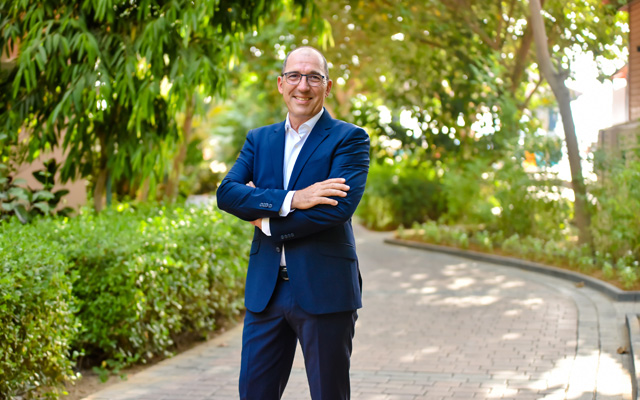
Anantara Iko Mauritius Resort & Villas has appointed a new general manager, Pascal Bertrand.
Bertrand brings over 35 years of luxury hospitality experience from around the globe, having worked with international hotel brands globally.
The French national got a taste for the hotelier life when he started his career in F&B, as sous-chef for Eleven Maple Street Restaurant in Florida. He continued his career in F&B by joining The Ritz Carlton in Atlanta as assistant banqueting manager, followed by The Ritz Carlton Cancun and The Ritz Carlton in Florida.
He progressed through the ranks of hotel operations before taking his first general manager position at the Legends Hotel Mauritius, in 2010.
Club Med has appointed Rachael Harding as the CEO of East, South Asia and Pacific, succeeding Xavier Desaulles, who led Club Med Asia Pacific Markets for the past five years.
In her new role based in Shanghai, Harding will lead the stewardship of the Asia Pacific (excluding Greater China) region as they navigate the current market dynamics and prepare for an aggressive rebound. She will also drive the advancement of a profitable growth strategy focused on nurturing matured markets and elevating the emerging markets.
Harding joined Club Med in 2018 as the general manager for Club Med Pacific (Australia and New Zealand). Over three years, her leadership led to the successful growth of the Pacific market by 26 per cent.
Harding possesses over 20 years of experience in the travel sector, spanning multiple sectors of the tourism industry across retail, corporate & wholesale in the Australian, New Zealand, UK and European markets.
Prior to joining Club Med, she spent 15 years working with The Travel Corporation on brands including Trafalgar and Contiki in various sales, distribution and marketing roles.
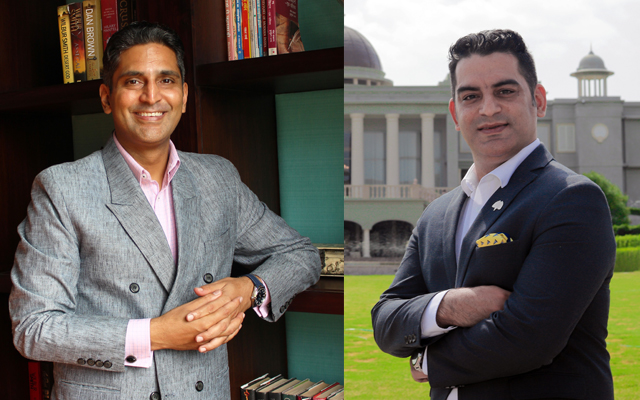
Raffles Udaipur, the brand’s first hotel in India, has made two new appointments – Abhishek Sharma as general manager, and Rajan Malhotra as director of sales and marketing.
Abhishek has over two decades of outstanding experience in luxury hospitality, and joins Raffles Udaipur with over nine years of leading teams in the role of general manager, throughout luxury hotels and resorts, including The Oberoi Group in India and Soneva Fushi Resort in The Maldives.
From left: Abhishek Sharma; and Rajan Malhotra
Prior to that, Abhishek worked as head of F&B with renowned hotels in India, Maldives, Mauritius and Egypt. His journey in F&B and hotel management includes various pre-opening and opening roles.
Meanwhile, Rajan will take charge of introducing the Raffles brand experience in India, as well as planning and implementing strategies to support the hotel’s positioning. He will be leading the sales and marketing team, exploring business opportunities and will be responsible for the budgeting, forecasting and achieving the hotel’s commercial objectives.
Rajan brings along with him 18 years of experience in the hospitality industry, with successful stints at Shangri-La Hotels & Resorts, Hyatt Services India, The Zuri Group of Hotels & Resorts, Le Méridien Jaipur Resort & Spa, Taj Palace, New Delhi and The Grand New Delhi.
New Zealand has launched a new event, the 2035 Oceania Summit, which will be held in Auckland in 2022 and showcase local solutions for global climate impact.
The regional follow-up summit will draw on the experience of New Zealand-based global agri-food-tech consultancy Wharf42, which will co-host the AgriFoodTech Climate Summit at COP26 in Glasgow in November.
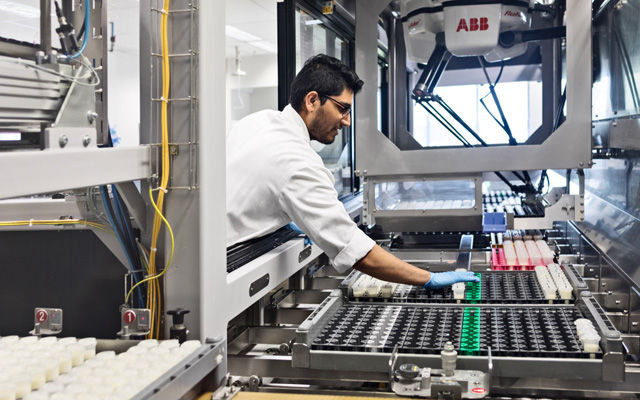
An employee preparing milk samples for testing
Wharf42 founder and event organiser Peter Wren-Hilton said that he hopes to attract 1,000 local and international delegates to the two-day Oceania Summit, which will take place in Auckland in April 2022.
It will feature regional and international keynote speakers, breakout panels, an exhibition showcasing current research being undertaken across the region, a startup hub with a pitch event to global investors, as well as networking opportunities.
He said: “If the borders are open, we’re hoping to attract delegates from around the world to come and share what is happening in this important space.”
Wren-Hilton added: “New Zealand is so strong in agrifood because our agriculture and horticulture sector is the backbone of our economy. In addition, the government in New Zealand is very committed to effecting resolution in climate change. The combination of these factors makes New Zealand the perfect destination for an event of this sort.
“There is great science being done by our universities and Crown Research Institutes. The objective is to provide farmers and growers with the tools they need to clean up the environment, address climate issues and reach net-zero emissions targets.”
The 2035 Oceania Summit event was launched during Fieldays 2021 in New Zealand, the Southern Hemisphere’s largest agricultural event.
Within 48 hours of the announcement, more than 250 people had registered their interest on the Summit’s landing page, a very positive indicator, Wren-Hilton shared.
The event has the support of Tourism New Zealand’s Business Events team, Auckland Unlimited, AgriTech New Zealand, and the Australian AgriTech Association.
Currently, Wren-Hilton is undertaking a roadshow around New Zealand to secure the involvement of other key players in the agrifood ecosystem.
Bangkok and 28 other high-risk zones will be placed under the strictest lockdown measures to curb Delta surge
Thailand will extend lockdown restrictions in Bangkok and 12 other dark-red zone provinces for another two weeks starting Tuesday (August 3), with 16 more provinces to come under the curbs, amid a Covid-19 surge.
Provinces marked as a dark-red zone are placed under the strictest of restrictions which includes a night curfew, a ban on dine-in services, and curbs on inter-provincial travel.
Bangkok and 28 other high-risk zones will be placed under the strictest lockdown measures to curb Delta surge
The restrictions will be evaluated after two weeks, said the Centre for Covid-19 Situation Administration (CCSA). If the situation does not improve, the restriction period may be extended until August 31, with more areas expected to be added.
The 16 provinces which have been added to the dark-red zone are: Kanchanaburi, Tak, Nakhon Nayok, Nakhon Ratchasima, Prachuap Khiri Khan, Prachin Buri, Phetchabun, Rayong, Ratchaburi, Lop Buri, Sing Buri, Samut Songkhram, Saraburi, Suphan Buri, Ang Thong and Phetchaburi.
With the new additions, a total of 29 areas in Thailand – or more than one-third of the country – will be under the tightest restrictions.
In the meantime, 37 provinces have been declared as red-zone or maximum controlled places, while 11 provinces are in orange or controlled areas.
Thailand has been listed as among the top 10 countries last week for recording the highest daily Covid-19 infections. On August 1, the country reported 18,027 infections and 133 deaths, bringing the cumulative total to 615,314 cases and 4,990 fatalities.
Due to the severity of the situation, Thai AirAsia has announced that it will temporarily suspend all business operations in Thailand until the end of August, but hopes to resume services in September.
Meanwhile, some hotel operators and travel companies in Phuket said that the ongoing semi-lockdown has taken a further toll on tourism businesses. They also claimed that the Phuket Sandbox programme has yielded no benefit for small operators as most returnees to the island are regular guests of big hotel chains.
Local media reported that more hotels have decided to pause operations amid the Covid surge.
Melbourne has been chosen as the host city for the International Congress of Psychology (ICP) 2028, the world’s largest gathering of psychologists from across the globe.
Held every four years, ICP 2028 will mark four decades since it has been held in Australasia and only for the second time in its 132-year history.
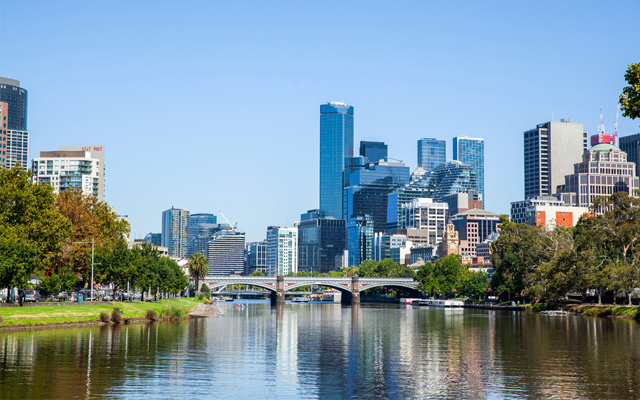
Melbourne CBD
It is anticipated ICP 2028 will welcome 5,000 international delegates to attend a six-day programme held at the Melbourne Convention and Exhibition Centre. The event has been projected to deliver in excess of A$39.2 million of economic contribution to the local economy.
ICP 2028 will provide the chance for delegates to exchange knowledge and foster excellence in standards for education, training, research and the applications of psychology and apply it to local settings in support of the Victorian Mental Health Workforce Strategy.
The bid was led by Melbourne Convention Bureau (MCB) in partnership with Australian Psychological Society (APS) and with support from the Victorian Government.
MCB’s chief executive, Julia Swanson said securing this event was “two years in the making”, and with this win, Melbourne is recognised for its long tradition of scientific exchange and collaboration across many fields of psychology internationally.
To win the event, MCB leveraged a suite of virtual and digital assets to connect with ICP key decision-makers in presenting Melbourne’s bid. The bureau also collaborated with local partner, Harry the hirer, who invested in remote filming capabilities was crucial to the video production achievements.
PCMA has appointed Florence Chua as its managing director APAC, taking over from Karen Bolinger.
Based in Singapore, Chua will lead the APAC team to expand upon the momentum of region-specific events, thought leadership, community building, education and content.
Florence Chua
Chua has more than 20 years of experience working with corporations and associations throughout the APAC region, most recently as vice president, growth and brand management for Entrepreneurs’ Organisation.
Bolinger, who has been managing director APAC for PCMA since April 2020 on a part-time consultancy basis, will continue to support PCMA in a consulting capacity and handle specific projects.
Under Bolinger’s leadership PCMA’s brand expanded throughout the region, PCMA launched its inaugural Convening APAC and for the first time ever Convening Leaders was live from Singapore in 2021.
Singapore’s pandemic exit could benefit year-end events
Safe meetings procedures are well in place; will inspire foreign attendees’ confidence
Asia’s fluctuating infections could handicap Singapore’s large-scale events recovery
MICE organisers in Singapore are optimistic about upcoming prospects as the city-state begins plans for an endemic phase; high-rise buildings in Singapore’s CBD pictured
Tradeshow and conference organisers in Singapore believe that easing of restrictions on business events and quarantine-free arrivals for vaccinated travellers, should these come into force once herd immunity is achieved in the coming month or so, could result in a livelier year-end calendar of events for the city-state.
Dylan Sharma, vice president, advocacy and communications with the Singapore Association for Conventions & Exhibitions Organisers and Suppliers (SACEOS), said the announcement was a “glimmer of light at the end of a long tunnel” for “an industry that has been severely impacted by the pandemic in the past one and a half year”.
“The easing of restrictions such as quarantine-free travel will come as a much-needed boost for the MICE and events industry, as it will provide a sense of certainty and sufficient runway for the planning of events,” commented Sharma. “More importantly, as a country that is heavily reliant on international participants, the government’s plan to allow a certain degree of normalcy while Covid remains in our midst will allow our industry to finally open up and attract foreign visitors.
Despite pandemic challenges that shut Singapore off to most international traffic, the country has been able to conduct some 90 business event pilots since August 2020, most of which were hybrids that saw overseas participation via the Internet. Such pilots include the 2020 IEEE International Conference on Computational Electromagnetics, the Asia Pacific MedTech Virtual Forum 2020, TravelRevive, and Geo Connect Asia 2021.
“Should this come to pass, it would be great news and a fillip for the MICE industry and Singapore,” agreed Edward Liu, managing director of Conference & Exhibition Management Services (CEMS). He added that quarantine-free travel would encourage regular foreign exhibitors and trade visitors to join the company’s tradeshows in person.
CEMS currently maintains a packed roster of tradeshows in Singapore over the months of October and November. They include Architecture & Building Services 2021, which comprises seven co-located exhibitions to present a comprehensive platform for all building needs for markets in South-east Asia.
“If the government could make the reopening pronouncements unequivocally, this would restore confidence in the economy both in Singapore and abroad. Businesses would be able to make firm decisions in sync with the government guidelines and policies. With their commitment to partake in our conferences and exhibitions, then it would be easier for us to persuade our international speakers and exhibitors to attend our events in-person,” added Liu.
Patricia Cheong, managing director Asia, of International Conference Services, told TTGmice that she is encouraged to “push forward with our plans for more in-person or hybrid events in the coming months”.
She said quarantine-free travel intentions are “spurring hope that regional, and maybe even global meetings and events, may be possible before the end of this year and paving the way for the return of larger-scale face-to-face events in Singapore”.
Cheong pointed out that compulsory quarantines have a direct impact on travel costs and time, discouraging companies from approving their staff’s in-person attendance at trade events in destinations with such requirements.
“This (in turn) impacted international attendance at events. Allowing quarantine-free travel for fully vaccinated participants means we can aim to return to live events with global participants as quickly as possible,” said Cheong.
Safety first
With an expanded in-person audience no longer a possibility reserved for the distant future, organisers here say that greater attention must be paid to participants’ health and safety.
Cheong said: “Nothing can replace the in-person greeting and serendipitous moments that face-to-face events allow – but we also need to demonstrate that we are meeting safely.
“Fortunately, Singapore has been demonstrating the ability to deliver safe events amid the pandemic and instilling confidence with business travellers. Coupled with the reopening of borders and quarantine-free travel options made available, we expect to see a rise in demand from international delegations to events here in Singapore.”
With foresight, SACEOS has been preparing for brighter days, launching the SG SafeEvent Certification on April 7. The “first-of-its-kind programme” aims to strengthen Singapore’s position as a leading global business events hub, explained Sharma.
“To date, 68 companies have registered for the SG SafeEvent Certification, and many more are beginning the certification journey to be an accredited SafeEvent Organiser, Venue or Supplier,” he detailed.
Cautious steps ahead
Tradeshow organisers acknowledged that the extent of Singapore’s border reopening will hinge on how well other countries are coping with Covid-19 infections as well as their rate of vaccination.
Even as Singapore achieves herd immunity and is able to manage local cases through frequent testing and quick tracing, Liu said continued high global infections will force the city-state government to limit the reach of its quarantine-free travel allowance.
Cheong made the same projection. “At this stage, the plan is to start reopening borders and to establish travel corridors with countries that have Covid-19 infections under control. Unfortunately, vaccination has been progressing quite sluggishly in Asia. This would mean that having participants from the region would continue to be challenging,” she said.
Asia’s ongoing struggle with new waves of Covid-19 infections also means Singapore is more likely to reopen to vaccinated travellers from Europe, the Middle East and the US – where governments have also resumed life and economic activities in a post-pandemic environment – and less likely to those in the South-east Asia neighbourhood.
For Kenny Yong, founder and group CEO of Fireworks Trade Media, this presents a challenging reality. He explained: “Many shows staged in Singapore are regional-led – they target mostly visitors from ASEAN member countries. (Singapore’s quarantine-free travel) will not address the problem of us not being able to reach out to ASEAN visitors, which are key to many tradeshows here.”
Furthermore, the uncertainty of Covid-19-related regulations continues to weigh heavily on Yong’s mind.
“Singapore has announced a more liberal opening of the country but we have all witnessed the fluidity of situations these past 18 months, with many decisions made at a short notice. These are unsettling and enough to give any bona fide organiser the jitters,” he said.
And should quarantine-free entry for vaccinated travellers kick off come September, trade events scheduled for 4Q2021 would have a very small window in August and September to promote and acquire international visitors, opined Yong, adding that the move is good but too late for the industry.
Sharma echoed the same concerns, but noted that industry players are determined “to not let Covid-19 get the better of us, and for us to continue what business events do best – bringing people and communities together”.
He added: “We are determined to stay the course, take all necessary precautions, and look forward with optimism.”
Meanwhile, Cheong is keeping an eye on Covid-19 test requirements for event attendees once larger shows are allowed to resume in an endemic Covid state.
“Cost of testing remains high, and will serve as a key consideration when organisations evaluate the overall cost of travel for their staff to attend events overseas,” she explained, adding that there is also an expectation that organisers should cover the cost of pre-event testing to encourage attendance.
Yong is less concerned about the cost of Covid-19 tests on arrival and at events, as the “hunger” among his overseas clients to resume business trips and engagements in person has led many of them to allocate test charges as part of essential travel expenses.
Metro Manila to be placed under enhanced community quarantine for third time since the outbreak of Covid-19
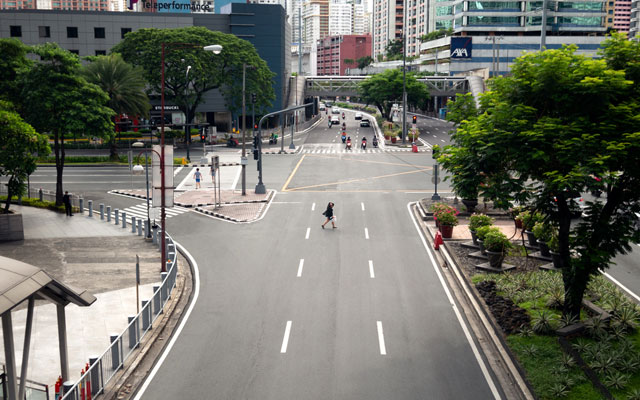
In yet another setback for the Philippines’ tourism industry, the government has announced that Metro Manila will be placed under the most restrictive enhanced community quarantine (ECQ) from August 6 to 20 to stave off a surge of the highly contagious Delta variant of Covid-19.
Under the ECQ, only essential industries are allowed to operate and public transportation either suspended or limited.
Metro Manila to be placed under enhanced community quarantine for third time since the outbreak of Covid-19
This comes after authorities extended the general community quarantine (GCQ) with heightened and additional restrictions in Metro Manila, from July 30 to August 5, with leisure and business travel being prohibited.
Various destinations throughout the Philippines are in varying levels of lockdown.
Philippine Airlines and Cebu Pacific have cancelled a number of domestic flights following the immediate suspension of point-to-point flights for leisure. Returning flights are for tourists residing in the NCR Plus (metro Manila plus Bulacan, Cavite, Laguna and Rizal).
Tourism secretary Bernadette Romulo-Puyat had informed the travel and tourism sector that from July 30, hotels are not allowed to accept leisure or staycation guests. Staycation guests residing in areas outside Metro Manila have to shorten their stay and return to their place of residence.
Essential meetings and social events are prohibited and dining is not allowed in restaurants in Metro Manila during the GCQ with heightened restrictions and ECQ.
Indoor tourist attractions have already been closed, and while outdoor attractions may operate at 30 per cent of maximum venue capacity, they will have to suspend operations by August 6.
Since July 30, point-to-point travel for leisure from NCR Plus areas has been banned. Accredited establishments outside NCR Plus areas are not allowed to accept leisure guests coming from NCR Plus areas, regardless of the date of the booking.
On August 1, the Philippines recorded 8,735 new Covid-19 cases, and 127 deaths. The country has reported 216 cases of the Delta variant, but health experts say the real number could be higher.
This is the third time metro Manila has entered ECQ, including the first at the onset of Covid-19 in March last year.
Like many social activities, corporate teambuilding programmes have been disrupted since early 2020 as governments enforced safe distancing requirements and companies began an unusual work-from-home experiment that has since become the norm in many Asian cities.
For Action Teams, a Singapore-based provider that has been in business since 1996, bookings tumbled almost 75 per cent.
Founder Raj Sandhu recalled how 2020 had started off strongly, with the whole year booked out with programmes all over the world, but spiraled into despair in February as the pandemic hit and clients either cancelled or paused their plans.
Other specialist providers, such as Asia Ability and smallWORLD Experience, saw bookings recede too. But even as governments eased restrictions and virtual teambuilding options emerged to connect remote teams, engagements throughout 2020 and 2021 are nowhere near pre-pandemic levels.
Slashed budgets due to poor corporate performance amid the global crisis, fatigue from daily online communications, and unfamiliarity with virtual teambuilding programmes are blamed for the slow pick-up.
What worries Sandhu most are companies freezing teambuilding activities because of human resource disruptions.
He explained: “Some clients have had to let people go. Hence, they feel that this isn’t a good time for teambuilding. But this is why now is a good time. If you are letting people go, the rest of the team will be worried. They will be wondering when it will be their turn.”
Sandhu said some clients also mistakenly believe that as long as teams were communicating daily via instant messaging tools, there was no need for engagement.
Lost connections
Elevated stress levels at work and remote work arrangements have presented employers with a welfare challenge, noted teambuilding specialists.
Ana Marques, general manager of Macau-based events specialist smallWORLD Experience, noted the downsides of isolation at the workplace: the growing lack of team interaction will dismantle team spirit, break down communications and eventually impact client servicing.
Remote work requires greater information sharing, as people could no longer simply walk over to a colleague for discussions, opined Marques. Teambuilding programmes can convey to participants the advantages of information sharing and identify ways to work efficiently with sharing tools.
Sandhu warned of staff burnout, especially as remote employees feel their purpose at work was just to generate results and go at it alone.
“This is the serious side of what we do,” commented David Powell, managing director of Asia Ability. “Teambuilding is often seen as being all about play. But the new work arrangements have highlighted the important values of teambuilding. Working remotely turns people’s attention to the task and away from relationships. By not conducting any team engagement now, companies risk team cohesiveness.”
Virtual uncertainty
While teambuilding specialists were able to translate their in-person teambuilding programmes for virtual use – and even craft new ones specifically for online interaction, they found themselves having to convincing clients to get onboard last year, as many companies struggled to make sense of the concept of remote work and video conferencing. This led Marques to describe the year 2020 as an “adaptation period”.
Powell: online teambuilding can be effective
“Many people were also waiting for things to get better and to return to in-person events. Different markets had different pandemic situations; some were improving and that fuelled hopes that things would return to normal soon. But as we have seen, conditions can go back and forth. Now, we are finally at a stage where people are realising that life as normal is actually some distance away and they are opening up to the idea of remote teambuilding,” said Powell.
As more clients came to accept their present situation and appreciated virtual and hybrid events, online teambuilding programmes started to see a brighter future this year, found Marques.
Teambuilding specialists were also challenged by the existence of simple and cheaper online games that competed with professional remote team engagement programmes – some of which disappointed corporate buyers and turned them off the real deal.
Sandhu said some competition came from escape room games that provided no real takeaways to achieve business goals. With prices as low as S$10 (US$7.30) per participant for these games, Sandhu said professional teambuilding providers are having a hard time competing, especially when clients are themselves unsure of what teambuilding truly means.
“For some companies, going bowling together or sharing a seafood dinner counts as teambuilding. Clients are comparing in-person experiential teambuilding programmes with (such options). To many of them, virtual teambuilding activities are perceived as just games, and therefore shouldn’t cost much.”
A real solution
Experienced teambuilding providers say clients have little to worry about the effectiveness of virtual teambuilding programmes, which are carefully designed to bring about similar results as a live engagement.
Sandhu: companies risk staff burnout
While Actions Teams had a programme matrix of 60-plus in-person activities, with each fulfilling specific team goals and serving different purposes, only 10 made the final cut for virtual conversion. Sandhu shared: “We had an intense discussion internally to determine which activities would translate well online. We have some excellent in-person activities that are not quite feasible as online versions, perhaps because it was not easy to put details on shared screens or on Google Drive.”
Actions Teams’s virtual selection attracted “great feedback”, with the company delivering five virtual and hybrid teambuilding events in November and December last year for clients in the thriving pharmaceutical industry, some of which engaged a global audience.
Powell believes that virtual teambuilding activities can be as effective as face-to-face versions – provided they are properly set up and designed to allow the same high level of energy and interaction.
“There is a lot of investment in the programme’s redesign to ensure we are doing it right,” said Powell, adding that most of Asia Ability’s virtual teambuilding programmes provide a higher facilitator-to-attendee ratio and more resources are channeled into demonstrations and rehearsals to prepare clients.
Since evolving its programmes in early-2020 to suit the online and hybrid event norm, Asia Ability has continued to innovate and today offers clients an opportunity to fulfill Corporate Social Responsibility (CSR) goals while engaging remote teams. It has also designed apps to collect live scores and other useful data for client’s real-time review.
Teambuilding specialists said virtual options offer some unique advantages, such as ease of preparations, lower logistical costs and time savings as participants do not need to travel and be far from their duties for too long.
Furthermore, a successful virtual teambuilding experience could even teach participants how to cope better with other forms of virtual engagements, added Powell.
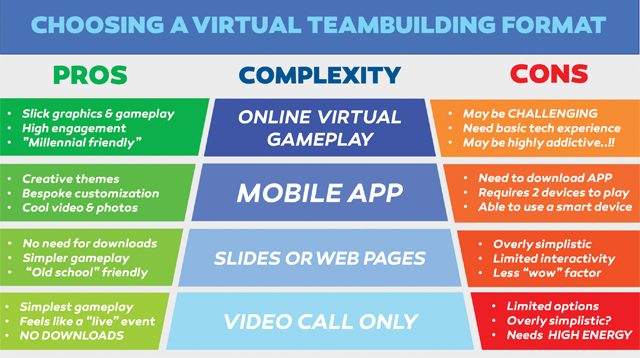
Choosing the right option will depend on factors such as corporate theme and objectives; time constraints; team’s demographic; and team’s level of technical readiness, advised David Fotheringham, director, Asia Ability. Here is a graphic to guide your selection:
The newly-opened Ritz-Carlton, Bangkok anchors the One Bangkok development with cosmopolitan elegance. Featuring the city's largest ballroom and a spectacular new penthouse suite, it delivers exceptional hardware and deeply authentic, soulful service for business and leisure travellers alike
Behind the imposing, Brutalist concrete that defines Zurich’s Oerlikon district lies a surprising secret. While its exterior honours the neighbourhood’s industrial roots, stepping inside Mama Shelter reveals a vibrant, neon-soaked world that is a far cry from its rigid shell
A polished urban retreat designed for business travellers, Hyatt Regency Kuala Lumpur at KL Midtown combines thoughtful design, seamless service, and exceptional facilities.








 Founder Raj Sandhu recalled how 2020 had started off strongly, with the whole year booked out with programmes all over the world, but spiraled into despair in February as the pandemic hit and clients either cancelled or paused their plans.