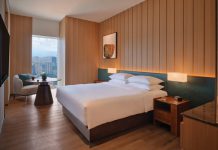
Centara Hotels & Resorts has appointed Wayne Duberly as area general manager of Centara Grand Mirage Beach Resort Pattaya, and Centara Sonrisa Residences & Suites Sriracha.
The British national started his career with Centara Hotels & Resorts as general manager in 2011 at Centara Anda Dhevi Resort & Spa Krabi, before he was transferred to helm the Centara Seaview Resort Khao Lak in 2013.
In 2015, he moved to Centara Karon Beach Resort Phuket as area general manager, where he also oversaw operations for both Centara Kata Beach Resort Phuket and Waterfront Suites Phuket by Centara.
PEOs the vaccination programme is a huge driver in opening up the world and enabling the return of global exhibitions
The global vaccination roll out is fuelling confidence in the return of in-person events towards the end of this year, with many PEOs expecting attendance to still be dominated by a domestic audience.
As a result, PEOs told TTGmice that a virtual or online element will remain for their upcoming events. Some, based on this projection, have gone on to kick off fresh, virtual-only shows.
The vaccination programme is a huge driver in opening up the world and enabling the return of global exhibitions
Claude Blanc, portfolio director, IBTM and WTM, said: “We are optimistic that our in-person IBTM World event – a flagship event on the IBTM calendar – will be able to go ahead in Barcelona this December, alongside a hybrid element.”
Similarly for Carina Bauer, CEO of the IMEX Group, she is confident that their next live show – IMEX America scheduled to take place from November 9 to 11 – will be able to proceed as planned.
Bauer elaborated: “The vaccine programme is a major determining factor as it builds confidence in the ability to travel and meet in person. We’re confident the programme will have significantly progressed by the time IMEX America takes place in November.”
This sentiment is echoed by Blanc, who has observed a “renewed sense of optimism in our industry and will continue to be a major factor in rebuilding confidence”.
However, event owners are bearing in mind the volatility of the pandemic, which could bring about sudden lockdowns or border closures.
Michael Duck, executive vice president, commercial development for Informa Markets, said: “Our strategy is to stay close to our markets, follow the government and relevant health authorities’ advice, as well as listen to our customers’ view on whether they feel confident enough to return.”
Meanwhile, Martin Ecknig, CEO of Messe Berlin, asserted that for exhibitors, the delivery of a safe event is not the “ultimate challenge”. This is because the “uncertainty lies with individuals and their willingness to travel”.
In clear indication that virtual events will be around even when in-person events return in full force, Ecknig shared that Messe Berlin is developing new concepts under Messe Plus, which “include virtual elements and address the basic need to make direct contact”.
Similarly, IBTM has permanently added the IBTM Wired event to its portfolio. The inaugural event will take place from June 28 to June 1, 2021, and bring business events professionals together for networking sessions, and a programme of live and on-demand education sessions.
“Incorporating online as part of the mix will give our community the opportunity to engage with new markets like never before by offering more flexibility and extra layers of engagement,” Blanc said.
In preparation for IMEX America, Bauer shared that the team will be launching “a series of digital activations” that will “pave the way” for the live show in November.
Duck added that Informa has been deploying a hybrid model since its return to the show floor, since its “strong comeback” in various markets.
“Our events in mainland China and Japan, including China Beauty Expo, CBME and PROJECT Tokyo, have attracted almost as many participants as before the pandemic, albeit mainly domestic exhibitors and visitors while travel restrictions remain in place. We have also held tradeshows in Thailand and Taiwan.”
All shows were concurrently opened to international participants through digital channels to help buyers and sellers connect. Duck said digital experiences, while complementary, will not replace live events, and added that they will remain part of Informa’s long-term strategy.
Despite the strengths of virtual events, Ecknig warned that the “consumption of online content is approaching a saturation point”.
PEO chiefs also agree that there is no replacement for real-life meetings and face-to-face experiences, and are eager for in-person events to return soon.
“Virtual has many advantages, but you can’t beat the excitement of a live event, and the chance meetings that occur as a result,” noted Blanc.
Bauer noted: “Virtual events…can’t offer the same depth of experience or interaction that meeting face-to-face does. There is a pent up demand to meet in person – to be able to look someone in the eye and shake their hand is a powerful way of connecting people, building relationships and creating memories.”
To restart the exhibitions industry, Duck said exhibition organisers need to work collaboratively with governments, health authorities and industry associations to reopen tradeshows. He cited Singapore as an example of having restarted events in a safe manner and that the country’s safe events plan is a “great catalyst for reigniting the industry”.
Auckland has won the bid to host the 36th Annual Scientific Meeting for the Epilepsy Society of Australia.
The event, which will be held in November 2022, will bring together 250 specialists involved in the diagnosis, treatment and research of epilepsy from Australia and New Zealand. It is expected to generate over NZ$415,000 (US$297,895) in economic impact for Auckland, including a total of 1,000 visitor nights.
Auckland will welcome the epilepsy conference next year
The bid was secured by Auckland Convention Bureau – a division of Auckland Unlimited – in partnership with Epilepsy Society of Australia, and with support from Tourism New Zealand.
Auckland Unlimited’s head of major and business events, Richard Clarke, said attracting international conferences is important for Auckland’s business events sector.
“It’s fantastic to see Auckland secure such a significant Australasian conference to further cement our position as a leading business events destination,” Clarke noted.
Tourism New Zealand’s general manager domestic and business events Bjoern Spreitzer said that it is pleasing to welcome Australasian business events back to New Zealand.
“These are important platforms for trans-Tasman collaboration, driving research and innovation in our region.”
One question many event organisers face today is: “How do I keep remote audiences engaged?”
Online attendees face many distractions, and they’re always one click away from leaving your event.
Online networking and virtual events will be around for a long time to come
It’s no surprise that deeper engagement is the number one way organisers want to improve their digital meetings and events, cited by 68 per cent of respondents in a new global survey by Aventri.
While producing a riveting virtual experience may seem daunting, new tools and smart event design make the job much easier. Try these eight tips below:
Short, snappy sessions work well with this audience. Build an engaging event agenda with live-streaming and on-demand content. Mix keynotes and main stage presentations with interactive meetings and small, collaborative breakout sessions.
People today are hungry for interaction. Keep sessions lively with insta-polls, Q&A’s, chat, social feeds, gamification and other interactivity tools.
Use matchmaking software to connect like-minded eventgoers. Attendees who opt in can get suggestions, view profiles, click a button and start a video chat. With targeted recommendations, they can interact naturally over shared interests, like they do at in-person events.
Keep it simple. Matchmaking software uses artificial intelligence to analyse profiles of attendees, sponsors and exhibitors and find networking opportunities based on mutual interests. Modern all-in-one platforms collect data across your portfolio of virtual, hybrid and in-person events. This means you capture more data for more precise recommendations.
Equip virtual breakout rooms with video chat and interactivity tools to foster meaningful connections. Attendees can meet up for one-on-one conversations or gather around a whiteboard to solve mutual industry problems with experts and peers.
Provide real-time, multilingual interpretation and closed captioning capabilities to make events accessible to diverse audiences. Cloud-based technology helps organisers scale events easily for a large global audience.
Energise the experience with creative content. Options abound, such as live concerts, deejays, improv comedy teams, photo contests, mini yoga sessions, teambuilding challenges, mixology classes, and more.
Finally, don’t let new contacts go unnoticed. Integrate your virtual event platform with marketing automation and customer relationship management (CRM) systems. You’ll streamline follow-up and keep conversations going after your event.
Complexity doesn’t work in a challenging economy, when planning teams are smaller. For successful events, thoughtful event design and technology help you do the heavy lifting.
Ryde, a Singapore-based mobility app company, has launched a premium service, RydeLUXE, targeted at business executives, corporate travellers, and premium customers.
With RydeLUXE, users will be matched with professional drivers with luxurious private-hire car hires within the Ryde App. In order to ensure premium service and quality, only professional drivers with the highest ratings will be allowed to accept RydeLUXE jobs. Car models that are currently accepted are the six-seater Toyota Alphard and Vellfire models.
Indicative fares during off-peak hours are S$25 (US$18.80) from Tanglin to Bugis and S$50 from Bugis to Changi Business Park. Both on-demand and advance bookings will be accepted.
Business owners, restaurants and hotels can also provide this service to guests looking for a premium ride via a partnership with Ryde.
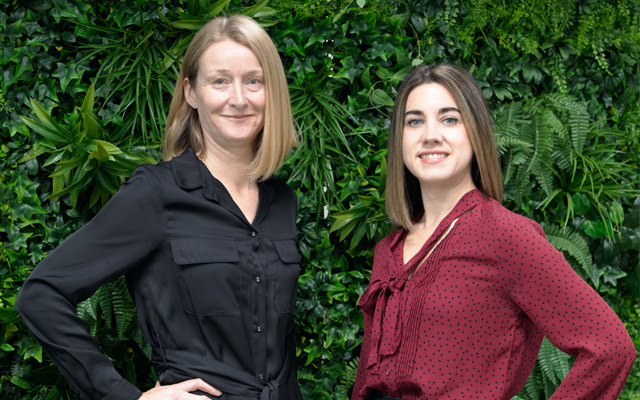
From left: Kimberley Wood and Kimberley Roberts-Salee
Canberra Convention Bureau has appointed Kimberley Wood as head of sales and Kimberley Roberts-Salee as head of marketing, in a strategic restructure aimed at streamlining operations.
Wood’s appointment as head of sales will see her guiding the organisation’s sales effort both domestically and internationally and build on the pre-pandemic success of Canberra Region as a business events destination.
From left: Kimberley Wood and Kimberley Roberts-Salee
With over 20 years of experience in the business events sector, Wood’s career spans multiple sales roles at Sydney Convention and Exhibition Centre, including business development manager – international, and most recently at Canberra Convention Bureau, first as market research manager, and subsequently as director of international bidding.
Meanwhile, Roberts-Salee will be taking on the head of marketing role, guiding her team to position Canberra as a world-class conferencing and events destination through the Bureau’s marketing and communications channels, industry events, and membership.
Beginning her career in Canada before moving to Australia, Roberts-Salee holds over 10 years of experience in the Australian tourism and business events industry, working at Business Events Cairns & Great Barrier Reef, managing tourism client accounts at Canberra-based Threesides Marketing, and for the past two years in her capacity as director of marketing and communications at Canberra Convention Bureau.
Leighton Wood, chief operating officer of Melbourne Convention and Exhibition Centre (MCEC) has announced his retirement following over 10 years of service. His last week at MCEC will be the first week of July.
Wood first joined MCEC in November 2010 as deputy chief executive.
Leighton Wood
In February 2012 he was appointed chief operating officer and currently oversees a team of more than 700 employees across operations, F&B, technology, planning, security & safety and capital works while also managing the working relationship with MCEC’s partners, Plenary Group and BGIS.
Leighton is responsible for the day to day delivery of the MCEC product and provides high-level strategic advice to the Executive Team and Trust, particularly in the areas of future business planning and ongoing organisational improvement. He is also passionate about sustainability and has driven significant reductions in MCEC’s environmental footprint.
He is currently president of the Venue Management Association of Asia Pacific and will see out his term until 2023. He was formerly vice-president of the EEAA.
Prior to MCEC, Wood held a number of senior executive roles for various organisations, including the Melbourne 2006 Commonwealth Games, Melbourne Major Events Company, Sport Knowledge Australia and the Princess Alexandra Hospital Foundation.
Following this news, MCEC has made two appointments within its executive team.
Helen Fairclough, current director of business relaunch has been appointed as chief operating officer.
Helen joined MCEC as director of people & culture and has over six years’ experience within its executive team. She has experience as acting COO and was appointed into the new role of director of business relaunch in May 2020.
Meanwhile, acting director of people & culture, Amanda Wilson has been permanently appointed as chief people officer.
In MICE business, coordinating travel for a large group of people can be a hassle, but it doesn’t have to be if you plan wisely. Whether you have to organise a business meeting; an incentive trip; an industry congress; or specialised event – the Swiss Travel System ensures meetings and incentives start as soon as your guests arrive.
The perfectly coordinated public transport system brings guests from abroad from the Swiss airport or border station directly to the congress destination.
With its charter trains the Swiss Travel System offers a mobility solution for every taste and need.
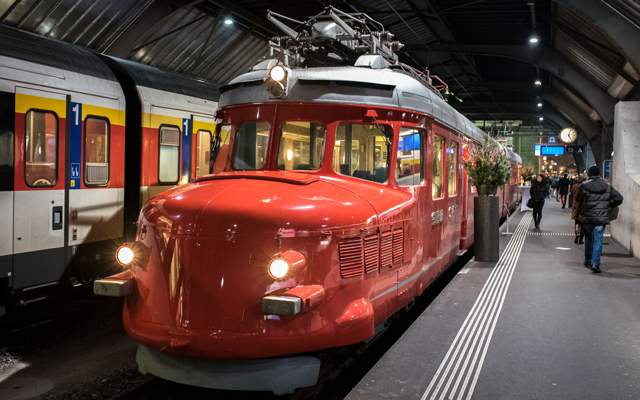
Red Arrow “Churchill”
1 of 3
This legendary train was specially designed to mark the occasion of the Swiss National Exposition in 1939. It owes its nickname to the former British Prime Minister Winston Churchill (1874-1965), who travelled across Switzerland on this train during his visit in 1946.
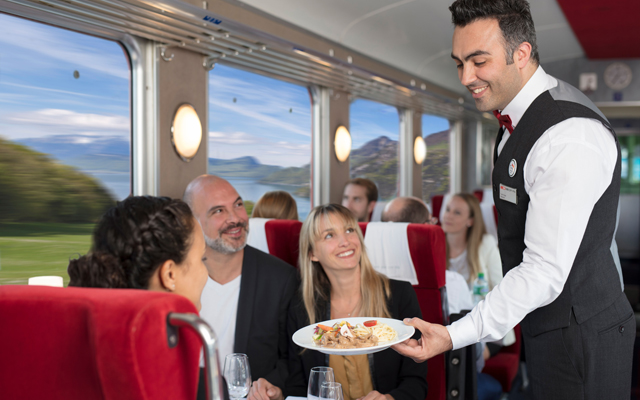
Even today, passengers can use it on individually selectable routes – just like the famous politician did – while enjoying culinary highlights or a relaxing Aperitif.
The Red Arrow “Churchill” train can accommodate 110 guests and is fitted with:
– 28 tables
– Air conditioning
– A fully stocked bar
– An on-board kitchen for catering
– Technical equipment compatible with other audio playback devices
– A wireless handheld microphone
Saloon Carriage “Le Salon de Luxe”
Le Salon de Luxe
1 of 3
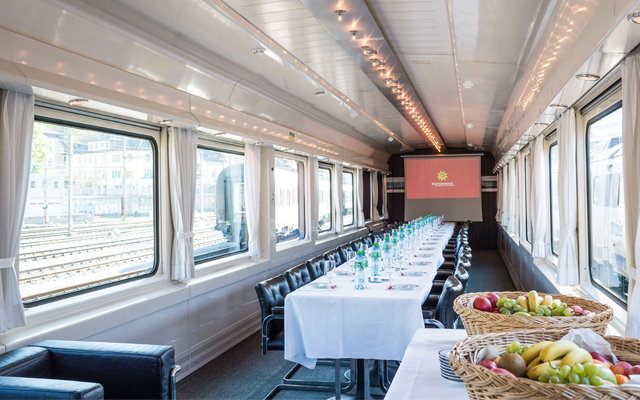
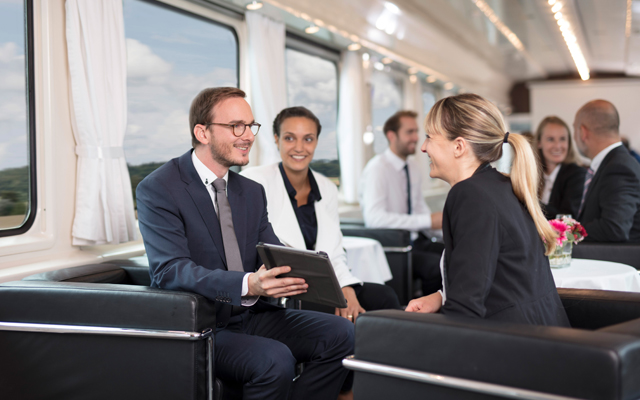
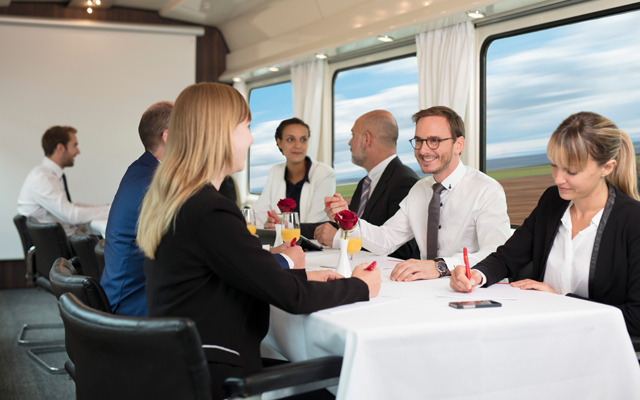
Passengers who want to use the travel time between the airport/border station and their destination for a first meeting travel in style in the charter coach Le Salon de Luxe – a conference room on wheels.
This coach is bookable in individual configurations specifically tailored to the client’s needs, e.g. with seating around a conference table, at tables of four, or in comfortable armchair and sofa seating configurations.
You will enjoy:
– Two roomy saloon carriages
– Air conditioning
– Armchairs, sofas, side tables, and chairs
– Customised interior designs and lighting
– A loudspeaker system
– Projectors and screens
– A wireless handheld microphone and headset
– A flip chart on request
– For meetings requiring a truly extraordinary ambiance, the Salon de Luxe can be integrated into a charter train including a dining car.
Sitting coaches
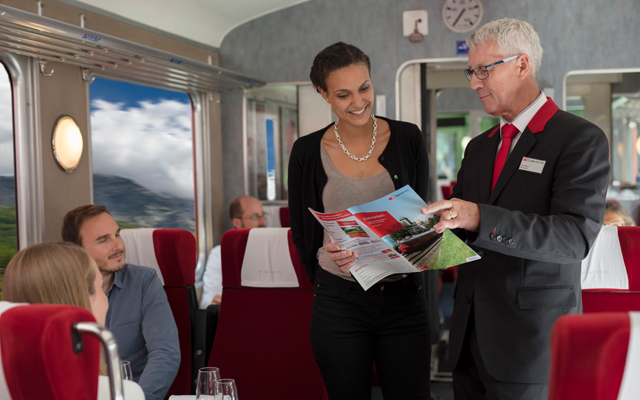
Another varied possibility onboard Swiss trains are sitting coaches. Offering superior comfort, they create an ideal setting for intimate meetings, and even catching up with work in a tranquil environment.
They can be added to the train as extra coaches, combined with other coaches or deployed as a special train, thus offering a sustainable mobility solution for up to 1,000 passengers.
Express group luggage door to door
Express group luggage door to door is available for groups of 10 or more persons (with a maximum of 50 luggage items) travelling in Switzerland by train, bus and boat.
The service is available between any two Swiss addresses including Zurich Airport. Luggage collection must be no later than 09.00, and will be delivered on the same day after 18.00. Booking, transport and payment are handled by SBB.
Price per transport: CHF 300 (net price without commission)
Things to note:
– Bookings are required no later than five working days prior to travel date
– Book online via sbb.ch/gruppengepaeck, or via email baggage@sbb.ch
– Additional services on request at individualised rates
– Luggage drop-off also possible at foreign airport (for arrivals at Zurich Airport before 11.30)
Luggage insurance
Railways provide coverage of up to CHF2,000 per luggage item in case of damage, late delivery or total loss.
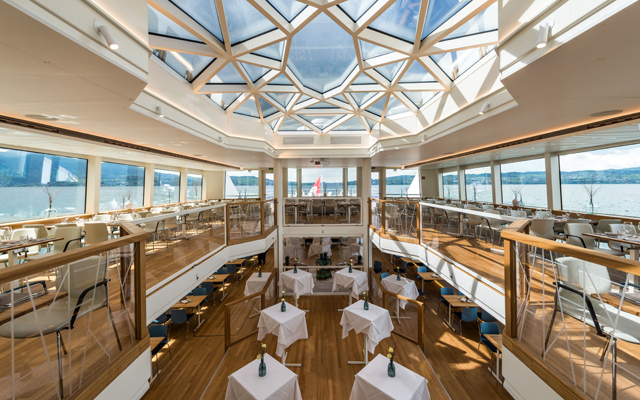
Apart from charter offers on board trains and an excellent luggage service at hand, Switzerland has several memorable charter experiences on boats and mountain railways as well.
Home to 40 museums, the city of culture for connoisseurs has the highest concentration of museums in the country. Be captivated by the charm of this “pocket-sized metropolis” – combining a romantic old town with world-class modern architecture, and the Rhine – an inviting spot to rest a while.
The new Mövenpick Hotel Basel is set to open in 3Q2021. Designed by the renowned Matteo Thun, the stylish hotel is conveniently located beside the SBB Basel railway station, marking the brand’s flagship property in Europe.
With 234 rooms and 30 suites, the hotel also comprises a meeting and events area covering a total of 2,000m2, which can accommodate up to 600 people. As well, a boardroom-to-ballroom facility at 505m2 is available – making it an ideal place to stay for both business and pleasure.
Geneva
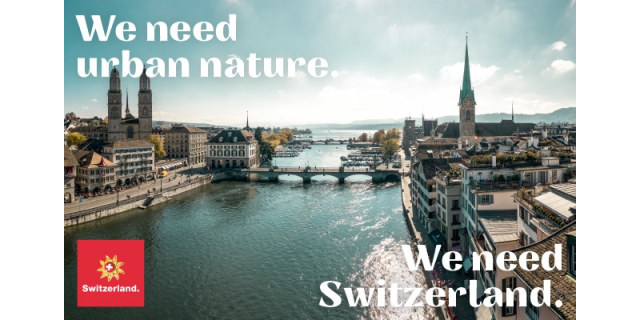
What we love about Geneva is its urban nature. One can either stroll along Lake Geneva or cruise down the Rhone River, before rounding it up at a café on a terrace in the Old Town.
An international meeting venue located in the heart of Europe known for being a global financial and technological hub, Geneva is a cosmopolitan city, a unique and particularly privileged setting for the meetings industry that takes its visitors by surprise.
Radisson Blu hotel group is adding a new property in Geneva to its portfolio. Located halfway between the city centre and the airport, it will offer 250 rooms, a restaurant and a bar. It will also have eight meeting rooms, a 350m² reception hall and eight conference rooms. Its wellness offer includes a spa and a fitness room.
Lausanne
Lausanne, the second-largest city on Lake Geneva, combines a dynamic commercial town with the locality of a holiday resort. The capital of the canton of Vaud is also a lively university and convention town. Sports and culture are given a high profile in this Olympic capital.
The Millennium is set to open in September 2021. You can expect the unexpected at this exclusive theatre and conference centre offering the best infrastructure to host your events, meetings, or special receptions, with several multipurpose meeting rooms and video-conference rooms.
Lucerne
A perfect combination of business & leisure. Excellent business infrastructures and a wide choice of hotels leave nothing to be desired. The gorgeous location by the lake and the Alpine peaks invite you to go on unforgettable excursions.
Mandarin Oriental Palace Lucerne is unveiling itself in 2022 after extensive renovation. The five-star hotel will comprise 146 rooms and suites, offering excellent views of the lake and mountains.
Zürich
The cosmopolitan city by the water combines creative urban life with nature in all its glory. Zürich is abuzz with activity day and night with its countless events, diverse museums, own food festival and Switzerland’s most vibrant nightlife. And if you’re after rest and relaxation, you can be in the Swiss mountains in less than an hour.
Become a maître chocolatier at the newly open Lindt Home of Chocolate. Discover the Instagrammable chocolate fountain over 9m tall and the biggest Lindt Chocolate Shop in the world, spread over 500m2. In the CHOCOLATERIA, you can create your very own masterpieces under the expert guidance of the Lindt Master Chocolatiers while learning many interesting things about the origin, history and manufacture of Lindt chocolate.
The Switzerland Convention & Incentive Bureau offers free of charge independent assistance in planning your event in Switzerland. Save time, talk to us!
Visit us at:www.MySwitzerland.com/meetings
A cruise plying the waters along Seoul's Han River
Despite the current travel situation, Seoul Convention Bureau has released various support programmes for hybrid events, as well as conducted strategic planning, to plan for the return of business events in the future.
Aside from beefing up meeting technology around the city to support hybrid events, SCB has released a Reassuring Package, aimed at providing MICE delegates with a peace of mind when visiting the city. The package includes emergency medical insurance, language services, and general concierge services for hotel and transportation reservations.
A cruise plying the waters along Seoul’s Han River
Organising an online or hybrid event will also be eligible for financial supports and more. For instance, when utilising the Virtual Seoul platform, not only are the 3D graphics offered at no charge, 10 million Korean won (US$8,980) will also be provided as a stipend to event planners to offset operating expenses.
Application requirements have also been eased to make it easier for event planners to receive the appropriate level of support when hosting an international conference. This support at the bidding phase includes consultations, official supporting letters, presentation tips, and a maximum stipend of 200 million Korean won during the hosting phase.
SCB also plans to offer consulting services in international marketing and IT technology to help local planners advance their skills as SCB pushes for more hybrid events are expected to take place.
The bureau has also enacted a strategic growth plan with the aim of developing international exhibitions comparable to CES. Currently, 34 exhibition organisers have been selected and provided with a grant of 80 million Korean won to scale their events up.
And finally, SCB is cooperating with the Korea Exhibition Organizers Association to develop an online platform so that local organisers need not create one on their own for every event.
The newly-opened Ritz-Carlton, Bangkok anchors the One Bangkok development with cosmopolitan elegance. Featuring the city's largest ballroom and a spectacular new penthouse suite, it delivers exceptional hardware and deeply authentic, soulful service for business and leisure travellers alike
Behind the imposing, Brutalist concrete that defines Zurich’s Oerlikon district lies a surprising secret. While its exterior honours the neighbourhood’s industrial roots, stepping inside Mama Shelter reveals a vibrant, neon-soaked world that is a far cry from its rigid shell
A polished urban retreat designed for business travellers, Hyatt Regency Kuala Lumpur at KL Midtown combines thoughtful design, seamless service, and exceptional facilities.