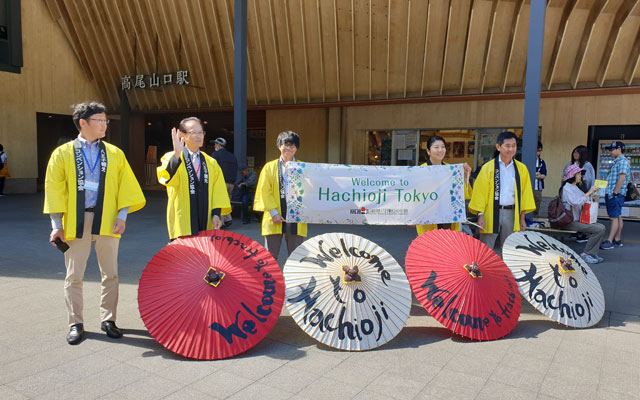
Representatives of the Hachioji Visitors & Convention Bureau welcoming MICE journalists during a Tokyo fam trip last Wednesday
The Japanese city of Hachioji in Western Tokyo – host of the IFSC Climbing World Championships in August this year – is hoping to leverage the international event to raise its profile as a popular destination for global sports meets and demonstrate its ability to welcome large, specialised gatherings including business events.
The Championships, organised by the International Federation of Sport Climbing (IFSC), was attended by more than 253 athletes from 39 countries over a 12-day period.
Representatives of the Hachioji Visitors & Convention Bureau welcoming MICE journalists during a Tokyo fam trip last Wednesday
Speaking to TTGmice through translators, Takeyama Jun, director, Hachioji Visitors & Convention Bureau, said hosting the IFSC Climbing World Championships has led to other climbing and bouldering sports events in the city.
Emphasising Hachioji’s expertise in supporting large events, Takeyama said the city attracts many sports gatherings, most of which are university leagues. The city with a population of just half a million has 21 universities, which are helping to bring many international academic conferences to the destination.
The city’s appeal among organisers of sports events is enhanced by its lush natural environment, with Mount Takao being the star attraction. Standing 599 metres tall and protected within Meiji no Mori Takao Quasi-National Park, Mount Takao is home to 1,600 plant species and rich wildlife including flying squirrels, foxes and wild boars.
Yumura Aiko, MICE marketer with Hachioji Visitors & Convention Bureau, said Mount Takao’s well-preserved natural environment and hiking trails have gained interest among some corporate groups that seek a different experience of Tokyo during their meetings.
To enhance a nature-based day trip extension from meetings held in nearby Tokyo, Hachioji Visitors & Convention Bureau is working with Takaosan Yakuo-in Yuki-ji temple on Mount Takao to offer local experiences to corporate and private groups. Besides architecture tours around the century-old Buddhist temple led by a monk and observations of the dramatic Fire Ceremony, Yakuo-in has tatami rooms for hire, where groups can conduct meetings or banquets over exquisite shojin ryori vegetarian cuisine.
“We are interested to get more international conventions, especially large ones. To this end, we are working with Tokyo Convention & Visitors Bureau to market the city to overseas MICE buyers,” said Takeyama, who added that venue capacity in the city will get a boost in the arm when a 2,400m2 convention centre opens in 2022 close to the Hachioji train station.
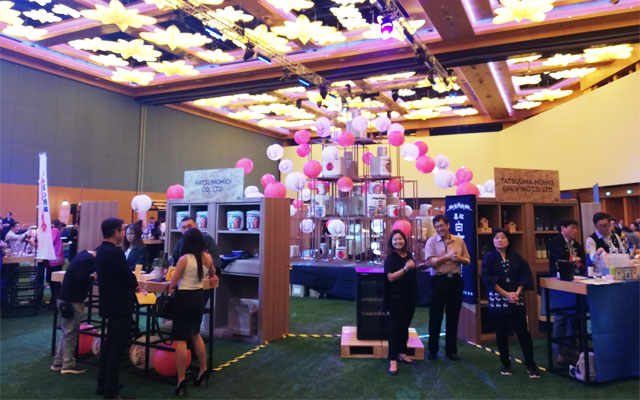
F&B professionals deepened their technical expertise and knowledge of fine wines at the event
New trade-targeted initiatives featured at Resorts World Sentosa’s (RWS) The GREAT Wine & Dine Festival last week has allowed the annual public event to accomplish greater business objectives.
Held from October 10-12, the festival featured an exclusive trade day for the first time. The event opened to visitors from the F&B sector from Singapore and the region, showcasing more than 400 wines, which attracted many sommeliers and bar managers, who took the opportunity to network with distributors at the wine crate-designed booths.
Exhibitors included 27 local and overseas wine distributors who brought in a comprehensive selection of wines ranging from classic regions such as Tuscany or Bordeaux to new-world regions such as Australia, New Zealand and California, as well as organic and natural wines.
A highlight on the showfloor was a special themed zone that featured eight sake breweries across Japan, which were brought in by a partnership between RWS and the Tokyo-based Japan Sake & Shochu Makers Association.
The second new trade initiative was The Harvest seminar on October 11. The by-invite event was attended by about 80 members of the wine trade across South-east Asia who built up their technical know-how through participation in a panel chaired by esteemed wine experts who were specially flown in for the event.
British wine writer and television presenter Oz Clarke spoke about trends in the global wine and spirits arena, while Kenichi Ohashi, owner of Yamajin, a liquor distribution company in Japan and a Master of Wine, shared wine pairing tips for Asian cuisine with Hong Kong-based wine critic Jeannie Cho Lee, who is also the first Asian Master of Wine. Swedish sommelier Andreas Larsson, who was elected World’s Best Sommelier in 2007 and American Master of Wine & Master Sommelier Doug Frost divulged tips and tricks on pairing wines with Western cuisine.
The wine experts also conducted masterclasses on topics such as Spain’s and Japan’s indigenous grape varietals, and comparing old and new-world wines. These classes were also opened the public.
RWS hopes to position these classes and The Harvest seminar as thought leadership platforms for industry practitioners to interact and share best practices in the wine industry.
By involving its sommeliers and F&B managers in this event, RWS also hopes to build up its wine programme and capabilities to complement dining experiences at its stable of 12 celebrity chef restaurants, including the one-Michelin-starred table65.
The GREAT Wine & Dine Festival also comprised a gala dinner on October 10, where the results of the inaugural Wine Pinnacle Awards, which celebrates fine wines and wine personalities, were announced.
Chef Nicolas Masse of two-Michelin-starred restaurant La Grand’Vigne in France was flown in to helm the five-course black-tie gala dinner for more than 300 guests, which included head honchos and ambassadors. The night’s entertainment included a wine-themed dance performance complemented by aerial dancers and jazz tunes by the Cultural Medallion recipient Jeremy Monteiro and his jazz quartet.
A RWS spokesperson said: “Welcoming the crème de la crème of the world’s wine community required seamless execution from our MICE and F&B teams. It put our hospitality, facilities and event planning expertise to the test.”
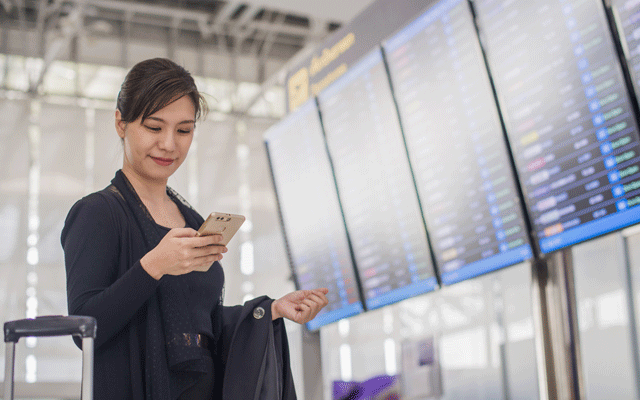
Amadeus predicts that travellers will expect everything to be easily accessible to them through one, simple to use app
‘Super apps’, voice-enabled bookings and 5G roll-out will have a significant impact on business travel in 2020, according to a new paper released by travel technology company Amadeus.
Despite the growth of technologies that make virtual meetings possible, business travel spend in the region is still predicted to double between 2020 to 2025, with the region forecast to eventually account for half of the world’s total spend.
Amadeus predicts that business travellers will expect everything to be accessible to them through one app eventually
‘Bleisure’ travel – where employees add leisure time and activities onto work trips – has also been rising in Asia, with a survey by Amadeus finding that Asian corporate travellers are twice as likely to book work trips that include weekends than their European counterparts.
Against this backdrop, Amadeus’ Future of Corporate Travel paper, written in conjunction with senior leaders from Musement, BorderPass and Mitsubishi Fuso Truck and Bus Corporation, identifies five key trends that travel companies in the region need to be aware of as corporate travel continues to grow and evolve:
1. Voice is the next frontier for bookings
There’s a major shift happening between human and computer interaction, particularly with voice technology across Asia-Pacific. As travel companies continue to invest in voice technology, businesses will have quicker access to the traveller’s profile, real-time alerts and in-flight amenity checks within a single natural sentence. This means that travel consultants and travellers won’t have to go through multiple screens; they will soon be able to achieve the same goal much more quickly – using voice.
Nishank Gopalkrishnan, chief business officer, Musement, commented: “I personally think voice will be the differentiator moving forward. If you think of it, talking to one another is the most natural thing humans do. Typing, swiping and other forms of interaction are all just intermediate steps, as we are unable to efficiently talk to a machine. This will change, and companies that devise the most efficient way of selling high value and high engagement products via voice will lead in the future.”
2. The rise of ‘Super-apps’
Corporate travellers are juggling so many travel apps, including for their airlines, travel agencies and hotels. In the future this will move to a ‘one-app/ super-app’ concept, giving corporate travellers the ability to book, make changes, get an itinerary and claim expenses – all on one single app. It is already one of the top trends among big players in the mobile space.
Much like WeChat has done for years in China, several other companies in Asia like LINE, KakaoTalk, Grab, and Go-Jek are expanding to other verticals to add functionalities and content to their apps, from mobility options to food delivery, media, payments and travel, targeting more business travellers.
Moving forward, travellers will expect everything to be easily accessible to them through one, simple to use app. This is a commercial opportunity for travel companies, and businesses need to bear this in mind when reviewing the solutions that they make available to their employees.
3. Feeling the impact of 5G
Faster networks through 5G are now being deployed across Asia-Pacific and are enabling other technologies to take off, changing the way that travellers move around their own cities and travel to others. Thanks to the increased speed and amount of data, there will be more advanced connected devices – from smart homes to self-driving cars and smart cities – and increased personalisation through Artificial Intelligence (AI).
This greater connectivity will allow travel companies to provide a seamless travel experience in which a business traveller can go door-to-door from their home to a hotel with little hassle and a truly personalised service. The frictionless experience will continue at their hotel with 5G smart hotels – offering faster connection speeds for smartphones and connected devices. With 5G, the end traveller is going to be better connected than ever before. Businesses need to be ready for this and ensure they best equip their employees to take advantage of 5G hyper-connectivity.
Edgar Vega, commercial head of APAC, mobile, Amadeus, commented: “Business travel is no longer just about getting to and from home. It is a series of experiences that demand an intuitive, streamlined management – which is driven through mobile. I’m convinced that the 5G rollout will completely transform the corporate traveller’s mobile experience. For starters, access to unlimited data will allow for more informative and productive business trips while on the other side corporations will be able to provide better guidance for their corporate travellers in terms of access to hotel, transfer and destination services in virtual reality format.”
4. Mastering security with a seamless travel experience
The security of corporate travellers will always be the number one priority for corporations and travel management companies. However, maximum security doesn’t always mean a smooth travel experience. One trend to look out for in the near future is how the travel industry will master security alongside a seamless travel experience.
Innovation in this space is already well underway and biometrics are playing a huge role in making this happen. Long queues and scanning passports will become a thing of the past as travel becomes frictionless. Amadeus is already working with several airports in line with IATA’s One ID vision to use biometrics to reduce wait times and move towards a remotely-hosted biometrics solution for the industry.
By providing a seamless travel experience, business travellers will be able to spend less time waiting in queues and spend more time focused on the job they are there for. This is crucial for those that travel regularly for work – especially in terms of keeping job satisfaction levels high.
5. Duty of care
In most countries, employers have a legal and ethical duty of care to their employees when they travel, which means they should take all reasonable steps to ensure employees’ health and safety.
In the near future, we expect to see companies evolving their duty of care approach to a real-time one that uses mobile technology and instant messaging to keep track of their employees’ well-being minute- by-minute. This will allow companies to provide real-time assistance and disruption management to tackle any issues directly and without delay.
Jun Noguchi, senior manager, head of HR systems health & safety Fuso, human resources, Mitsubishi Fuso Truck and Bus Corporation: “In any industry, the safety and security of employees traveling for corporate travel is a company’s number one priority. For us, it’s essential that we have a trusted travel technology partner that will help us focus on operations and then cost optimisation. This will ensure we always undertake the right duty of care priorities and help us continue to give our employees the highest quality experiences whilst they travel for work.”
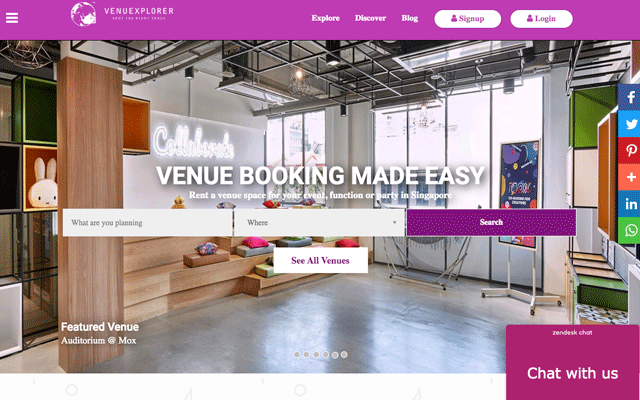
This acquisition is expected to bolster Venuexplorer Singapore’s growth in the region; screenshot from Venuexplorer
Online venue marketplace Venuexplorer Singapore is looking at a network power-up through its acquisition by global online hotel reservations services HotelPlanner.
Venuexplorer’s founder Christopher Lee said in a statement: “New advances in technology are fuelling the events industry, and we’re confident that HotelPlanner’s revolutionary booking technology will help take us to whole new levels.”
This acquisition is expected to bolster Venuexplorer Singapore’s growth in the region; screenshot from Venuexplorer
Venuexplorer Singapore features over 100 event spaces in Singapore, including restaurants, banquet halls, conference centres and less conventional places like *SCAPES, Singapore Turf Club, F1 Karting Circuit and more.
The company’s target is to increase the market share by up to 300 event spaces by the end of this year, and to broaden its network in Asia-Pacific by 2020.
Lee has also been appointed executive vice president, APAC for HotelPlanner Singapore, and has been tasked with spearheading the company’s growth into Asia-Pacific.
Tim Hentschel, co-founder and CEO of HotelPlanner, remarked: “We are very pleased to have Venuexplorer as part of our extended family and are confident that our success in the industry will allow them to continue exceeding expectations.”
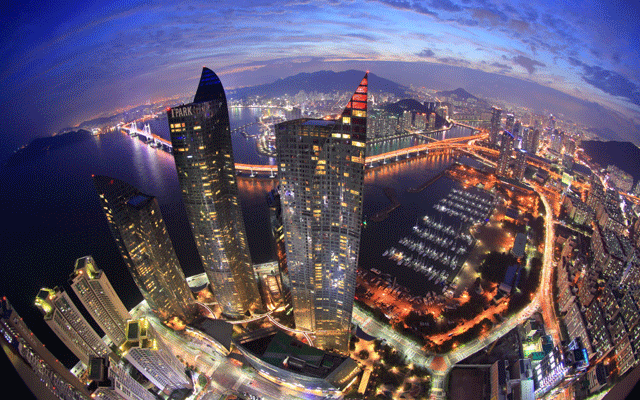
Busan, a large port city in South Korea, is the site for this large-scale conference
South Korea has won her bid for the 23rd International Federation of Automatic Control (IFAC) World Congress, an event that will welcome approximately 3,500 delegates to Busan from August 20-25, 2026.
The decision was unveiled during the IFAC board meeting on September 8, 2019, in Vienna.
Busan, a large port city in South Korea, is the site for this large-scale conference
Founded in 1957, the IFAC is focused on automatic control and has representation in the fields of engineering, science and the impact of control technology on society. Its community boasts members from 50 countries.
Korea Tourism Organization (KTO), Busan Tourism Organization (BTO), and Control Robot Systems Society, South Korea’s member of IFAC, supported the bid. On KTO’s part, for example, it conducted site inspections and hosted events such as Korea Night. Earlier in 2018, KTO appointed vice president of IFAC, Cho Dong-il, as an honorary Korea MICE Ambassador.
Oh Choong-sub, head of the convention team at KTO, said: “At international conventions, a large number of experts visit Korea from overseas and conduct academic exchanges. This has significant effect not just on related industries in Korea, but on Korean tourism as well. Particularly, the IFAC World Congress in Busan will have significant impact on the local economy and help to raise global awareness about Korea.”
Previous IFAC congresses were held in France (2017) and South Africa (2014). Next year’s congress will be held in Berlin, Germany.
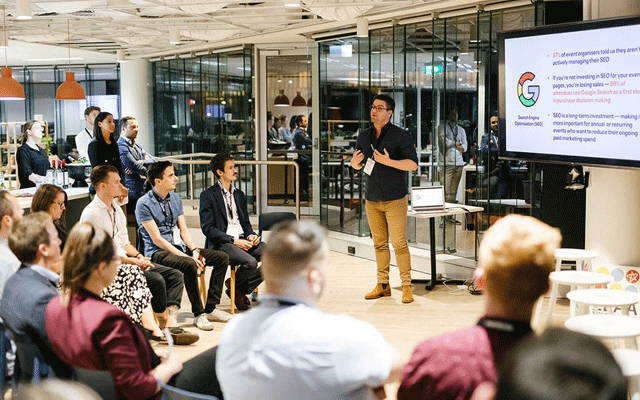
Josh McNicol, general manager and head of marketing for Eventbrite APAC, also presented Eventbrite’s annual Pulse Report, which deep-dived into the most effective event marketing channels for 2019
The Exhibition and Event Association of Australasia (EEAA) Young Stars, a group that engages under 35-year-olds working in the exhibitions and events industry, gathered in Melbourne last week to discuss emerging marketing trends for the exhibitions and business events sector.
More than 50 people gathered at the Eventbrite headquarters, to learn from a panel that shared case studies on successful marketing strategies for both trade and consumer events.
Josh McNicol, general manager and head of marketing for Eventbrite APAC, presenting Eventbrite’s annual Pulse Report
The panel was led by Chris Schlueter, EEAA board member and product manager from Sprintr by AV1, with industry experts Timothy Collett, managing director, Specialised Events; Megan Coningsby, strategic marketing manager, Eventbrite APAC; Dean Prenc, general manager, Madman Anime Group; and Laura White, marketing manager, Events & Exhibitions Australia.
Josh McNicol, general manager and head of marketing for Eventbrite APAC, also presented Eventbrite’s annual Pulse Report, which deep-dived into the most effective event marketing channels for 2019.
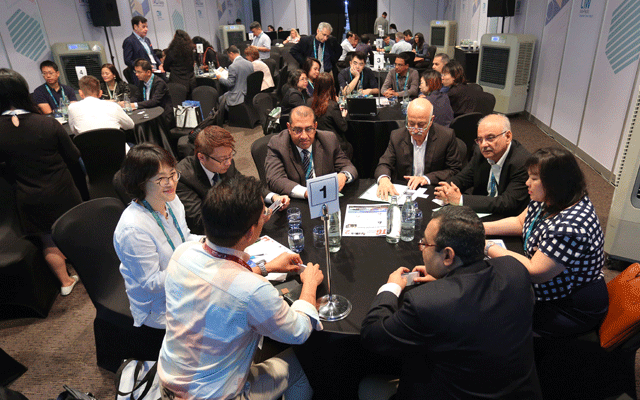
IT&CMA and CTW Asia Pacific 2019 concluded on a high with delegates expressing positive experiences across the board, as a variety of business, learning and networking objectives were met through new initiatives.
Notable highlights, aside from the 12,000 business appointments, were the popular Brand Showcase Presentations, Meet-The Corporates and Exhibition Walkabouts.
Meet The Corporates session, where IT&CM Asia exhibitors get to meet CTW Asia-Pacific’s corporate buyers
The 10 Brand Showcase Presentations saw full attendance with participating exhibitors being “extremely satisfied” with the turnout of attendees and the opportunity to share their latest highlights and features they offer, according to a post-show satisfaction survey.
“It is a good platform to showcase India as a MICE destination to relevant buyers and we are extremely pleased to have more prospective buyers approaching us after the Brand Presentation Showcase,” commented Sudeshna Ramkumar, assistant director of India Tourism.
Susan Maria Ong, MICE director, Asia Pacific of Japan National Tourism Organization, which was featured in the Exhibition Walkabout, commented: “This is the first time that IT&CMA has had this Exhibition Walkabout initiative and it was a great opportunity for us to meet more association buyers at one go compared to one-to-one business appointments.”
Say Hi To Everyone, the first day’s opening ice breaker, was a highlight for many.
“Say Hi to Everyone was a very good networking session where we got to know new buyers who were at the show this year. This new initiative is definitely a good opportunity for business,” said Walter Ng, manager, sales & event services of Setia Convention Centre.
Delegates also commended this year’s networking sessions that saw a bevy of sponsored luncheons, coffee breaks, dinners and cocktails by participating exhibitors and sponsors.
“Known for mountaineering, trekking and organising renowned art and music festivals, little has been talked about Nepal being one of the preferred destinations for corporate travel despite hosting various regional government and corporate conferences. The networking luncheon organised by Visit Nepal Year 2020 Secretariat during IT&CM Asia 2019 was an opportunity to showcase the country as one of the perfect MICE destination of choice and to promote Visit Nepal Year 2020 Campaign,” stated Rohini Prasad Khanal, programme manager of Visit Nepal Year 2020 Secretariat.
Meanwhile, the expanded Asian MICE Cruise Conference, established Association Day forums, reintroduced ASEAN MICE Forum, and CTW Asia-Pacific Conference also received positive reviews from delegates.
Noor Ahmad Hamid, regional director (Asia Pacific) of ICCA, said: “IT&CMA has always been a great platform for sharing and having discussions with like-minded peers during the various knowledge sessions. The lingering question of whether CVBs and PCOs should work together for greater success was addressed during one of the Association Day forums. It was truly an eye-opener for both delegates and panelists.”
IT&CM Asia and CTW Asia-Pacific will return on September 22-24, 2020.
Park Inn by Radisson has opened Park Inn by Radisson North EDSA, the fourth of its brand in the Philippines and the first in Metro Manila.
The hotel in Quezon City offers 238 rooms, including 16 suites with separate living areas and upgraded services such as VIP welcome amenities, Nespresso machines, minibars with free drinks, complimentary daily newspapers, late check-out and discounts on transfers and spa services.
Guests can refuel at three F&B outlets: Casa, the all-day dining restaurant; Terraza on 7, which serves poolside drinks and light snacks; and the social Lobby Bar. Aside from the fitness centre, other facilities include the Makiling Grand Ballroom, Banahaw Meeting Rooms and a pre-function area that accommodates up to 640 delegates.
The hotel is surrounded by educational institutions, medical establishments, offices and entertainment areas, with Manila International Airport just 22km away.
Wharf Hotels has appointed Christopher Johnson as general manager of Marco Polo Jinjiang.
With 20 years of experience in hospitality industry, Johnson has held senior leadership roles at international hotel brands including Hyatt, Hilton, Four Seasons, InterContinental and Fairmont.
Prior to joining Marco Polo Jinjiang, Johnson was general manager at Millennium Gaea Resort Hualien, Taiwan.
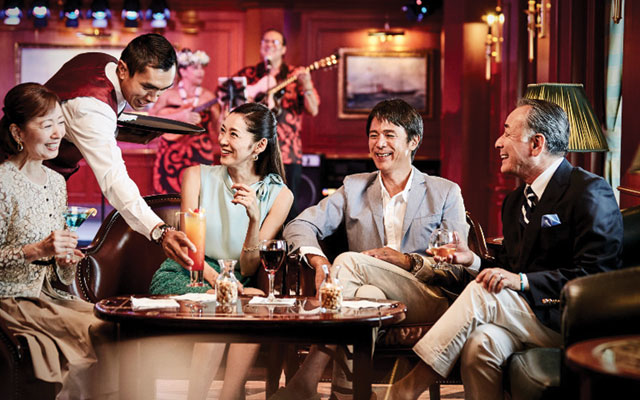
Princess Cruises’ Crooners bar conveys a classic Sinatra era vibe
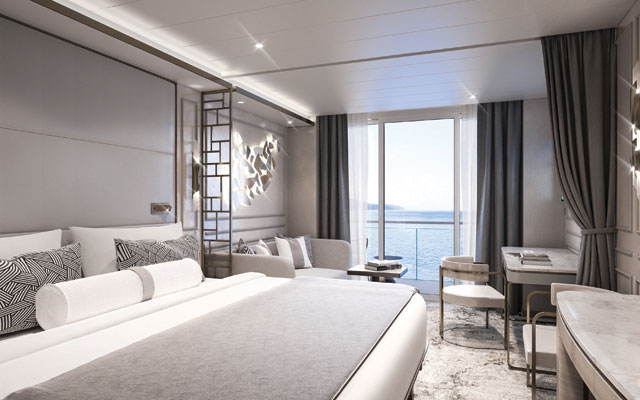
Crystal Endeavor’s deluxe suite promises a fine stay onboard Silversea Cruises
CRYSTAL CRUISES ShipCrystal Endeavor Capacity 200 Destinations Japan, Taiwan, the Philippines, Indonesia and Australia Why meet onboard?Crystal Endeavor is a polar class mega-yacht with 100 twin rooms and six different dining venues that come with meeting facilities. This compact but luxurious cruise ship welcomes whole ship charters.
To deliver the best event experience for guests, staff onboard works closely with planners to tailor programmes according to specific requirements and needs.
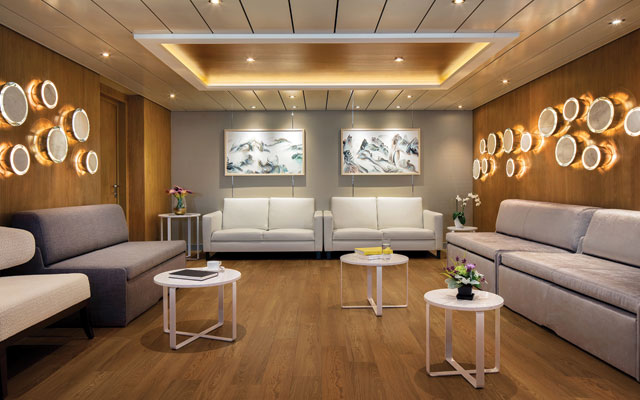
Meeting Room Lounge on World Dream
DREAM CRUISES ShipsGenting Dream, Explorer Dream Capacity 3,300 (Genting Dream); 1,856 (Explorer Dream) Destinations Indonesia, Malaysia, Singapore and Vietnam (Genting Dream); Australia, China, Japan, Hong Kong, New Zealand and Vietnam (Explorer Dream) Why meet onboard? Built with corporate events in mind, both Genting Dream and Explorer Dream feature the latest business equipment and a selection of indoor and outdoor venues, including the massive Zodiac Theatre.
On Genting Dream, the Zodiac Theatre seats 999 people while on Explorer Dream it seats 830.
An event experience unique to Dream Cruises is Dream Night, a spectacular fireworks display against the night sky as guests celebrate the start or end of their event over champagne and cocktails.
Both ships are packed with activities that are great for corporate teambuilding and incentives. For instance, planners can make magical moments with a private foam
party at Zouk Beach Club onboard Genting Dream, or hold VR/AR arcade game challenges at the ESC Experience Lab onboard Explorer Dream.
C-suite gatherings can be held within The Palace, an ultra luxurious ‘ship within a ship’ area that promises exclusive privileges to VIP guests.
Princess Cruises’ Crooners bar conveys a classic Sinatra era vibe
PRINCESS CRUISES ShipsSapphire Princess, Diamond Princess Capacity 2,670 guests Destinations Singapore, Malaysia, Indonesia, Vietnam, Cambodia, China, Hong Kong, South Korea and Japan Why meet onboard? Both Sapphire Princess and Diamond Princess are group-friendly, with cabins that can offer either twin beds or a queen at the planner’s request, plus staterooms for three or four sharing guests.
There are also numerous facilities for corporate gatherings. The Princess Theatre can accommodate group sizes of up to 700, while dining functions can be arranged at various dining rooms that can take up to 240 guests in one sitting.
As well, both ships offer a variety of dining experiences and venues, ensuring happy bellies all around. Furthermore, complimentary room service is available for event delegates.
There’s never a dull moment onboard, thanks to plenty of recreational options such as Broadway-style entertainment shows, art auctions, game shows, ballroom dancing classes, and movies under the stars, featuring the latest blockbusters and complimentary popcorn and hotdogs.
Tying all these together is Princess Cruises’ events services support team that will ensure assistance for all onboard programmes as well as group shore excursions.
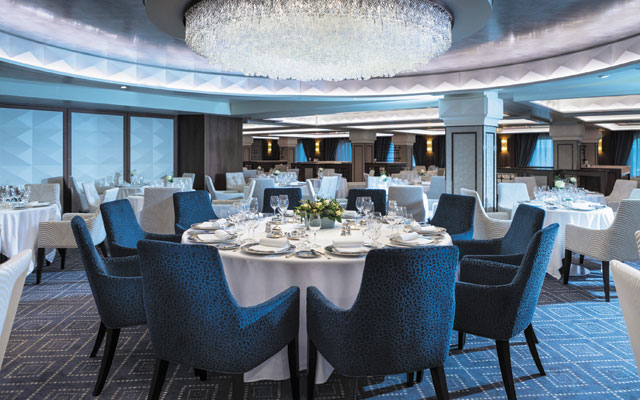
The elegant Compass Rose on Regent Seven Seas Mariner
REGENT SEVEN SEAS ShipRegent Seven Seas Mariner Capacity 700 Destinations Singapore, Indonesia, Malaysia, Thailand, Sri Lanka and India Why meet onboard? Spacious conference and meeting rooms for up to 700 people are available onboard the Regent Seven Seas Mariner, all armed with state-of-the-art multimedia facilities. Corporates that choose a full charter have the option for corporate branding throughout the ship.
On top of the signature restaurants and casual eateries, the ships feature complimentary in-room dining with free flowing premium wine and spirits – perfect for delegates to wind down after a long day of meetings.
There are also world-class theatrical productions and musicals including performances by the Regent Signature Orchestra.
ROYAL CARIBBEAN CRUISES ShipsVoyager of the Seas, Quantum of the Seas Capacity 4,269 guests Destinations Malaysia and Thailand (Voyager of the Seas); Malaysia, Thailand and Vietnam (Quantum of the Seas) Why meet onboard?Voyager of the Seas and Quantum of the Seas are giants to ride Asia’s waves in 2019/2020, making them perfect for large MICE groups.
Voyager of the Seas offers 1,600 twin cabins and meeting rooms for up to 1,400 people. The largest function space is the elegant La Scala Theatre which, in the evening, is home to Broadway-standard shows.
There are several recreational gems onboard that planners can be weaved easily into a corporate programme. One such facility is the ice skating rink where performances by professional skaters from around the world are held. Outside of scheduled shows, the rink can be used for teambuilding activities or casual meetings for up to 800 pax. Other facilities include a basketball court, rock-climbing wall, miniature golf course and the FlowRider surf simulator.
Quantum of the Seas offers 1,900 twin cabins and meeting facilities for up to 1,400 people. The jewel in its crown is the Two70, an entertainment hub that offers guests multiple experiences throughout the day – a feature that is unique to the Quantum-class ships. With capacity for 615 guests, it is the perfect venue for meetings and seminars, especially when impressive visuals are needed to complement messages.
Thrills are available across the Quantum fleet, from RipCord by iFLY – the first skydiving simulator at sea – to SeaPlex bumper car ring and FlowRider surf simulator, among others.
A spread of 15 restaurants, including the famed Jamie’s Italian by Jamie Oliver and the ultra exclusive Chef’s Table, help planners dish out varied dining experiences.
SILVERSEA CRUISES ShipsSilver Spirit, Silver Muse Capacity 608 (Silver Spirit); 596 (Silver Muse) Destinations Singapore and Hong Kong (Silver Spirit); Tokyo, Singapore, Hong Kong and Vietnam (Silver Muse) Why meet onboard? Both Silver Spirit and Silver Muse are luxurious all-suite ships with twin-sharing possibilities. Each vessel houses eight restaurants and a theatre that accommodates 320 guests.
Silversea’s team of corporate and incentive planning professionals provides creative solutions to ensure that corporate events take off successfully. The extensive host of event planning resources available onboard ensures that all special activities and services are well customised and arranged, promising delegates an unforgettable experience.
Upon arrival, the butler welcomes guests personally, orientating them to their suites and even offering to unpack their bags.
STAR CRUISES ShipStar Pisces, Superstar Aquarius, Superstar Gemini Capacity 1,027 (Star Pisces); 1,511 (Superstar Aquarius); 1,530 (Superstar Gemini) Destinations Hong Kong, Indonesia, Japan, Malaysia, Singapore, South Korea, Taiwan and Thailand Why meet onboard? Star Cruises liners boast facilities that are on par with world-class hotels, offering corporate groups quality twin-sharing accommodation, fully-equipped work spaces, and a wide variety of teambuilding activities.
Event planners have the flexibility to customise onboard activities with the help of Star Cruises’ in-house planners and event coordinators.
Offering panoramic views of the ocean from a glass-fronted observatory area, the Galaxy of the Stars lounge onboard these ships is ideal for presentations and product launches. With a seating capacity of up to 292 guests, it also serves as a popular party ground where delegates can dance their night away after a day of meetings.
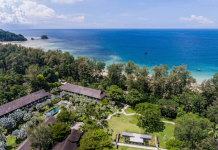
Just 10 minutes from Phuket International Airport on the serene northern coast, this 178-key, Bill Bensley-designed resort offers delegates a quiet, tropical paradise steeped in Phuket’s tin-mining heritage
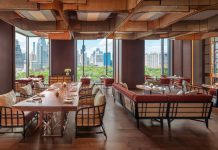
The newly-opened Ritz-Carlton, Bangkok anchors the One Bangkok development with cosmopolitan elegance. Featuring the city's largest ballroom and a spectacular new penthouse suite, it delivers exceptional hardware and deeply authentic, soulful service for business and leisure travellers alike
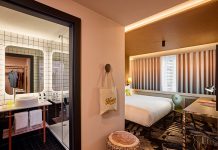
Behind the imposing, Brutalist concrete that defines Zurich’s Oerlikon district lies a surprising secret. While its exterior honours the neighbourhood’s industrial roots, stepping inside Mama Shelter reveals a vibrant, neon-soaked world that is a far cry from its rigid shell