Corporate buyers are spending more per delegate and expecting higher returns as they move around South-east Asia, prompting DMCs and tour operators to overhaul generic itineraries in favour of bespoke, highly-localised programming.
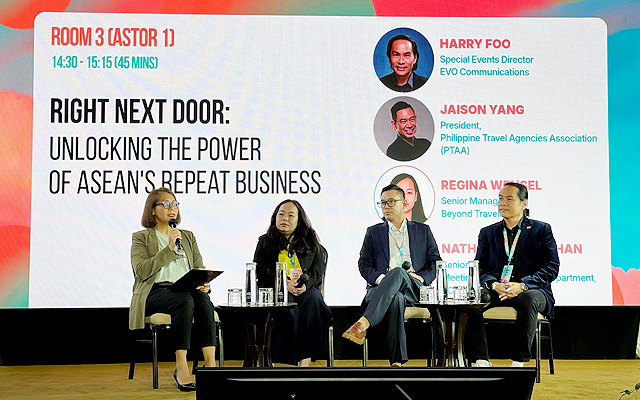
Speaking on a panel titled Right Next Door: Unlocking the Power of ASEAN’s Repeat Business at TIME 2026 Knowledge Exchange in Bangkok, regional travel trade leaders warned that off-the-shelf packages for corporates – dominated by standard temple tours, generic shopping stops, and routine boat rides – are losing traction among repeat corporate clients.
“Something you can lessen is the templated MICE itinerary. Operators tend to focus on numbers, so they tend to just sell the same itineraries. But the market is changing, said Jaison Yang, president of the Philippine Travel Agents Association.
A central takeaway was the danger of treating the South-east Asia region as a monolith. DMCs must segment their product strategies based on source market geography and urban demographics, with preferences varying wildly across neighbouring countries.
Harry Foo, special events director with Singapore-based Evo Communications, cited urban Singapore as an example of how delegates from high-density cities lack rural exposure, hands-on immersive activities like farm-to-table morning experiences resonate strongly. Conversely, the same concept holds little novel appeal for delegates from markets with abundant countryside, such as Malaysia or Indonesia.
“If you have a proposal that is one-size-fits-all, then it’s not going to work. You have to customise your proposal to each market,” Foo said.
Similarly, geographical origin dictates destination choices. Yang noted that corporate clients from the Philippines rarely want beach or resort destinations like Phuket for corporate travel. Instead, Philippine planners seek cultural depth, mountain retreats, and historical settings.
Reginal Wensel, senior manager at Beyond Travelindo in Indonesia, added: “Repeat visitors must be able to find something new; something experiential that they can participate in.”
Rather than chasing brand-new attractions, Foo urged operators to reframe familiar destinations through fresh, thematic concepts. He shared an example of a corporate client returning to Bangkok for the third time, where his team built the entire business gathering around a Muay Thai concept, translating the sport’s discipline and winning strategy into corporate teambuilding goals.
“It is not about trying to find a new Thailand or a new attraction. It is more about experiencing a familiar part of Thailand, but in a completely different way,” Foo explained.
At the same time, destination bureaus are actively driving interest toward second-tier cities to combat destination fatigue among multi-year accounts.
Nathinee Chamchan, senior manager of the meetings and incentives department at Thailand Convention and Exhibition Bureau, added that secondary locations also play a part in retaining clients who rotate host cities across Asia.
Panellists highlighted growing demand for emerging destinations including Chiang Mai, Sukhothai, Chiang Rai, and Khao Lak. Wensel noted that Indonesian corporate groups are increasingly choosing Chiang Mai for its distinct regional culture and cooler climate, while Yang pointed to mountain destinations like Sukhothai as major opportunities for beach-saturated source markets.