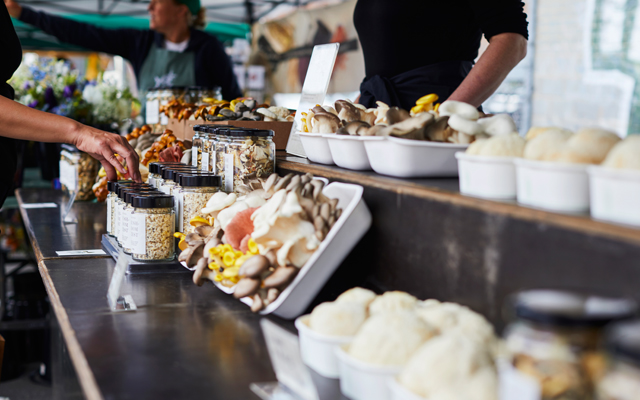
Such events provide opportunities to share the destination’s culture, ideas, and create opportunities for future investment. Photo credit: Rennee Hodskiss Photography
As one of only 57 UNESCO Cities of Gastronomy around the world, Launceston is ready to host the 25th Symposium of Australian Gastronomy (SAG 25) from July 5-8, 2024.
The event will welcome more than 100 gastronomic enthusiasts from Australia and New Zealand, and visitors will have multiple opportunities to sample local food and drink, as well as dine at Launceston’s restaurants.
Such events provide opportunities to share the destination’s culture, ideas, and create opportunities for future investment. Photo credit: Rennee Hodskiss Photography
Chair of the symposium organising committee and board member of the Tasmanian Agrifood Network (TAN), Andrew Pitt, said the national event will be the first of its kind held in northern Tasmania.
“The theme for this year’s event is ‘island’ which perfectly encapsulates the fine produce that can be sourced and enjoyed across our state. SAG 25 will be a significant event for our F&B industry as it has an established audience who will exchange their knowledge and ideas with local producers,” he added.
Pitt was also a key member of the successful bid for Launceston to become a UNESCO City of Gastronomy in 2021.
“We are developing an identity revolving around F&B and this symposium will play a vital role in showcasing this identity to a captivated national audience,” Pitt said.
Business Events Tasmania’s CEO Marnie Craig pointed out this is a key example of how strategically aligned events can benefit Tasmanian economy and reputation beyond visitation.
“Business events such as this are worth A$199 million (US$131.7 million) to the Tasmanian economy. These events attract world-renowned experts to Tasmania while providing opportunities to share our culture and ideas, and create opportunities for future investment.
“Twenty eight per cent of delegates bring at least one other person with them, 20 per cent explore regional Tasmania and 89 per cent intend to return within three years,” she added.
Perth, Western Australia, has been chosen by Suicide Prevention Australia, the national peak body, as the host destination for the National Suicide Prevention Conference (NSPC) 2025.
In its 26th edition, NSPC 2025 will bring over 700 industry professionals together to address critical issues surrounding mental health and share innovative practices.
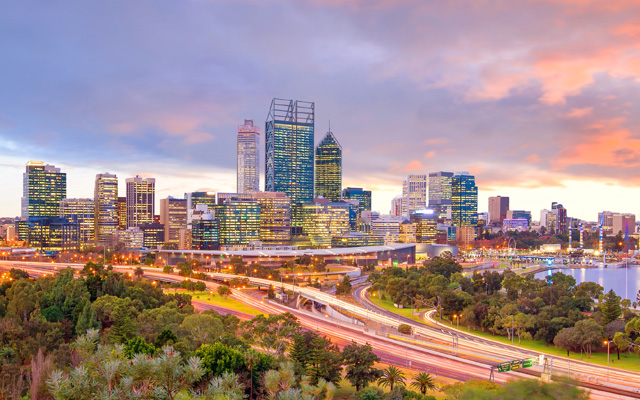
Perth’s skyline
Gareth Martin, CEO of Business Events Perth, said that the win is a testament to Western Australia’s commitment to the health and medical life science sector.
“Our recent ‘Re-aWAken’ mega fam played a strategic role in attracting NSPC 2025 to Perth and Business Events Perth looks forward to collaborating with stakeholders and partners to ensure its success, providing delegates with an enriching and memorable experience in Western Australia,” he added.
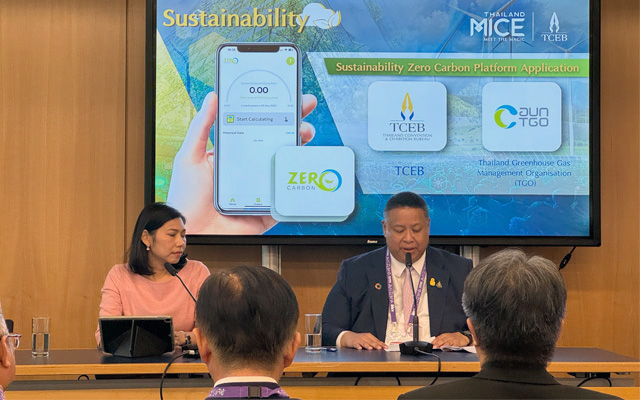
From left: TCEB's Supanich Thiansing, and Chiruit Isarangkun Na Ayuthaya
Thailand aims to be more than just a business events destination, and is striving to offer authentic experiences by harnessing its cultural heritage, while embracing innovation and sustainability to create high-value experiences for visitors.
During a press conference at IMEX Frankfurt on May 14, TCEB’s president, Chiruit Isarangkun Na Ayuthaya, shared that Thailand has welcomed 636,694 business events travellers who have spent 36.7 million baht (US$1 million) as of the six-month mark; Thailand’s fiscal year is from October 2023 to September 2024.
From left: TCEB’s Supanich Thiansing, and Chiruit Isarangkun Na Ayuthaya. Photo: Rachel AJ Lee
He mentioned that TCEB will focus on attracting more business events in key emerging industries, as millennials, the upcoming generation of business event attendees, are showing significant interest in these sectors. These industries include food security, health tech innovation or medical tourism, urban quality of life and mobility, as well as creative soft power.
Chiruit added that TCEB is also exploring how to organise more “non-conventional events”. For instance, the recent Money20/20 Asia event held from April 23-25, 2024, in Bangkok, was a blend of conference, exhibition, and festival.
In addition, sustainability continues to be paramount in TCEB’s agenda. As of the same fiscal year, TCEB has actively supported over 90 events in carbon emission avoidance, reducing over 240,000kg of carbon dioxide, equivalent to planting some 14,000 trees.
TCEB also created the Bangkok Protocol, a sustainable gastronomy framework, as a legacy of the ICCA Congress 2023. The framework examines various aspects of food production and consumption, including the sourcing of ingredients, cultivation methods, journey from farm to table, cultural significance and authenticity, and strategies for managing food waste.
Said Chiruit: “We are thrilled to learn that sustainable food sourcing and food-waste management at the ICCA Congress 2023 in Bangkok will be used as a model at the next ICCA Congresses, starting this year.”
Supanich Thiansing, TCEB’s director of meetings and incentives department, also highlighted several new infrastructure investments that would benefit event groups.
This includes the introduction of new rail links connecting key destinations like the airport and IMPACT exhibition and convention venue in Muang Thong Thani, as well as the addition of over 50 new hotels nationwide. Additionally, the inauguration of SAT-1 terminal at Suvarnabhumi Airport, has significantly increased the airport’s capacity from 45 to 60 million passengers annually.
Moreover, Bangkok’s EM District also welcomed the opening of UOB LIVE in February 2024. This venue is capable of hosting up to 6,000 attendees for various events, including concerts, conventions, and exhibitions.
To showcase these new products, network with Thai suppliers, and explore Thailand’s potential for business events, Supanich extended an invitation to participate in the upcoming Thailand Innovative Meetings Exchange, scheduled to be held in both Bangkok and Chiang Mai from June 17-22, 2024.
From cocktails made with native Asian botanicals and handcrafted spirits by homegrown Asian distillers to rattan bags handwoven by indigenous tribeswomen, local flavours, brands and artisans are getting more air time at country pavilions led by Asian CVBs at IMEX Frankfurt this year.
At the Singapore pavilion, a lively bar presenting cocktails crafted by Singapore-based The Orientalist Sprits welcomes buyers and show visitors and offers a peek into the city-state’s growing movement in craft spirits and hints at the vibrant cocktail culture that can be found in Singapore. On the morning of May 15, the quintessential Singaporean breakfast favourite, sweet kaya (coconut jam) toasts, were dished out to media guests ahead of a press briefing led by the Singapore Tourism Board.
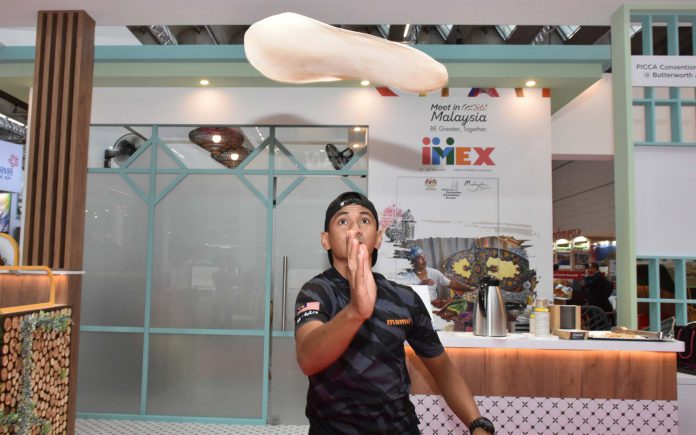
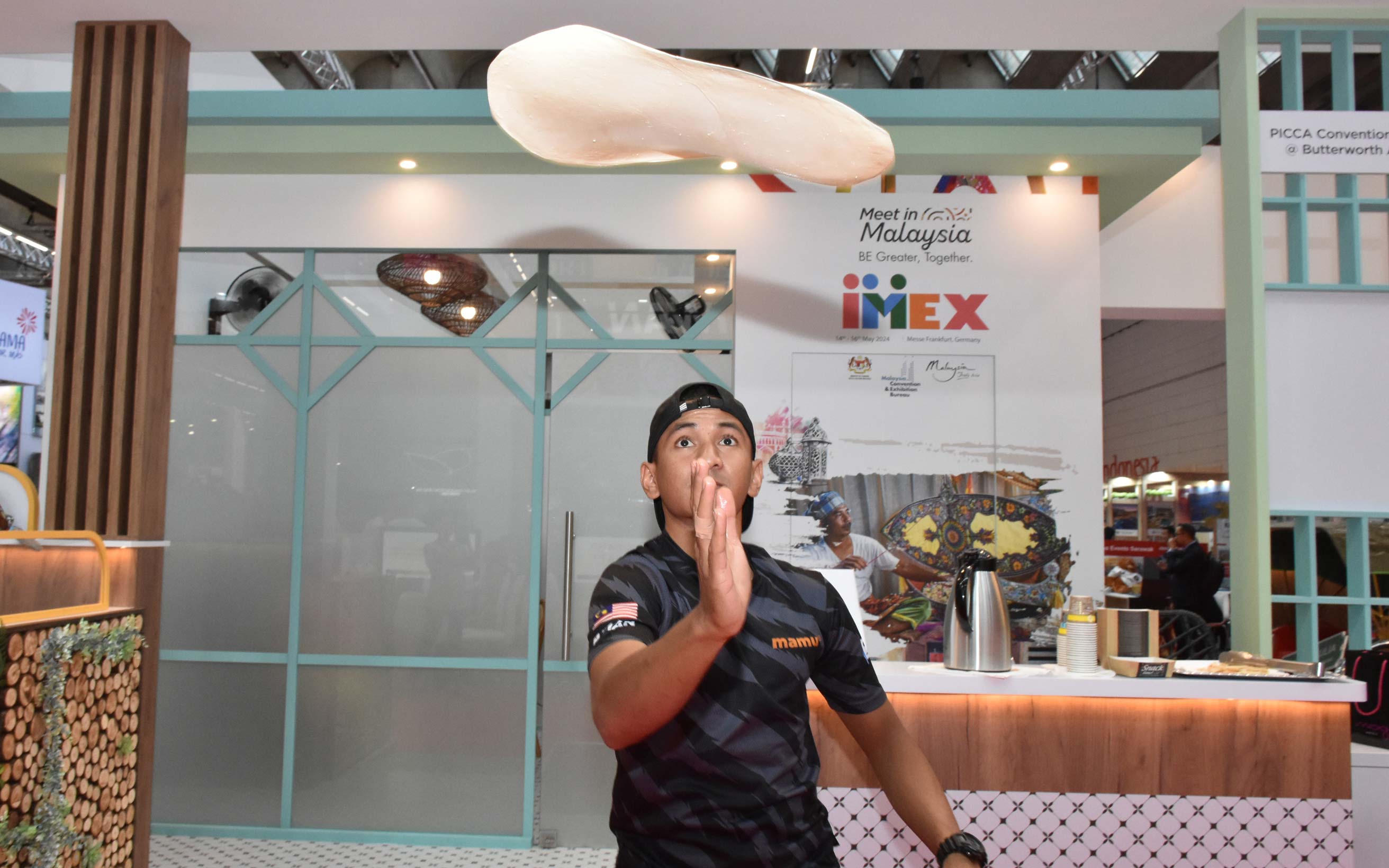
Aiman journeys from Penang to Frankfurt to showcase the Malaysian state’s well-loved roti canai to show attendees
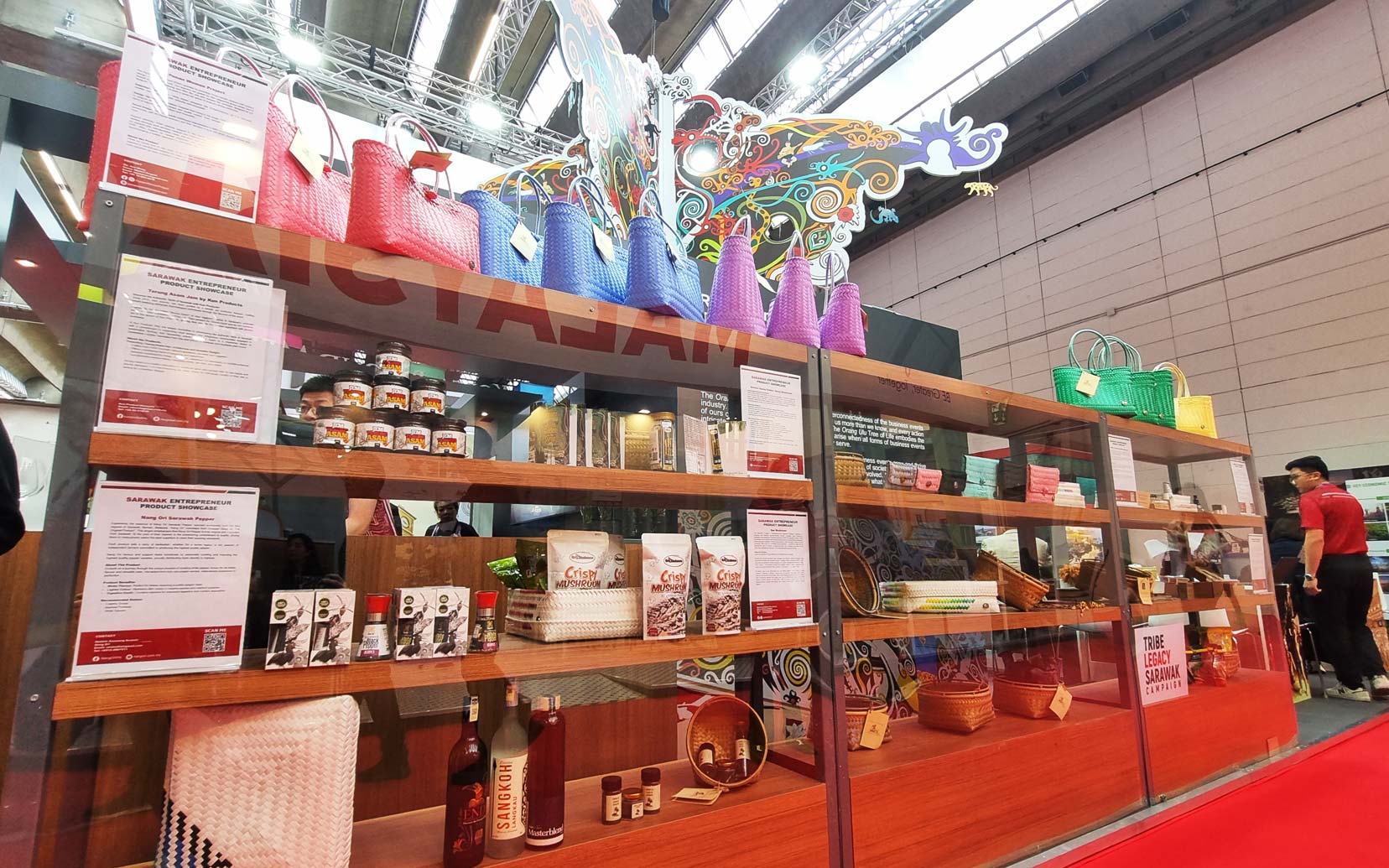
Over at the Sarawak pavilion, visitors can dig into a hot bowl of laksa (noodles in creamy, spicy broth) or knock back cocktails made with native ingredients, like torched ginger flower and langkau (traditional rice wine), while browsing an extensive collection of products from small-scale entrepreneurs with a sustainable and responsible business practice.
Business Events Sarawak (BESarawak) spokesperson, Rose Bruce, told TTGmice that the Sarawak Entrepreneur Product Showcase and local F&B service would often be done at tradeshows where the CVB has its own destination pavilion, as that would mean more floor space to use to present unique destination experiences.
Seoul Tourism Organization hosts a K-Food Fiesta on the first two days of the trade event, feeding pavilion visitors with Korean beer and fried chicken – a favourite meal combination among South Koreans. At the Macao X Hengqin joint destination pavilion, visitors can get their caffeine fix from traditional claypot-brewed coffee or sip a glass of Sangria, which highlights Macau’s Portuguese and Spanish heritage.
However, showcasing local products and brands at destination pavilions is more than just a means of attracting and entertaining buyers.
Jessie Heng, regional director of Singapore-based events specialist MICE Maestro, which exhibits with Team Singapore this year, is giving away little jars of Tiger Balm, a local analgesic heat rub that is present in every Singaporean household. Previously, popular local snack brands like Irvins, known for its addictive salted-egg coated chips, have also been gifted to buyers at B2B meetings. All gifts come with a story of the brand, product, and relation to Singapore’s way of life.
“These are uniquely Singapore brands and products, and will remind our clients of the destination. Some clients also draw inspiration from these gifts for their delegate goody bags and destination experiences,” said Heng, adding that events’ inclusion of made-in-Singapore products would also allow more businesses to share the prosperity of the country’s business events industry.
Business Events Sarawak brings the Sarawak Entrepreneur Product Showcase to its destination pavilion at IMEX Frankfurt 2024 to connect responsible local SMEs with event organisers looking for meaningful local engagements
BESarawak’s Sarawak Entrepreneur Product Showcase prioritises local brands with local owners, are small and medium enterprises (SMEs), and whose work support and build local communities. Different brands and products are presented each time. This initiative has a positive business impact on featured SMEs. Take for instance the Penan Women Project, whose handwoven rattan products, from purses to shoulder bags, have charmed event organisers keen to present their guests with authentic Sarawakian welcome gifts that have a meaningful backstory. These rattan products use sustainable materials, ensure the longevity of a heritage craft, and direct earnings to women weavers and their families.
“The whole idea behind the Sarawak Entrepreneur Product Showcase is to support such companies and give them an international exposure because we can – we have the privilege of showing this off to the world when we lead destination showcases at such major tradeshows,” explained Bruce.
Ashwin Gunasekaran, CEO of Penang Convention & Exhibition Bureau (PCEB), said local F&B could be a lasting hook for destination awareness and recall. He said: “I tasted local coffee at a Tourism New Zealand pavilion years ago, and can still remember the flavour and aroma today. Now, good coffee reminds me of New Zealand. Similarly, I want Penang’s tau sar piah (a sweet and savoury pastry with green bean paste fillings) and roti canai (local flatbread) to connect MICE buyers with us.”
The Penang pavilion at IMEX Frankfurt 2024 dishes out roti canai with curry and cups of teh tarik all day – and not just regular ones. Aiman, a young man whose family has been serving both for generations in Penang, prepares these local refreshments at the pavilion for event attendees. At certain intervals of the day, he swirls and flips dough masterfully, drawing cameras and eyeballs alike.
“We are trying to get the younger generation to be involved in the MICE business ecosystem. Aiman’s parents were once part of PCEB’s destination promotion activities, and now it is his turn,” remarked Gunasekaran.
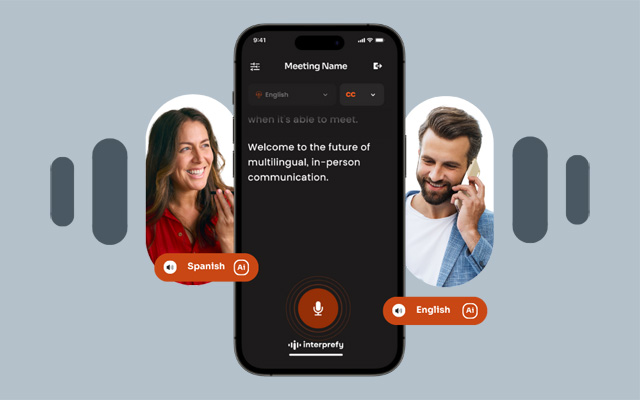
Interprefy Now provides instant, AI-powered live translation for professional meetings
Interprefy, a multilingual meeting technology and services provider, has rolled out Interprefy Now, a new product which provides instant, AI-powered live translation (audio and text captions) on the smartphone.
Once users or companies subscribe to Interperfy Now, they will gain access to the only small- to medium-sized professional meeting interpretation solution good for up to 30 people. Attendees can jump into multilingual conversations using a smartphone without any pre-meeting booking or technical setup of specialist equipment.
Interprefy Now provides instant, AI-powered live translation for professional meetings
Existing solutions for small meetings are typically tied to specific meeting/ conference rooms through the use of specialist AV equipment. Consecutive interpretation software for use on the go is typically only suitable for two-way conversations, and not for multi-person professional meetings.
Oddmund Braaten, CEO at Interprefy, said: “If you’ve ever needed to communicate with people who speak a different language than yours in a professional situation, and don’t want to extend your meeting’s duration with consecutive interpretation or have equipment for simultaneous interpretation, then Interprefy Now is for you.”
Braaten continued: “… For large multilingual events, we have our flagship mobile app. This is ideal for large, pre-planned events or conferences with a high number of attendees. With Interprefy Now we are providing the capability for instant access to live translation for smaller, more personal meetings, through the mobile app and subscription plans.”
As well as small business meetings, Interprefy Now can also be used for guided tours, where the tour guide’s voice is translated live. Visitors also do not need specialist equipment, which significantly reduces the cost for the tour guide and inconvenience for the customer. Moreover, Interprefy Now allows customers to interact and ask questions in their language and everyone (including the guide) will understand.
BCD M&E demonstrates its commitment to innovating solutions that inspires change
After two exceptional years of growth focused on adapting to the return of meetings and events, BCD Meetings & Events (BCD M&E) has transitioned back to a longer-term strategy and planning cycle with the launch of its first three-year plan since 2019, Thinking Forward.
The plan is equal part strategy and mindset, empowering employees and clients alike to be active participants as BCD M&E defines its future and leads the industry. Thinking Forward will stabilise existing business and guide innovative solutions for an evolving, sustainable future.
BCD M&E demonstrates its commitment to innovating solutions that inspires change
Thinking Forward is guided by three core pillars: engagement, creativity, and growth. Specifically, the plan focuses on caring for culture, community and planet by driving efficiencies and creative solutions to strengthen foundations, and investing in technology and innovation as services continue to diversify.
“We’re excited to share what this means for the business, clients, and our people. Our clients can expect a more collaborative, personalised partnership with enhanced flexibility of services and increased efficiencies across the globe. Additionally, we’re making significant investments in technology and areas like sustainability which we recognise as critical components of the future of meetings and events,” said Bruce Morgan, BCD M&E’s global president.
BCD M&E’s expanded in-house services have already taken root with the recent launch of Films, their production and content arm. Momentum following the 2023 best place to work recognition by Flexjobs continues, as recruitment remains a focus with ongoing training and incentive programming. BCD M&E’s partnership with MPI UK & Ireland chapter recently welcomed the Vanessa Cotton Scholarship, an 18-month internship opportunity for new talent entering the industry.
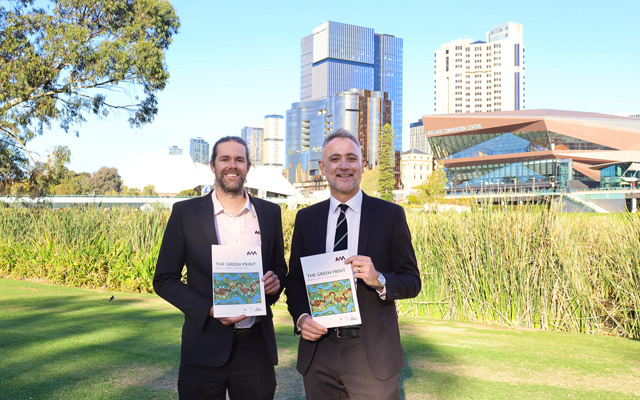
From left: AVM’s Martin Radcliffe and Julian Marchant outlines AVM’s targets and actions with The Green Print
Adelaide Venue Management (AVM), operators of Adelaide Convention Centre, Adelaide Entertainment Centre and Coopers Stadium, has unveiled its inaugural Environmental Social Governance (ESG) strategy, The Green Print – a plan that underlines AVM’s commitment as a force for good in the events and venue management industry.
The four-year plan (2024 –2027) maps AVM’s path to a more sustainable future, minimising the organisation’s environmental footprint and maximising its positive impact on communities. The Green Print builds upon AVM’s commitment to delivering responsible events, with initiatives closely aligned to State and Federal sustainability targets, and the United Nations Sustainable Development Goals.
From left: AVM’s Martin Radcliffe and Julian Marchant outlines AVM’s targets and actions with The Green Print
Key focus areas of The Green Print include:
Going green: exploring new methods to reduce energy use, lowering greenhouse gas emissions, and eliminating and avoiding waste. As part of The Green Print, AVM will work to divert 95 per cent of waste from landfill, transition to 100 per cent LED lighting, and increase on-site renewable electricity generation across its venues.
Sustainable sourcing: continuing to support South Australian suppliers to ensure the benefit of AVM’s operations extend to support local businesses. The Green Print commits to maintaining at least 97 per cent South Australian-based suppliers, with representation of all the state’s renowned F&B production regions.
Community education and engagement: collaborating to build awareness, motivate change and improve collective outcomes. This focus area extends to social sustainability, fostering deeper relationships with First Nations suppliers and local not-for-profit organisations.
Adapting to a changing climate: developing resilience to navigate climate change, guided by EarthCheck standards, exploring sustainable food production capabilities, and supporting biodiversity/ecosystem services growth in South Australia.
Good governance: regular and transparent communication of AVM’s ESG contributions to highlight impacts to the business, including publication of an Annual ESG Report, highlighting progress against key targets,
Julian Marchant, AVM’s first dedicated ESG Planning and project manager, said: “At AVM, we recognise the important role we play in creating awareness, educating and promoting solutions to some of the world’s most pressing issues, from climate change to waste avoidance, accessibility and First Nations reconciliation.
“The Green Print outlines AVM’s targets and actions relating to these themes, and is designed to maximise our positive impact and help create lasting legacies for our clients and the broader community. The plan is ambitious in its targets, but we remain fully committed to inspiring and driving positive environmental and social change.”
Mariko Tatsumi has been appointed as the new executive director of the Japan Convention Bureau (JCB), a division of Japan National Tourism Organization (JNTO).
Tatsumi brings with her over 20 years of experience working in both the leisure travel and business events industry.
She was previously the executive director at JNTO’s Frankfurt and Sydney offices. Prior to that, Tatsumi was a MICE specialist at Japan Tourism Agency, where she helped launch Japan’s business events marketing strategy. As a MICE specialist, Tatsumi was also in charge of conducting MICE branding campaigns for JCB.
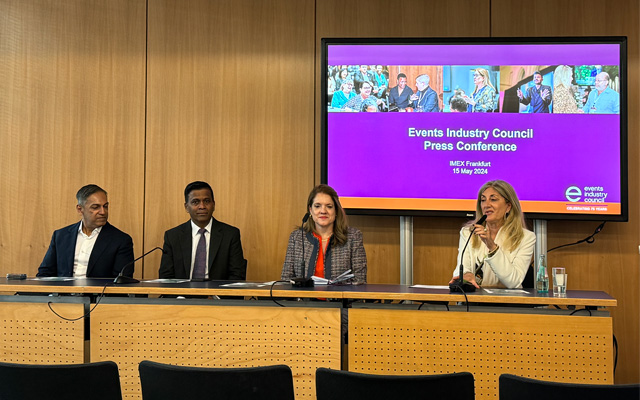
From left: PCMA’s Sherrif Karamat; ICCA’s Senthil Gopinath; EIC’s Ana María Viscasillas and Amy Calvert
The Events Industry Council (EIC) unveiled its Futures Landscape Project at a press conference at IMEX Frankfurt today (May 15), a comprehensive initiative aimed at understanding and influencing the critical trends shaping the business events sector.
The project, a year-long collaborative initiative, aims to equip industry leaders with the tools and knowledge needed to anticipate and influence future trends, ensuring that the industry can continue to thrive in an ever-changing global landscape.
From left: PCMA’s Sherrif Karamat; ICCA’s Senthil Gopinath; EIC’s Ana María Viscasillas and Amy Calvert. Photo: Rachel AJ Lee
Ana María Viscasillas, board chair of EIC and past vice president for COCAL (Confederation of Latin American Associations of Congress Organisers), detailed the project’s scope: “This project is a combination of efforts from our members and partners, focusing on critical issues and trends that impact our industry. Our goal is to influence these trends positively, and prepare our industry for future challenges.”
The project will involve a series of consultations with EIC members and partners, leading to the development of a comprehensive survey designed to gather broad input from stakeholders. It will also draw on the collective insights and expertise of more than 50 association and corporate members, and hundreds of volunteers worldwide. This data will inform the final report, set to be released by end 2024 which will offer a roadmap for the industry to navigate future trends proactively.
Amy Calvert, president and CEO of EIC, also highlighted the industry’s resilience and recovery post-2019 and 2020. She noted the significant progress reflected in EIC’s latest barometer report and emphasised the catalytic impact of business events in driving industry-wide changes.
She noted: “The power of business events lies in their ability to foster innovation, collaboration, and economic growth. The Futures Landscape Project is a testament to our commitment to preparing our industry for the future, fostering sustainable practices, and driving positive change.”
Sherrif Karamat, president and CEO of the Professional Convention Management Association (PCMA) and EIC’s immediate past chair, further highlighted the economic significance of the business events industry, which would rank as the 13th largest country by GDP.
“Our industry’s economic impact is immense, but our responsibility extends beyond economic contributions to include social and environmental stewardship. We are committed to achieving the highest standards of sustainability and advocating for our industry’s positive societal impact,” he added.
Senthil Gopinath, ICCA’s CEO and EIC’s chair-elect, pointed out: “EIC’s initiatives, like the economic impact study and climate resiliency work, provide invaluable data and insights. These efforts are essential for advocating the importance of our industry globally, and ensuring that we continue to make a positive impact.”
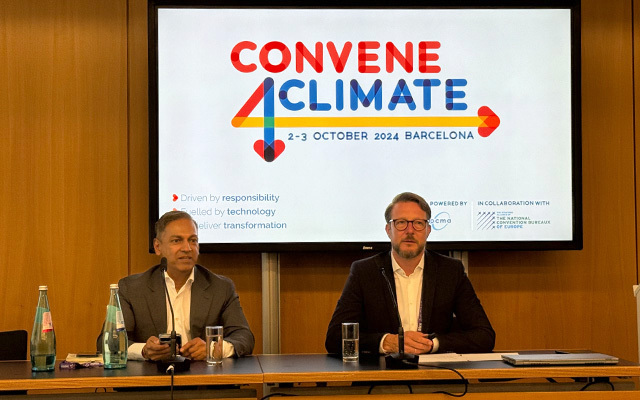
Convene 4 Climate, the global business events industry’s inaugural sustainability conference will be held from October 2-3, 2024, in Barcelona, spearheaded by PCMA (Professional Convention Management Association) and the Strategic Alliance of National Convention Bureaux (SANCBE).
Sherrif Karamat, PCMA’s president and CEO, elaborated during a press conference on May 14 at IMEX Frankfurt: “The audience will be intentionally curated, and we’re looking at a maximum of 120 people. (Attendees) will be those who are leading sustainable business practices within their organisations. Some of them will be from the business events industry, but we also want academia, and people from (the travel) supply chain, such as airlines and car companies. At some point, we’ll also want (to involve the) government.”
From left: PCMA’s Sherrif Karamat and German Convention Bureau’s Matthias Schultze. Photo: Rachel AJ Lee
When asked why Convene 4 Climate was limited to a maximum of 120 people, Karamat stated: “We could have more, but we feel that 90 to 120 people would suffice. We want the event to be meaningful and intentional.”
The venue for Convene 4 Climate, NTT DATA’s corporate headquarters in Barcelona, was also deliberately chosen, having been recognised as the most sustainable office in Europe – its LEED certification score was 91 – for its environmentally-friendly design.
Recognition was awarded after evaluating the environmental impact of the design and construction and identifying that NTT DATA achieved energy savings of 37.3 per cent, 46 per cent water savings, recycling of 82 per cent of construction waste, and sustainable materials have been used, and prioritising the installation of those with high recycled content.
As to how the event will be structured, Matthias Schultze, managing director, German Convention Bureau, and also the co-chair of SANCBE, revealed that content for Convene 4 Climate will revolve around two mega trends in the business events industry: sustainability and digitalisation.
He pointed out that the meeting will not be about just “listening to smart ideas”, and will instead explore initiatives and learning points from companies around the world how they use technology to solve problems, in this case, sustainability.
“The conference is not about creating another guideline or initiative, but being a platform that brings these good initiatives together. We don’t want to have different solutions in Europe. Instead we want to align our activities, talk about the same standards, have the same vision and idea, and have a shared set of measurements.
“The target is to produce tangible content, create milestones, and build a roadmap that will lead us to a more sustainable future with the help of technology,” added Schultze.
Though the conference is held in Barcelona, Karamat also called upon other international destinations to be part of the effort to tackle sustainability challenges in the business events industry.
He concluded: “Sustainability cannot be done in isolation. Sustainability is not a challenge for one organisation, it is a global problem that’s we face. And we all have to be a part of the solution.”
Just 10 minutes from Phuket International Airport on the serene northern coast, this 178-key, Bill Bensley-designed resort offers delegates a quiet, tropical paradise steeped in Phuket’s tin-mining heritage
The newly-opened Ritz-Carlton, Bangkok anchors the One Bangkok development with cosmopolitan elegance. Featuring the city's largest ballroom and a spectacular new penthouse suite, it delivers exceptional hardware and deeply authentic, soulful service for business and leisure travellers alike
Behind the imposing, Brutalist concrete that defines Zurich’s Oerlikon district lies a surprising secret. While its exterior honours the neighbourhood’s industrial roots, stepping inside Mama Shelter reveals a vibrant, neon-soaked world that is a far cry from its rigid shell