A new partnership struck between Interprefy and Korea MICE Association (KMA) will grant the latter’s members easy access to cloud-based interpretation services at a special rate.
Kyuree Kim, international coordinator at KMA said the partnership with Interprefy will provide operational relief to her members, as “providing translation and interpretation services is still one of the biggest issues for running online events because of unstable connections, audience inconveniences, and accessibility”.
Interprefy will bring its remote interpretation services to KMA members at special rates
Kim added KMA’s decision to be “an official partner of Interprefy” was made due to the platform’s simplicity in setup and usage.
Interprefy allows interpreters to deliver their services remotely, without the need for anything or anyone to be located on-site. Online event participants simply login and listen to the language of their choice through their smartphones, laptops or desktops.
An affiliated association of the Korean Ministry of Culture, Sports and Tourism since 2003, KMA represents South Korea’s business events industry and has around 300 members which conduct business events in the country and overseas.
As Malaysian borders remain closed to overseas event delegates and venues continue to operate at only half their capacity due to Covid-safe measures, industry players in the country believe that hybrid events will continue to dominate the format of business activities taking place in the new year.
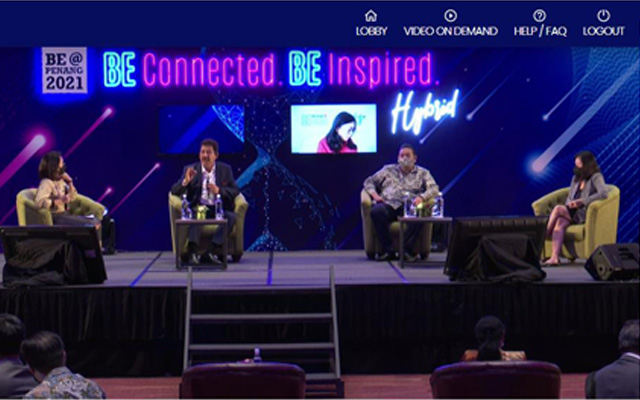
At the recent BE@Penang hybrid event for the business events community, Ashwin Gunasekeran, CEO, Penang Convention Bureau, highlighted the positives of hybrid events, such as allowing local and foreign delegates who could not attend in-person an opportunity to attend virtually.
From left: Place Borneo’s Mona Abdul Manap, Malaysia Convention & Exhibition Bureau’s Abdul Khani Daud, Penang Convention & Exhibition Bureau’s Ashwin Gunasekeran, BESarawak’s Amelia Roziman, with virtual speaker Sabah Tourism Board’s Noredah Othman
He observed that hybrid events have improved much since the early days of the pandemic, with content-enhancing elements such as holograms getting more commonplace. He expects virtual experiences to only get better as technology improves, allowing organisers a chance to leverage technology to meet event objectives and enhance the delegate experience.
Malaysia’s recent entry into the Hybrid City Alliance, alongside four local city representation from Penang, Kuala Lumpur, Kuching and Kota Kinabalu, emphasises the country’s commitment to positioning herself as a knowledge capital and to supporting multi-city hybrid conferences.
Speaking on the matter, Abdul Khani Daud, CEO, Malaysia Convention & Exhibition Bureau, said: “We are looking forward to working closely with other cities around the world to do multi-city hub events.”
Fellow panellist, Sabah Tourism Board general manager, Noredah Othman shared that being part of the Hybrid City Alliance would help the tourism board expand its network and learn from established cities, especially in terms of hosting successful hybrid events.
These industry leaders presented their observations and projections at a panel discussion, The Big Picture: Business Events 2022 & Beyond Outlook.
While the future of hybrid events remains promising, moderator Mona Abdul Manap, founder and CEO, Place Borneo, said such events receive much smaller financial support from convention bureaus as compared to in-person events.
She called on convention bureaus to change their mindset, as hybrid events could market a destination and entice virtual delegates to visit the destination in future.
In response, Amelia Roziman, CEO, BESarawak, said the state convention bureau provides equal support for hybrid and physical events. However, BESarawak is currently conducting a study to understand how it could support virtual events and the deliverables expected from hybrid meeting planners.
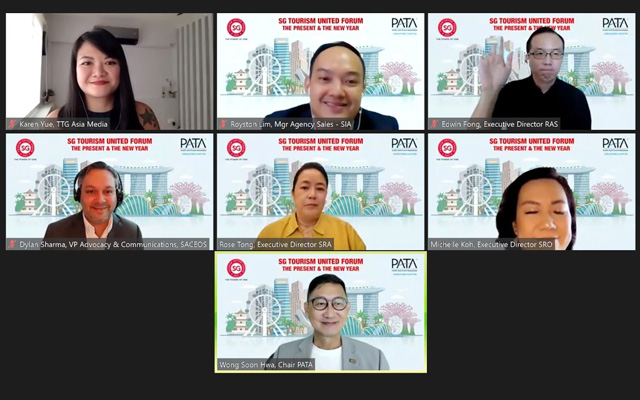
Tales of collaboration with government agencies, travel, tourism and hospitality trade associations, organisations from other sectors and even competitors have dominated panel discussions throughout the two-day SG Tourism United Forum online event on December 8 and 9.
The second day of SG Tourism United Forum featured (top row from left) TTG Asia Media’s Karen Yue, Singapore Airlines’ Royston Lim, Restaurant Association of Singapore’s Edwin Fong; (second row from left) Singapore Association of Convention & Exhibition Organisers & Suppliers’ Dylan Sharma, Singapore Retailers Association’s Rose Tong, Singapore River One’s Michelle Koh, and (bottom row) PATA’s Wong Soon Hwa
The event, presented by PATA Singapore Chapter with event partner, TTG Asia Media, featured top level executives representing the country’s most important trade associations in the industry: Singapore Hotel Association, National Association of Travel Agents Singapore, Singapore Association of Convention & Exhibition Organisers & Suppliers, Singapore Retailers Association, Restaurant Association of Singapore, Orchard Road Business Association, Association of Singapore Attractions, and Singapore River One.
They were joined by representatives of Singapore Tourism Board who detailed trade support efforts; Changi Airport Group, Singapore Airlines and Dream Cruises who presented a snapshot of how their organisations reimagined operations to remain sustainable and to continue to deliver quality customer support and experiences throughout the unusual circumstances presented by the Covid-19 pandemic.
Tough issues facing the industry were also discussed. Panellist inputs and audience polls conducted during the discussion identified that Singapore’s Vaccinated Travel Lanes, while critical for travel recovery, have not resulted in equal impact for the various sectors of the travel, tourism and hospitality industry, and that sustained recovery hinges on many factors such as a coordinated reopening across Asia, certainty in governments’ border restrictions, and relaxation of social restrictions. At the same time, rising operating costs and loss of industry talents are causing concern among industry players
However, organisations such as the Singapore Hotel Association, Changi Airport Group and Singapore Airlines are seeing an improved hiring landscape in the destination, with recruitment activities intensifying over the past few months.
The recordings can be reviewed now on TTG Asia Media’s YouTube channel.
The demand for digital services is highest among event organisers this year, found the second and latest Industry Partners Benchmark Survey released by UFI, the Global Association of the Exhibition Industry, while demand for services considered mandatory for running an event have experienced a steady decline in demand.
Developed by the UFI Industry Partners Working Group, the survey benchmarks and assesses the relationships between industry partners and suppliers and exhibition organisers and venues. It also identifies areas for improvement with regards to collaboration.
Demand for services of physical events has declined, with consultancy services seeing the widest slip
In analysing the demand for services of physical events, the survey finds that booth construction remains the most relied upon service (75% of respondents are continuing to use this service in 2021 versus 80% in 2020), alongside staff and security (75% in 2021 versus 79% in 2020).
Use of event technology and software has climbed from 66% in 2020 to 67% in 2021 – the only defined service that has seen greater usage this year among event organisers.
Consultancy services are among the least utilised services, and are experiencing a further steady decline in demand.
It is concluded that that demand for services considered mandatory for running an event have experienced a steady decline in demand.
Asia-Pacific respondents are relying more on event services than their European counterparts
The survey also discovers a growing demand for event services in Asia-Pacific, while that in Europe is declining.
In determining the impact of services on the success of events, the year-on-year change has been marginal but on the rise. Consultants are found to contribute the least impact on the success of events, while communication and marketing is regarded highly. The latter could be linked to the ability to track the success of marketing activities more effectively than other services, and are the biggest contributors to ensuring event participation.
Survey analysts suggest that consultants’ low perceived impact may be due to inconsistent quality of consultancy services across the industry. That said, there is a significant increase in the perceived value of consultants among pure venue owners, especially in countries in Asia-Pacific.
As the perceived impact of services on event success is relatively homogeneous, it is suggested that a successful event requires a wide array of services.
Findings also indicate that the demand for more innovation from service providers remains high. In rating service providers’ level of innovation, Asia-Pacific respondents gave event technology and software service providers an average satisfaction score of 3.6, with 5 indicating high satisfaction and 1 being low satisfaction. This is the highest score among all other services. Communications and marketing comes in second with an average satisfaction score of 3.5.
Event technology and software as well as communications and marketing service providers also scored highly with European respondents, at an average satisfaction score of 4 and 3.9 respectively.
“The results of our first survey showed in tangible terms the value organisers place on their suppliers and partners for the success of their events. Our second survey goes deeper and also demonstrates where the suppliers and partners relationship stands vis-à-vis the organisers for their recovery period events,” said Ravinder Sethi, chair of UFI’s Industry Partners Working Group.
Sebastian Witt, vice chair of UFI’s Industry Partners Working Group and who is responsible for the survey, said the findings provide “valuable insights for service providers in our industry”.
“We are happy to note that service providers are regarded as an integral part of the exhibition ecosystem and contribute tremendously to the success of our industry. Nonetheless, we observe that service quality is not consistent and demands from service providers are changing; service providers can and should invest more into innovation,” Witt added.
The survey was conducted at the start of 2021 with some 190 companies from around the world, with the majority based in Europe and Asia-Pacific.
Complete findings of the second Industry Partners Benchmark Survey can be downloaded from the UFI website.
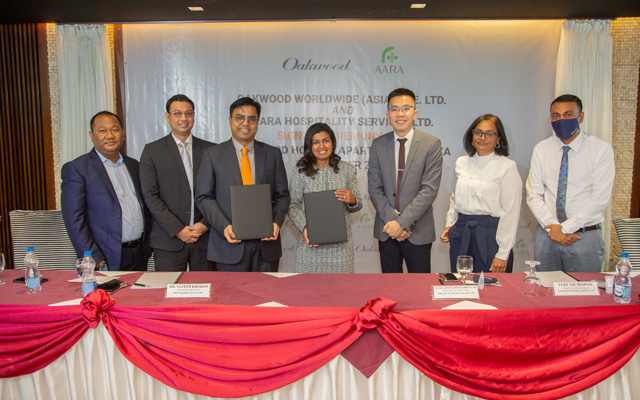
Oakwood will be making its entry into Bangladesh with the signing of Oakwood Hotel & Apartments Dhaka, scheduled to open in April 2022.
Aara Hospitality signed Oakwood on in a ceremony on December 8
Located on Gulshan Avenue within Dhaka’s affluent precinct, Oakwood Hotel & Apartments Dhaka will feature a collection of 89 hotel rooms and serviced apartments, from studios to two-bedroom units.
The property will offer a range of F&B outlets, including a split-level rooftop bar, all-day restaurant, lobby lounge-café and cigar divan bar; as well as meeting and event facilities.
Oakwood Hotel & Apartments Dhaka will add to Oakwood’s enlarging footprint across South Asia in support of its goal to double the global portfolio of managed properties by 2025.
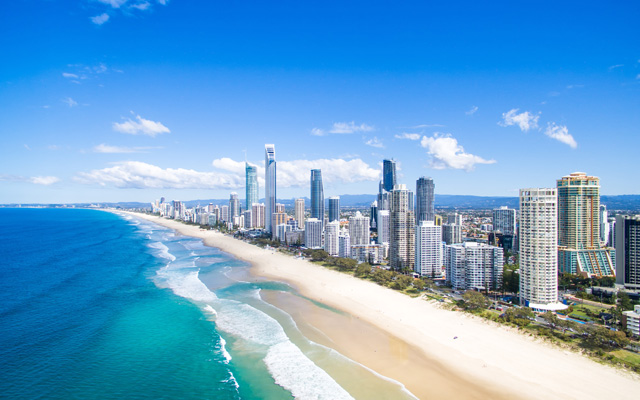
Destination Gold Coast has secured 104 conferences with an estimated economic impact of A$99.3 million (US$70 million) in the 12 months leading up to June 2021, with the level of enquiry and bidding opportunity remaining strong.
Announcing the results at the marketing body’s Annual General Meeting on November 24, Destination Gold Coast CEO Patricia O’Callaghan said the city is looking forward with renewed optimism.
The Gold Coast’s event pipeline between 2022-2030 comprises 144 conferences and meetings
According to O’Callaghan, the Gold Coast is well positioned to lead the visitor economy into recovery with business events set to contribute significantly.
“There is a strong desire to meet and connect in person and we have been highly aware of this consistent sentiment across the industry as this demand will drive growth,” she said.
“Business events are a vital part of our visitor economy, particularly as they support Gold Coast’s economy from Monday to Thursday and during off peak periods.”
“Our future pipeline reflects this with 144 conferences and meetings, worth an estimated A$191 million (US$136 million), committed to meet here between 2022-2030.
“Beyond our world-class infrastructure, natural environment, and extraordinary delegate experiences, we’ve also been quietly building a knowledge economy that will contribute significantly to strengthening our business events sector,” she noted.
Conferences newly confirmed for the Gold Coast include the Royal Australian and New Zealand College of Obstetricians and Gynaecologists in 2022; the 35th Topical Meeting of the International Society of Electrochemistry, 2023; and the Australian Medical Students Association (AMSA) National Convention, 2023.
Industry leaders speaking at the Indonesia MICE Outlook 2022 last week in Bali have expressed optimism in the country’s business events future, with confidence stemming from a schedule of international events as well as strong domestic appetite for local meetings.
The Indonesia MICE Outlook 2022 was organised by the Ministry of Tourism and Creative Economy.
Raty: Strong event line-up for Indonesia come 2022
Raty Ning, chairman of ICCA Indonesia, said 30 international events are scheduled to take place in 2022, and among them are the 2022 G20 Bali summit, the 7th Session of the Global Platform for Disaster Risk Reduction, and an Asian Venture Philanthropy Network meeting.
She expects the G20 summit to spin off even more government-led meetings and events with in-person attendance, while the country continues to benefit from a strong showing of domestic business events.
“The year will be more exciting if the government could provide financial incentives to local associations to (encourage them to) organise events, such as annual scientific meetings and national deliberation,” she added.
Raty hopes government offices will also hold events around the country to fill available spaces and spread out the economic benefit of meetings and events.
Gary Grimmer, CEO, GainingEdge, opined that Indonesia’s recovery, along with the strength of her domestic market, was “in line with the prediction that at the end of 2021 the industry will start to move, and in 2022 it will increase as the regional market recovers”.
However, he expects global meetings to only resume in 2023.
Commenting on 2022 event trends, Grimmer said virtual and hybrid meeting formats will continue to play an important role as they allow organisers to reach larger audiences, allow for an integrated virtual contingency plan, and increase revenue.
“Future options may include multi-channel content to form a larger global event,” he added.
Desaru Coast Destination Resort in Johor, Malaysia has launched MICE Reinvented, a new campaign that aims to inspire new ways of hosting business and social events at the destination.
It puts forth five distinct event pillars: Corporate events, reimagined; Future-proof conference and exhibitions; Wanderlust destination weddings & celebrations; Sports & such and, Nature & nurture.
Desaru Coast promises fully customisable events that will inspire, rejuvenate and reconnect people
Roslina Arbak, managing director and CEO, Desaru Coast Destination Resorts, said in a press release: “Just as the pandemic redesigned the way we live, it has driven us to relook and rethink how events will look like in the future.
“Leveraging our portfolio of assets as an international destination in the world where people seek inspiration, rejuvenation and reconnections, Desaru Coast has reimagined all possible spaces and experiences across the destination to offer a multitude of integrated indoor and outdoor programmes.
“Future (events) at Desaru Coast can be designed with an enchanting mix of indoor and outdoor experiences to include all five-star facilities along with curated activities at the beach, forest, mangroves, local villages, golf courses, ballrooms and conference centre.”
The destination offers four-, five-star international hotel brands with an inventory of close to 800 rooms, indoor event spaces that can accommodate more than 2,300 delegates, two award-winning golf courses, and the region’s largest waterpark.
Desaru Coast has a positive reputation among sporting events. In 2019 it hosted the Desaru International Bike Week, which drew over 45,000 bikers and visitors to the destination.
Come 2022, L’Etape Malaysia will be held in the destination on June 4 and Desaru Coast Ironman on July 24.
With Queensland fast approaching 80 per cent of fully vaccinated residents, the Australian state has decided to reopen its borders to fully vaccinated interstate travellers from Covid-19 hotspots from December 13 at 1.00 – four days ahead of initial schedule.
Queensland premier Annastacia Palaszczuk told local media that “nominating a time and date provides travellers and business with certainty to make their plans”.
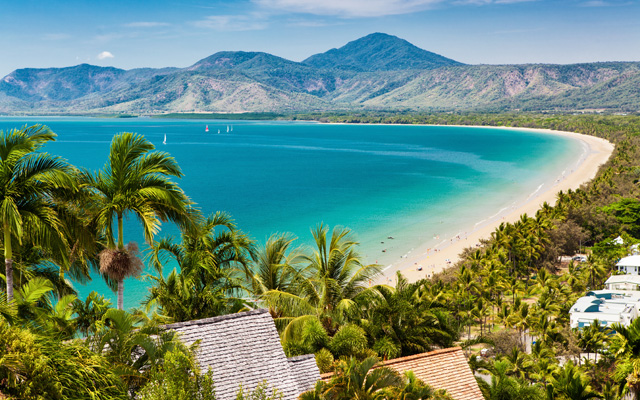
Queensland state will ease border restrictions from December 13; Port Douglas, Queensland pictured
Fully vaccinated interstate travellers can arrive by road or air, and must provide a negative Covid test in the previous 72 hours. They will not need to serve quarantine.
Fully vaccinated International arrivals must provide a negative Covid test within 72 hours of departure for Queensland, and fulfil a test on arrival. These travellers are required to serve a 14-day home or hotel quarantine.
Travellers no longer have to wait two weeks to be considered fully vaccinated; one is enough. However, all travellers from hotspots must get a test on day 5 after their arrival.
Vaccinated border zone residents will also be allowed to move freely across the border without the need for a PCR test.
Unvaccinated residents will continue to face travel restrictions.
“We will live with Covid – but on our terms,” Palaszczuk said.
Only fully vaccinated people will be permitted to enter pubs, clubs, cinemas, festivals and theme parks in Queensland from December 17.
The newly-opened Ritz-Carlton, Bangkok anchors the One Bangkok development with cosmopolitan elegance. Featuring the city's largest ballroom and a spectacular new penthouse suite, it delivers exceptional hardware and deeply authentic, soulful service for business and leisure travellers alike
Behind the imposing, Brutalist concrete that defines Zurich’s Oerlikon district lies a surprising secret. While its exterior honours the neighbourhood’s industrial roots, stepping inside Mama Shelter reveals a vibrant, neon-soaked world that is a far cry from its rigid shell
A polished urban retreat designed for business travellers, Hyatt Regency Kuala Lumpur at KL Midtown combines thoughtful design, seamless service, and exceptional facilities.















Industry leaders speaking at the Indonesia MICE Outlook 2022 last week in Bali have expressed optimism in the country’s business events future, with confidence stemming from a schedule of international events as well as strong domestic appetite for local meetings.
The Indonesia MICE Outlook 2022 was organised by the Ministry of Tourism and Creative Economy.
Raty Ning, chairman of ICCA Indonesia, said 30 international events are scheduled to take place in 2022, and among them are the 2022 G20 Bali summit, the 7th Session of the Global Platform for Disaster Risk Reduction, and an Asian Venture Philanthropy Network meeting.
She expects the G20 summit to spin off even more government-led meetings and events with in-person attendance, while the country continues to benefit from a strong showing of domestic business events.
“The year will be more exciting if the government could provide financial incentives to local associations to (encourage them to) organise events, such as annual scientific meetings and national deliberation,” she added.
Raty hopes government offices will also hold events around the country to fill available spaces and spread out the economic benefit of meetings and events.
Gary Grimmer, CEO, GainingEdge, opined that Indonesia’s recovery, along with the strength of her domestic market, was “in line with the prediction that at the end of 2021 the industry will start to move, and in 2022 it will increase as the regional market recovers”.
However, he expects global meetings to only resume in 2023.
Commenting on 2022 event trends, Grimmer said virtual and hybrid meeting formats will continue to play an important role as they allow organisers to reach larger audiences, allow for an integrated virtual contingency plan, and increase revenue.
“Future options may include multi-channel content to form a larger global event,” he added.