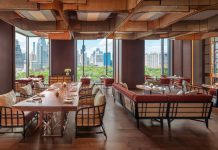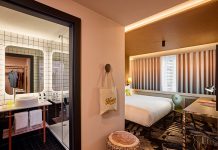

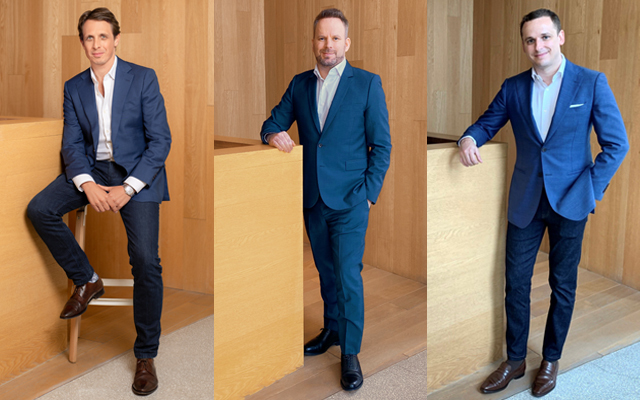
Ryan Jette has been appointed executive chef at Capella Singapore.
As executive chef at Capella Singapore, Jette will be responsible for overseeing the smooth running of Capella Singapore’s F&B offerings across its three venues.
He was most recently executive chef at Fairmont Marina Resort and Fairmont Residences.
The American has two decades worth of experience, having sharpened his knives at hotels and restaurants such as the Mandarin Oriental Hotel Group, The Carneros Inn, California, The Sentosa Resort and Spa, Singapore, Jumeirah and The French Laundry, a three-star Michelin restaurant in California.
Despite setting a four-week deadline to deliberate on the fate of the Tokyo 2020 Olympic Games on Sunday, Japanese prime minister Shinzo Abe and International Olympic Committee President Thomas Bach have just announced their agreement to push the event to the summer of 2021.
The event will also get to retain its name, Tokyo 2020.
Earlier today, outbound agents told TTG Asia that they hoped for a quicker, clearer decision on the fate of the Games so as to facilitate ticket refunds, where needed, or rearrangements of travel programmes that were crafted and booked in better times.
To be held in 2021, the Games will continue to bear the Tokyo 2020 name
Tokyo 2020 was scheduled to open on July 24 this year, and run till August 9.
Over 340kg of fresh produce and surplus food sitting in the holds of Kuala Lumpur Convention Centre have been channelled to the Food Aid Foundation, as the government’s ongoing Movement Control Order meant little use for these supplies without event activities at the venue.
Kuala Lumpur Convention Centre has been prioritising sustainable operations and to-date has made several donations, amounting to more than 590kg of surplus food, which has helped feed over 1,200 people since partnering with Food Aid Foundation earlier this year.
Outbound agents in Singapore and Malaysia are waiting with bated breath for a clear decision on the fate of the Tokyo 2020 Olympic Games, following statements from Japan and the International Olympic Committee (IOC) on March 23 that a postponement may be inevitable.
Alicia Seah, director, public relations & communications, Dynasty Travel, told TTGmice that several corporate hospitality packages built around the Games, which were customised for clients in better times, were now lying frozen.
Corporate packages sold for the Tokyo 2020 period are put on hold
“These packages were all different, crafted according to what clients wanted to do and see at the games and around the destination. But with so much uncertainty around travel and rising fears of the pandemic, our clients are reluctant to move on with their plans and hope a firm decision would soon be made,” Seah said.
She explained that without a clear decision to cancel or postpone, refunds for opening and closing event tickets cannot be processed.
Seah opined that a postponement of the Games would be ideal to ensure a high quality event that spectators can enjoy, where the full global delegation of athletes is in participation and where all competitors are in top form.
Several media reports are now debating the implications of IOC president Thomas Bach’s revelation on March 22 that a decision on the Games would be made “within the next four weeks”.
Different IOC members have offered their own interpretations. IOC vice president Anita DeFrantz had said that it was “premature” to say that the Games would be postponed to 2021, while IOC member Dick Pound had told the media that the decision to postpone was clear.
Postponing the Games would be better for business, said Rosli Seth, managing director of Feel Japan with K, who has sold ground arrangements – hotel rooms and transport between the sports venues and hotels – for 60 people, largely sports association members in Malaysia and a smaller number of corporate clients.
He believes that clients were unlikely to cancel their bookings and would proceed as planned with the new dates.
“If rooms were cancelled now, it would be difficult to get new bookings closer to the new dates, and the rates would be high. Those who made bookings through us know this,” Rosli said.
He described his Japanese hotelier partners as being understanding and said they would be willing to carry bookings forward to the new dates.
Meanwhile, Kingdom Sports Group (KSG), an authorised ticket reseller for the Tokyo 2020 Olympic Games, has suspended the sale of all event tickets, ticket bundles, ticket packages and tours.
KSG’s website now bears a notice saying: “Given current uncertainties relating to the Games’ start date, in the interest of all our guests, we have decided to temporarily suspend sales, pending further updates from the IOC, IPC (International Paralympic Committee) and Tokyo 2020.”
As a dedicated specialist of international sports ticketing based in Sydney, KSG is the official ticketing agent for Tokyo 2020 in 36 nations, including Malaysia, Brunei, Indonesia, Singapore, the Philippines and Vietnam. – Additional reporting by S Puvaneswary
Brief
Held annually at the Kuala Lumpur Convention Centre since 2006, International Architecture, Interior Design and Building Exhibition (ARCHIDEX) has grown from 7,000m2 of exhibition space to over 30,000m2 in 2019. It involved 600 exhibitors (1,400 exhibition stands) from over 20 countries, and attracted more than 35,000 visitors.
Last year was also the year ARCHIDEX celebrated its 20th edition. In addition, the show was also the inaugural event to be held in Kuala Lumpur Convention Centre’s purpose-built and flexible 11,000m2 expansion.
Highlights
Trade visitors to the show had the opportunity to explore the latest industry trends and innovation, which included the opportunity to pilot a drone.
A new feature this year was the Innovation Hall at Hall 8, which also housed the Malaysian Institute of Architects Pavilion of Tomorrowland. It featured exhibits for the global futurist to explore the possibilities in architecture, and urban design for the future.
Meanwhile, Artwright, ARCHIDEX’s strategic partner, also unveiled the Office of Tomorrow in the Innovation Hall, which featured a concept that showcased state-of-the-art furniture aimed at utilising space and resources effectively to boost growth and productivity.
Challenges
It was key that the various contractors involved could meet the expansion’s completion date, as well as ensure the space was ready for the large-scale event.
Alan Pryor, general manager at Kuala Lumpur Convention Centre, recalled: “The completion date was also close to the start of the event, which threw up additional challenges. Particularly, the lack of preparation time for our team, the organiser, official contractors, freight forwarders and sub-contractors was limited, as the space was unfamiliar.”
To get around this, Pryor shared that the team worked “intensively” with various parties to ensure deadlines were met. Pre-event planning and numerous organisational meetings were also held over seven months, which resulted in a detailed plan with several contingency strategies to ensure that all parties understood their roles and responsibilities when it came to move-in and move-out. The close collaboration resulted in a seamless move-in and move-out process.
Another challenge was that both regular and new ARCHIDEX exhibitors and visitors were unfamiliar with the new space, and hence, it was important to manage visitor flow to the expansion halls.
As such, Kuala Lumpur Convention Centre worked closely with C.I.S. Network to implement ways to drive visitors into the expansion area, which included a new visitor registration location, eye-catching directional signage strategically located throughout the venue, and interactive activities in Halls 6 to 8.
Event International Architecture, Interior Design and Building Exhibition (ARCHIDEX) 2019 Organiser C.I.S. Network Venue Kuala Lumpur Convention Centre Date July 3-6, 2019 Attendance Over 35,000 visitors from 70 countries
Mike Williamson has been appointed general manager for Conrad Singapore.
Williamson has more than 36 years of hospitality management experience, of which he spent 24 with Hilton.
The British national brings with him a diverse background in operations, revenue management and business development. His career has taken him to the UK, Belgium, Romania, the Netherlands, UAE (Dubai), China and most recently, Japan, where he was the general manager of Hilton Tokyo.
He has also previously held the positions of general manager in other Hilton hotels, such as Hilton Shanghai Hongqiao, Hilton London Heathrow, Hilton London Green Park, and Hilton London Paddington.
Australia closes its borders to all non-citizens; travellers at Sydney Airport pictured
Australia’s business events sector is reeling with billions of dollars in losses and revenue now down to zero, as the country employs drastic measures in a bid to control the spread of Covid-19.
Australia’s borders were closed from 21.00 last Friday, banning non-residents and non-citizens from entering the country. Some states like Queensland, South Australia, Western Australia have since gone further to announce border closures to interstate visitors.
Australia closes its borders to all non-citizens; travellers at Sydney Airport pictured
Then on Sunday, it was announced that indoor sporting and entertainment venues would close from midday today (Monday), following a ban introduced last week on gatherings larger than 100 people, which now effectively halts the paltry number of remaining small meetings at event centres.
Just hours before Sunday’s government announcement, the Business Events Council of Australia (BECA) reported a A$2.5 billion (US$1.4 billion) monthly loss to the Australian economy because of the Covid-19 outbreak.
“Even before Australian Governments took decisions to limit gatherings of people, many companies had begun cancelling travel and postponing face-to-face events,” said the statement issued by BECA. “The business events sector had seen a massive reduction in revenue across the entirety of 1Q2020 and as of this week, revenue is zero.”
Prior to the latest lockdown measures, some convention centres like ICC Sydney were working around meeting limits. In ICC Sydney’s case, audiovisual services were offered to clients who could still meet in capacities of a maximum of 100 per room. They included live or recorded web streaming, remote presentations, video conferencing and use of a broadcast studio.
Meanwhile, Melbourne Convention and Exhibition Centre, and Perth Convention and Exhibition Centre, are closed to the public until mid-April. Now, other convention centres are joining them in what seems to be an uncertain future with the government warning that limits could remain in place for six months.
Chair of BECA, Vanessa Findlay, warned that many in the tourism supply chain will suffer, with businesses “at immediate risk of closing their doors, some already have, and most have had to let go casual staff and are processing redundancies for the majority of their full and part-time staff now”.
“It is a dire situation for the sector, for the nation, for the world,” she said.
BECA states it is working with the government to make wage support packages, loan repayment relief, low or no-interest loans and tax deferrals available to support the sector.
It may become “inevitable” to postpone the Olympics amid the Covid-19 pandemic, Japan’s prime minister conceded on March 23, after the International Olympic Committee (IOC) acknowledged that it was deliberating a delay amid a growing chorus of dissent from sporting federations and athletes.
The comments from Shinzo Abe were his first acknowledgement that this summer’s Tokyo Games may not open as scheduled on July 24, as the global death toll from the coronavirus crosses the 14,000 mark.
Olympics postponement to 2021 on the cards, but IOC said cancellation “not on agenda”
Abe told parliament on Monday that Japan was still committed to hosting a “complete” Games. However, he added: “If that becomes difficult, in light of considering athletes first, it may become inevitable that we make a decision to postpone.”
On Sunday, IOC president Thomas Bach was quoted by media reports as telling athletes that a decision on the Games would be made “within the next four weeks” after detailed discussions has been held.
“Human lives take precedence over everything, including the staging of the Games,” Bach wrote in an open letter to athletes.
Bach also stressed that cancellation was not on the cards as doing so “would not solve any problem and would help nobody”.
In February, Japan and Olympic officials maintained that the Tokyo Olympics will go on as scheduled despite the growing threat of the coronavirus, but they are facing opposition from sports bodies and athletes as the virus has thrown a wrench into their Olympic preparations.
Meanwhile, Canada’s Olympic and Paralympic committees said on Sunday that they will not be taking part in the Games if they are held this summer, due to the health risks posed to their athletes and the public.
Elsewhere, the Australian Olympic Committee said in a statement that athletes should prepare for a Tokyo Olympic Games in the northern summer of 2021.
UFI releases updated global assessment of the escalating economic impact that COVID-19 is having on tradeshows and exhibitions
UFI, The Global Association of the Exhibition Industry, has released updated numbers that reflect the impact that tradeshow postponements and cancellations are having for both the exhibiting companies as well as for the tradeshow industry around the world.
Based on UFI data, the orders that exhibiting companies will not secure will add up to €134.2 billion (US$144.9 billion) globally, projecting to the end of the 2Q2020. This is an increase of almost five times the figure reported last week (€23 billion) which took into account cancellations only up to the end of the current quarter.
UFI releases updated global assessment of the escalating economic impact that COVID-19 is having on tradeshows and exhibitions
“Right now, the marketplaces that industries rely on to trade are closed around the world. This is unprecedented. Mass closures of events in relation to Covid-19 have now also reached North and South America, meaning the entire global exhibitions and events industry is grinding to a halt”, said Kai Hattendorf, UFI managing director / CEO.
Related to the exhibition industry, €81.6 billion of total economic output will not be generated by the end of 2Q. Broken down into regions, the respective total economic impact that will not be generated is:
€21.8 billion and 378,000 FTE jobs for Asia Pacific;
€28.8 billion and 257,000 FTE jobs for Europe;
€29.2 billion and 320,000 FTE jobs for North America.
The backbone of the exhibitions industry are many micro and small enterprises, and the lack of business is putting these at immediate risk of bankruptcy. As the industry’s global trade association, UFI is working with many national associations to help secure government and regional support for the companies that are badly affected. From Hong Kong to Denmark, there have been several examples already of economic relief for our industry.
“We call on every government to secure the future of our sector through imminent subsidy and credit programmes. Their investments now will pay off extremely well. We will build and operate the marketplaces and meeting places for all the sectors and industries to meet and do business after the pandemic – our industry provides the fastest of all fast tracks to any economic recovery”, said Hattendorf.
No stranger to adaptation, exhibition venues around the world are meanwhile offering their support to the respective health sectors.
“Many of our members are supporting the emergency response to the
crisis in their respective cities, building temporary shelters and installing beds in case local hospitals are unable to cope with demand. It is always humbling to see how our industry comes together in difficult times”, said Hattendorf.
The Covid-19 outbreak is a global challenge, and with a strategy in place, stakeholders can rebound quickly when the situation improves
As Covid-19 is an officially declared pandemic, nowhere is immune. Our hearts go out for those that are suffering the worst, the people and the countries. At times like these, despair and resignation are understandable and normal human responses. Is it possible that, even out of something this bad, there could still be opportunity in adversity?
In our view, there is always opportunity in adversity, it is all about the response. Our advice is that there are ways that you can actually wrestle this situation into some positives:
Win back the business you are going to lose
Gain more credibility in the market
Build a more united supplier community
Improve your market intelligence
Add to your sales pipeline through increased research
Engineer more efficient processes
Strengthen your esprit de corps
Achieve faster business growth in the future
Generate more local community understanding and support
Bring your government on board like never before
Here is some perspective and advice we hope will be helpful to you in trying to achieve these things.
Time to communicate – really well
At times like these, it’s important to remember that you have multiple audiences and that they are all important. Your staff, board, business partners, local industry, government and the broader community, as well as your customers, need to be engaged.
When it comes to the local stakeholders, they will all want to feel consulted and listened to, kept up-to-date and to be able to contribute to solutions moving forward. If you become communications central and the epicentre of the response planning then you are in a position to lead your team and your community towards the achievement of the outcomes listed above.
What you should be saying to customers
The key driver for your communications right now should be about building credibility.
No amount of destination promotion is going to calm the fear. Saying that any destination is safe just isn’t credible. The assumption is the whole world is exposed and that the pandemic could spring up anywhere and everywhere. So, if your destination is currently safe, the real question on peoples’ minds will be, “for how long?”
Our advice is that there’s only one kind of communication right now that can really bring you value – communication designed to build your credibility among potential customers. Credibility is power. Use this time to build credibility more than trying to build interest in your destination. Then when the situation improves, you can leverage the credibility you’ve built and use it to immediate effect. Customers will be more predisposed to you because you’ve built more trust with them.
What is credible communication? Short, radically transparent, spin-free and to the point, such as:
What’s the Covid-19 situation in your destination and country?
What groups are cancelling?
What’s happening to visitor numbers and hotel occupancy rates?
How are flights being affected?
How is your government responding?
If the situation is bad, don’t attempt to hide or spin the facts. Share the facts. As a destination promoter, you’ll gain credibility when you do. And, in the current environment, there’s really not much you can lose.
Then when things start improving give the same type of information. Groups are booking, visitor numbers and occupancies are going up, flights are returning. Because you were transparent, your customers will
trust your information. Again, the trust you can build could be one of the most positive things you can derive from this whole situation.
Your greatest strategic focus should be on recovery
There are two fundamental principles of crisis management, mitigation and recovery.
Mitigation
Mitigation is what you do during the crisis to make things better. This should be thoroughly explored, but in the current reality, there are limits to what you can do.
For example, if groups are cancelling dates you won’t be able to convince them otherwise. The focus should be on getting them to reschedule. Turn a cancellation into a postponement or a rebooking when you can.
You should be working with your industry to develop a city-wide response to clients wanting to cancel or postpone their events. It’s in your destination’s interests to minimise the pain and to keep clients on side and more favourably disposed when in recovery mode.
Your industry can also provide you with data on business lost or affected. This will help you communicate effectively and also to develop a strong business case to government for crisis support.
While the mitigation phase is not likely to afford any short-term selling opportunities, it is a time when you can focus on building stronger client relationships for the future. Think of ways that you and your team can connect with current and potential clients in a way that is more personal and less business orientated.
Resist any pressure to make staff reductions, your team is your backbone. You are going to need all of them to help you manage your communications and stakeholder engagement efforts and to effectively plan for and then implement the recovery phase.
Rebound strategy
Rebound is what you do once the crisis is over to recover what you’ve lost as quickly as possible.
Your rebound strategy should be developed around restoring your business levels and recouping your losses. Here’s the calculation:
What was our business trend line before the crisis?
How has the crisis impacted that trend line and how much business did we lose?
How much business will we need to secure to both restore our trend line and recover what we lost?
Keep in mind, many of your competitors will be doing the same thing. So, what do you do to stay ahead of the pack?
Engage your local stakeholders
When everyone else is panicking, true leaders emerge. If you are leading your destination, you need to get your stakeholders in a room and help them to work with you to find solutions. They should be part of your brainstorming on your communications, mitigation and rebound strategies.
A crisis is probably the most opportune time to get your stakeholders working more cooperatively.
Leverage that sense of common purpose to build an even stronger and more united supplier community – another lasting positive outcome that you can take from this crisis.
Refocus your team’s energies to best effect
You and your team will likely be spending less time servicing and selling these days. As an example, we all recently lost the opportunity to promote our destinations at IMEX.
So, what do we do instead? Think about it, just travelling and participating in a show like IMEX is effectively a week of time, or more. How many people did you have going and how many people-weeks can you now reinvest?
During the depths of this disruption, you may find that customers are less interested in talking, even if you are focusing on events that are years or more into the future. So, what can salespeople do when they aren’t selling? They can be preparing themselves better to sell more efficiently when things improve.
Now is a good time to strengthen and build your client database. Research and prioritise accounts. You could also take a pause and have your team get creative in engineering a better future. When the time comes and markets start to move again, have a plan and new creative approaches for how your team is going to do things faster, better and more successfully.
Address your resource needs
Covid-19 is a wake-up call for policymakers. They too are human, and they take things for granted until times get tough. Most destinations are losing business, and that becomes news the policymakers notice.
Our industry is front of mind right now and they are feeling our pain. Your rebound strategy should be developed into a business case for one-off “recovery funds” that you request. Governments typically shun requests for new recurring funding, but are often more open to requests for special, non-recurring funding.
They are looking to provide funding that tells the story of them addressing the business loss from this crisis. Their pocketbooks will be open and you need to give them a plan soon with numbers and an ROI analysis.
Hopefully, the world will get past this soon. In the meantime, you can use this difficult time to focus on getting stronger, a focus which will pay dividends far into the future.
Jon joined GainingEdge as CEO in October 2019. He is a specialist in Public-Private Partnerships (PPP projects) including finance as well as project advisory. In all cases, his work involved managing consulting teams, mostly in relation to infrastructure projects and he has in-depth experience consulting both governments and private sector developers.
He brings over 20 years of experience, and has previously worked for four years in Hong Kong, first as Capital Projects & Infrastructure group leader for PwC and then in infrastructure consulting for KPMG. Prior to that, he worked with PwC in Canada, New Zealand and Singapore where he served for seven years with PwC’s infrastructure group.
A polished urban retreat designed for business travellers, Hyatt Regency Kuala Lumpur at KL Midtown combines thoughtful design, seamless service, and exceptional facilities.
The five-star property excels in backing its expansive facilities with seamless service and personalised attention, setting the benchmark for luxury in Bangkok.