Asia/Singapore Wednesday, 22nd April 2026
Page 676

Orchard Hotel revamp promises enhanced event solutions

0

Local landmark Orchard Hotel has completed its multimillion-dollar renovation, spanning 260 guestrooms, the lobby, two dining establishments, and 11 conference and function spaces.

The enhancement project, which was officially unveiled last Thursday, refreshes the 40 year-old property and touts a “360 degree guest experience”.

Orchard Hotel’s Grand Ballroom gala dinner setup

On the business events front, Orchard Hotel now boasts one of Singapore’s largest pillar-free grand ballrooms at more than 900m2 and comes equipped with two floor-to-ceiling LED walls – a first in Singapore. The conference centre has also been redesigned with five intimate meeting rooms and upgraded facilities.

Additionally, event planners now have the luxury of choice with numerous catering options from the hotel’s four restaurants – Hua Ting Restaurant, The Orchard Cafe, Mon Bijou and Bar Intermezzo – as well as a Halal-certified kitchen.

Other upgrades include autonomous room service and chef associate robots; polished new dining spaces; a new contemporary clock tower; and 260 sleekly refurbished guestrooms each equipped with a Handy smartphone and six USB ports.

Jean-Philippe Jacopin, general manager of Orchard Hotel, said that the hotel’s large pillarless ballroom allows the flexibility for clients to build large structures or configure spaces to suit their conference needs.

The hotel refresh comes at a timely juncture as Orchard Road gears up for a major transformation and customer demands are changing, remarked Jacopin.

He explained: “We are facing great competition around us as there are many beautiful hotels here. We’re working very hard with the Singapore Tourism Board to revamp and enhance the old charm of this area.”

One way in which the revitalised hotel will pull its share of guests is through revamping the guest experience, using tools such as data and staff training to elevate customer satisfaction.

“Today, the hotel is more vibrant and elegant. The service of today is completely different from that of before. People now have no time, we have to be fast, and there’s no margin for error. Each customer is now a VIP who deserves my attention. For our reception, we are working a tool that scans guests passports without our staff having to touch it,” shared Jacopin.

AMEX GBT reveals average national meal limits for business travellers

0
Meal allowance is the third largest corporate travel and expense category

American Express Global Business Travel (GBT) has launched its meal expense whitepaper, Savings for Cravings, which examines tactics and policies that optimise what is widely seen as the third largest corporate travel and expense (T&E) category.

While air and hotel expenses have been a core focus of T&E management for many years, challenges regarding policy creation and spend visibility mean that meal expenditure limits have been difficult to enforce.

Meal allowance is the third largest corporate travel and expense category

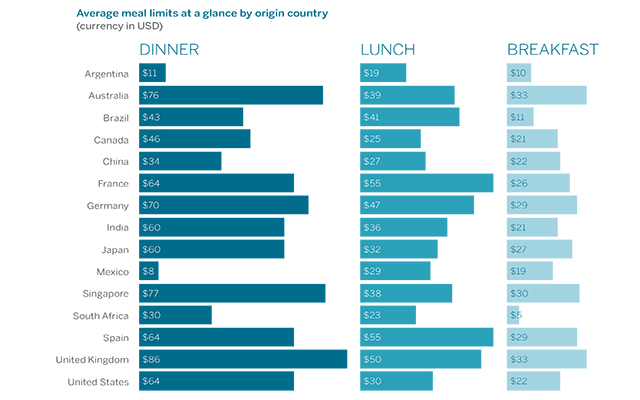
In a list of 20 key countries, GBT data has revealed that Australia and the UK have the equal highest meal allowances for breakfast (US$33), France and Spain have the equal highest lunch allowances (US$55), while the UK also has the highest dinner allowance (US$86).

Harris Manlutac, GBT’s head of global business consulting, Asia-Pacific, said: “Many companies have adopted a standardised global meal policy with limits set by destination. These policies can be effective, when adhered to, in controlling spend. However, for multinational organisations, such policies can be difficult to create. We find in many instances that compliance is driven by the attitude of an employee’s line manager.

“A common approach is to set traveller per diem limits. However, as rates can vary greatly between countries it can create challenges. For example, employees from a country with a low per diem rate may often travel to countries where food is expensive. At the same time, a colleague from a different country with higher per diem rate may be on the same business trip, highlighting the disparity. ”

Cultural differences, food preferences, and dining styles can vary significantly depending on an employee’s origin, home country, age, and other demographics. Providing flexibility as part of a policy can, therefore, by advantageous, according to the whitepaper findings.

For example, travellers should be able to spend beyond their meal limits while staying within a prescribed daily limit or quota. Organisations should also consider this practice when staff or external business partners attend meetings, as exceeding a quota for one specific meal may be appropriate.

Manlutac continued: “One of the biggest assets that a company can have is visibility over what employees spend. When employees book flights and accommodation according to their company’s approved travel policy, the recorded travel volume data can be used by companies to negotiate the best rates with suppliers.

“By having effective policies, and spend visibility, meal expense data can also be mobilised as a tool through a number of tactics, such as negotiations with preferred dining programmes. This is a huge growth area for companies looking at new ways to drive considerable savings. We expect technologies, such as mobile apps, to be tracking and supporting meal spend behaviours in the very near future.”

A copy of the meal expense whitepaper, Savings for Cravings, can be downloaded here.

Food waste for thought

0

What first inspired you to come up with a food waste prevention programme?
I identified a huge knowledge gap, which was when I realised there was an opportunity to bring about a positive impact on both business and society, while addressing one of the world’s most pressing issues.

Could you share with us a few tangible examples and successes of your work?
We started focusing on cutting food waste seven years ago, when food waste was not an issue.

One of the successes we are the proudest of is when we managed to convince the Thailand Convention and Exhibition Bureau (TCEB) to endorse us, and subsidise hotels and convention centres that are adopting our food waste prevention programme.

The other achievement worth sharing are results from some of the largest hotel properties in the region such as Bangkok Marriott Marquis Queen’s Park, Marriott’s flagship property in Asia-Pacific. From the beginning of our collaboration in August last year, the hotel reduced food waste by more than 24,850kg in the first four months of implementation, and cut food waste per cover by 30 per cent. We also helped Marriott’s Goji restaurant be the first to achieve the Pledge on Food Waste Gold certification with 94 per cent compliance.

We are currently supporting other restaurant groups in Asia and Europe, to help them reach the gold level of certification.

Another important achievement is the implementation of a food waste prevention campaign at a school for children aged seven to 17 about 1.5 years ago, to encourage lesser food wastage. We’ve seen these kids influence their own parents to cut their wasting habits at home, which for us, is important.

Aside from TCEB, have you approached any other government organisation in South-east Asia like Singapore Tourism Board to partner with them?
We have not worked with other any government organisation in South-east Asia yet. We are, however, currently collaborating with the French Environment and Energy Management Agency, and sharing our expertise with culinary and hotel schools in France. This way, we’ll have a wider impact.

It is worth mentioning that with the TCEB scheme, we helped seven hotels to save more than 155,000kg of food, trained more than 600 professionals, and helped brought about US$600,000 worth of savings in six months. This result will hopefully convince other governmental agencies to partner with us.

The Singapore Tourism Board would be a fantastic partner, especially since
the country’s Ministry of the Environment and Water Resources has designated 2019 as the Year Towards Zero Waste, where the government body is working towards becoming a circular economy and zero waste nation. We first initiated talks with The National Environment Agency two years ago, but they did not seem interested at that time, though it may be different today.

I really want to work with Hong Kong, as the need to address food waste is dire there, with landfills choking on waste, and I hope to build bridges with the country soon to bring about an impact.

Could you share with us an overview of the organisation’s learning modules on food efficiency for hospitality schools?
Our work entails three complementary steps.

One, implement a food waste prevention system within operations of culinary schools; two, using the framework offered by the PLEDGE on Food Waste to involve students, staff and chef instructors in a hands-on certification project; and three, sharing knowledge with students from a more scientific angle.

The last is composed of five modules covering the global economic, social and environment repercussions of food waste; food waste and other negative impacts along the supply chain; how to set up an efficient food waste prevention system in food operations (categories, methodology, stakeholders, tools and practices); metrics, KPIs and the necessary new ways to assess F&B performance; and finally, innovation, technologies and international standards such as the PLEDGE on Food Waste, and the Food Loss and Waste Protocol by World Resources Institute.

You mentioned you are working on designing strategic food efficiency programme for hotel groups. Could you please share more?
We want to help hotel groups design and implement a food efficiency strategy across their entire portfolio, as this will save hundreds of tonnes of food, and several million dollar, a year.

They might have goals to cut food waste by 30 or 50 per cent, but reality is knowledge is lacking, data collection is not done properly, and people don’t understand the food waste situation. One of our largest challenges is that hotel groups may not realise the true cost of food waste as it is not quantified, or they do not look at operation costs as a whole.

Misconceptions are hard to change, for example, buffets have been identified as a focus point whereas it only represents 10 to 15% of all food waste for large operations. It is common for large catering venues and hotels to waste more than 900kg of food per day, with an estimated cost at US$3,000 to US$5,000 a day. The cost of food waste ranges between eight to 14 per cent of total revenue!

So we want to make the most of our seven years of experience; thousands of hours spent bin-diving; and all the trial and errors we went through, to support large hotels and restaurant groups design and adopt the right strategy, define the right KPIs, analyse the right data, and use the correct approach and adapted tools. Using a food excess monitoring solution that includes a corporate performance dashboard for example, would help them monitor the situation closely.

Aside from hotels, are you also working with event organisers and corporate planners and their caterers?
We currently do not work with event organisers. We have been working on the capacity building side, for instance, delivering energy-packed workshops for MICE professionals on how to integrate food efficiency strategies and revealing tips on ways to reduce food going to landfills as a differentiation factor.

We haven’t been able to explore a complete food waste prevention programme at events yet, but I am confident it’s just a question of partnership and timing.


Alila SCBD opens two new event spaces

0

The recently-opened Alila SCBD Jakarta has unveiled two event spaces – the Artisian Bar and Event Gallery – on the property, both of which have been made available for corporate bookings.

Situated at ground level next to the lobby, the Artisian Bar has been designed as a gathering space for the artisan community. Spanning 512m2, this space offers a high-ceiling, and is furnished in a modern, minimalist fashion. The space would be good for creative events, or intimate gatherings.

Artisian Bar

Guests will also be able to admire the many pieces of curated artworks from across Indonesia that adorn walls and niches, celebrating the artistic heritage of regions and indigenous cultures such as South Sulawesi, East Java, and Kalimantan’s Dayak tribe.

Meanwhile, the Event Gallery is located on the third floor of the Alila SCBD. The U-shaped gallery is enclosed by floor-to-ceiling windows that fill the space with natural light, and offers panoramic views of the capital city.

Event Gallery

Spanning 714m2, the gallery can accommodate around 765 guests cocktail-style. It can also be divided into two smaller spaces – a 313m2 South Gallery and 410m2 North Gallery. In addition, the gallery is also connected to the hotel’s outdoor Catwalk Pool and terrace, offering a spill-out area surrounded by skyline views.

Event planners need to note that F&B minimum spends apply depending on the event, and corporate buyouts for spaces start at 145 million rupiah (US$10,012).

Email scbd@alilahotels.com.

CWT names head of channel evolution

0

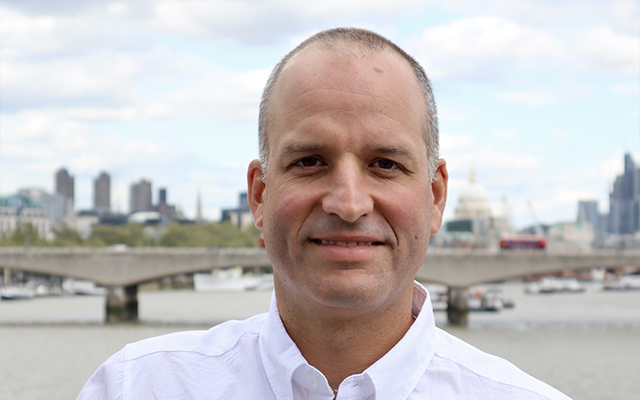
CWT has appointed David Zimmer as head of channel evolution.

In this newly created role, he will ensure CWT continues to deliver industry-leading options for the way travellers want to interact with the company.

David Zimmer

He will be based in London, and report to Niklas Andreen, CWT’s executive vice president and chief traveller experience officer.

Zimmer brings over 20 years of international experience in growth and product innovation across multiple roles. Prior to joining CWT, Zimmer held various leadership positions in the travel industry, where he was most recently global head of innovation & data, hospitality for Travelport.

Clark means business

0
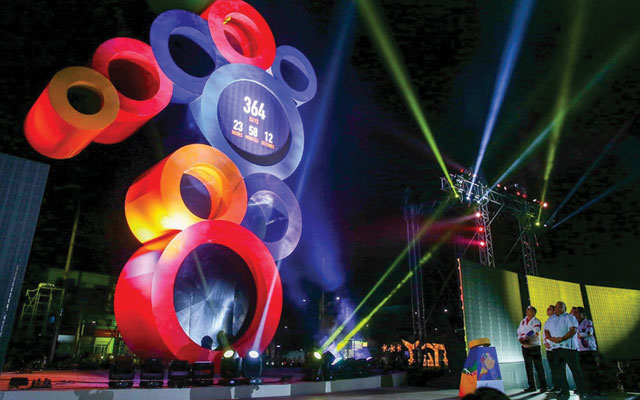
major events like the 2019 SEA Games will show off the city’s prowess

Major developments in Clark are opening the doors to future business events.
For example, Clark International Airport is now undergoing significant modernisation and expansion. By next year, it will open a new terminal that is expected to triple passenger capacity from four million to 12 million.

When completed in 2021, the NLEX-SLEX Connector Road will radically reduce travel time between industrial hubs Clark and Calamba in Laguna, and the Subic-Clark Cargo Railway will connect Clark’s airport to Subic Port in 2022.

major events like the 2019 SEA Games will show off the city’s prowess

This is amid an increasing number of investments pouring into commercial, industrial, trade and real estate projects into the Philippine city.

Emboldened by these developments, SMX Hotels and Conventions has started building the standalone 4,000m2 SMX Convention Center Clark, a departure from the usual SMX convention centres that are within an SM shopping mall.

Vice president sales and marketing, Maria Agnes Pacis, for SMX Hotels and Conventions expects Clark to see “a surge in domestic and international flights, and an upswing in numbers and size of corporate meetings and trade events.”

As such, SMX Clark will have three trade halls, three function rooms and 14 smaller meeting rooms with eco-friendly features. The company is also expanding its existing Park Inn by Radisson Clark, adding 100 more hotel rooms. Both developments are slated to open in 1Q2020.

SMX Clark is also seen as an option for northern Luzon clients to hold big conventions and other events, instead of having to travel all the way to Manila. Clark also has a handful of smaller venues, such as the ASEAN Convention Center and Quest Plus Conference Center.

In addition to Park Inn by Radisson, other hotels are moving in quickly to open international brands in the city. Hilton Clark Sun Valley Resort is expected to open in November this year, while the 350-room Hyatt Regency will open in 2022. The 260-room Marriott Hotel Clark also recently opened last year.

Meanwhile, homegrown hotel brands such as Quest and Royce are also expanding their hotel portfolios in Clark.

With these new developments, Clark has the potential to become a conference and exhibition hub, and possibly even serve as an alternative business events city to metro Manila, located about two hours away.

Darlene Achumbre, assistant sales and marketing manager of Midori Clark Hotel, noted: “We are seeing unprecedented infrastructure build up and scores of business, commercial and industrial establishments moving into Clark, reminiscent of the not-so-distant past when Bonifacio Global City (BGC) in Taguig strove to compete – successfully, it turned out – as metro Manila’s other CBD.

“Clark’s accessibility to major road networks and the growing number of domestic and regional airlines flying to and from Clark International Airport makes it one of the preferred MICE destinations,” Achumbre said.

Clark is also less congested than metro Manila and is renowned for being a safe destination.

“Clark is proving to be the elusive combination of a business and leisure destination without the traffic that characterises most urban destinations,” Achumbre added.

She said that the new point-to-point buses that leave hourly for Clark from Terminal 3 of Ninoy Aquino International Airport, Ortigas business centre, and Trinoma in Quezon City “are a big help” in further boosting Clark’s accessibility from Manila, in addition to the increased domestic and Asian regional flights to and from Clark.

Because of Clark’s tourism pull, Achumbre said there are no more high and low seasons. In February for example, her hotel enjoyed unusually high occupancies in the 90s.

The Clark brand launched late last year integrates its four districts, and highlights plans for a clean, green and vibrant city without the pressures of city life. Instead, it seeks to offer effective town planning that can mix business, pleasure and a relaxing lifestyle comfortably.

Colliers International research manager, Joey Bondoc, said: “Developers [should] expand their MICE facilities in Clark, because it is becoming a preferred destination for international events and conferences.”

In addition, neighbouring areas of Pampanga and Zambales also offer attractions for incentive travel, CSR activities, and pre- and post-tours.

JP Cabalza, inbound manager for Corporate International Travel and Tours said Pampanga is renowned for having the best cuisine in the Philippines. The cuisine is a medley of Spanish, Chinese and local influences that are unique to Pampanga, and would be a wonderful experience for delegates.

Cabalza also agreed that meeting planners can put together teambuilding events with sports activities and adventure destinations nearby such as Mount Pinatubo volcano, or the jungles and animal safaris in Subic. CSR activities can also be held with indigenous communities and farming communities in and around Pampanga and Zambales.

Come December, Clark will also reveal its hosting capabilities by hosting some of the 30th SEA Games events at its world-class sports facilities currently under construction in New Clark City.

Hospitality veteran Mark Swinton heads Capella Ubud

0

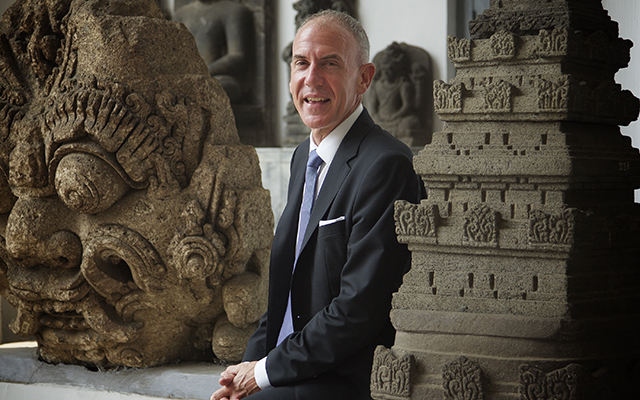
Capella Ubud has appointed Mark Swinton as general manager, a hospitality veteran with more than 30 years of professional experience in the luxury hospitality industry.

Prior to joining Capella Hotels & Resorts, Swinton led the pre-opening efforts for Six Senses Bhutan, where he acted as country general manager, assisting with the conceptualisation, development and operational strategy implementation for all five lodges.

Previously, the Canada-born spent 10 years with Aman, working in management roles across Bhutan, Beijing, Borodubur, and Bali, where he was regional director of Aman, Indonesia.

Loud and serious about legacies

0

Professional associations perform more than self-serving roles for their members and the industry they represent. Fact. Professional associations, through their meetings and events, leave behind more than just tourism receipts for the host city. Fact.

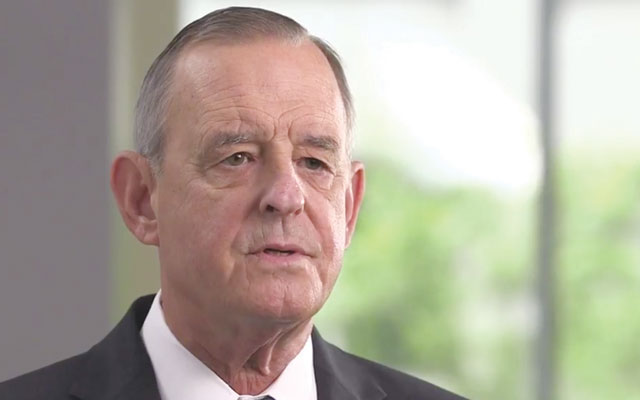
John Graham

Unfortunately, also a fact, a lot of the good that associations do are kept within their walls.
Illustrating the extensiveness of associations’ work, John Graham, president and CEO of the American Society of Association Executives (ASAE), said: “Everything in life is touched by associations. Associations set the safety standards of the smartphone you are using, the production standards of the blouse that you wearing, and the quality of the medical care you are receiving. And that’s just the standard-setting part of the work associations do.

“Associations also boost the economy, create jobs and conduct research to improve lives. But not many people know about the public good that associations are achieving, and it is important that associations talk about that.”

For years, the ASAE has run the annual Power of A Awards in North America, which recognises associations that are able to leverage their unique resources to solve problems, advance industry/professional performance, kickstart innovation and improve world conditions.

Award winners have traditionally been North American associations, but ASAE is now hoping to globalise it by including nominees and winners from Asia-Pacific.

“The concept of the Power of A is relevant in any part of the world, and so we thought why not try to get some associations based in Asia-Pacific to apply for the awards in 2019 and into the future? Furthermore, the awards is one way to bring wider attention to the legacies of associations,” he added.

Here in Asia, the Philippine Council of Associations and Association Executives (PCAAE) organises the Ang Susi Awards which recognises individuals who have sustainably managed an association and produced remarkable results, and also membership organisations that have demonstrated outstanding achievements in helping the environment, empowering people, serving communities, enhancing trade and industry, developing technology solutions, and for being agents of change.

Graham believes that associations need to “get smarter” in publicising their good work, something that Richard Holmes, director of the International Bureau For Epilepsy (IBE), echoes.

“It could be talking to the press or using social media to spread the word on what the association is doing in the lead up to, during and after its meeting,” Holmes said.

Association leaders who spoke to TTGassociations also emphasised the importance of measuring and communicating the legacies of associations to the government and relevant agencies, so that their meetings aren’t only recognised for their contribution to tourism. This in turn would encourage more local government and national agencies to support hosting bids for global association meetings.

Another critical aspect of association legacies, opined association leaders, is the need to carefully build opportunities to do good into their programme.

Iain Bitran, executive director of the International Society For Professional Innovation Management (ISPIM), said: “Legacies don’t just fall from the sky or materialise with the wave of a wand. Associations must plan for it to happen.”

On ISPIM’s part, the association has moved to “build legacy into our Asia-Pacificmeetings” by having challenge-based content. In preparation for the ISPIM Connects Fukuoka conference in Japan in December 2018, Bitran met with the city government and had them identify seven to 10 local issues that could be addressed with innovation.

“From that we picked three: ageing, energy transition and building a start-up ecosystem,” Bitran explained.

“Our members worked on possible solutions in the lead up to our conference, and presented them to the city and local participants at the meeting. Our solutions became the legacies we left behind for Fukuoka.”

Far-reaching goodness of associations
From improving safety and living conditions of people to conserving wildlife, associations can effect deep social benefits through their meetings and the work they do.

AIDS Society of India
The AIDS Society of India lobbied successfully for the establishment of an AIDS/HIV law in 2017 that protected patients from abuse, as well as government support and recognition for the need for AIDS/HIV public education which has helped to reduce the number of infections. Its intensive promotion of far more affordable AIDS/HIV medication produced by qualified Indian pharmaceutical companies and their export to Africa have allowed more patients in that continent to access medicine.

Life Saving Society Malaysia
When the World Conference on Drowning Prevention 2015 was held in Penang, Malaysia, the local host, Life Saving Society Malaysia, took the opportunity to call for the creation of a council to promote water safety culture, and to lobby for swimming lessons in school. A year after the conference, the Malaysian cabinet approved the formation of the Water Activity Safety Council, which was placed under a ministry. The conference itself also brought about nation-wide awareness of the vast number of drowning cases and prevention methods.

International Congress and Convention Association (ICCA)
ICCA, through its annual ICCA Congress, runs the Gift of Love project which allows delegates to contribute to charitable causes in the host city. As well, in the lead up to ICCA Congress 2016 in Kuching, Sarawak, ICCA ran a year-long Borneo Orangutan Project which invited delegates to adopt one of six orphaned baby orangutans. It drew excellent response, where companies – not just individuals – offered large sums of money to support the programme.

This article was first published in TTGassociation April 2019, a sister publication of TTGmice

Philippines makes move on two major 2021 conferences

0
Cebu city (pictured) has successfully hosted two major conferences, and has emboldened the government to pursue more

The Philippines government has announced that it will be making bids to host the UNWTO (United Nations World Tourism Organization) General Assembly, and WTTC (World Travel and Tourism Council) Global Summit, both scheduled for 2021.

Tourism secretary Bernadette Romulo Puyat declared that the country is “ready”, while addressing the PATA Annual Summit in Cebu City last Friday.

Cebu city (pictured) has successfully hosted two major conferences, and has emboldened the government to pursue more

She added that the country is “bullish in the pursuit” of hosting the two major events, after having successfully hosted Routes Asia 2018 and this year’s PATA Annual Summit, both held in Cebu City.

UNWTO’s General Assembly, the most important global meeting of senior tourism officials and high level private sector representatives, is held every two years. It will be hosted by the Russian Federation this year, where previously it was held in Chengdu, China in 2017.

Meanwhile, the annual WTTC Global Summit was held in Seville, Spain recently in April while last year’s was in Argentina.

The business event sector is being considered a “new initiative” for the Philippines government, and the 2019 work programme of the Department of Tourism and its marketing arm, Tourism Promotions Board, has indicated intentions to bid for “big ticket events”. Aside from the WTTC and UNWTO, the country is also keen on other major events such as other UNESCO Creative Cities Network Annual Conferences.

Last year, the country launched its first-ever MICE roadmap, in a bid to reclaim the destination’s place as a business events powerhouse.

Global travel body meets in Colombo in aid of Sri Lanka’s recovery

0
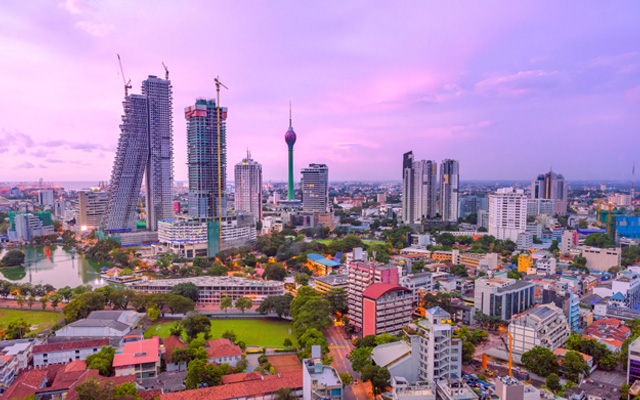
UFTAA’s meeting wants to show that Sri Lanka is ready to receive tourists; Colombo pictured

An international body of travel agents, the Universal Federation of Travel Agents Associations (UFTAA), has announced plans to hold its next meeting in Sri Lanka to support the destination which took a devastating hit in the wake of last month’s Easter Sunday attacks.

UFTAA president Sunil Kumar Rumalla told reporters in Colombo last Friday: “UFTAA board member, Trevor Rajaratnam, appealed to us to try and look at Sri Lanka as a destination for our next immediate event which is normally held in August (in another country).”

UFTAA’s meeting wants to show that Sri Lanka is ready to receive tourists; Colombo pictured

Rajaratnam, who is also the president of the Travel Agents Association of Sri Lanka, told TTG Asia that he was preparing a formal letter address to UFTAA’s board of directions to look into meeting earlier in Colombo in June or July. Some 100 tourism leaders and experts from 30 countries are expect to attend.

Rumalla also informed reporters that the event was fast-tracked by a month or so as it could “serve as a message to the whole world that a global body of tourism experts and leaders is present in Sri Lanka”.

He added UFTAA is committed to supporting Sri Lanka, similar to its support of Turkey to rebuild confidence in the country in the aftermath of terrorist attacks there three years ago.

“We are very keen to see that this most wonderful country is brought back to normalcy as soon as possible,” Rumalla shared.

In the meantime, Emirates and SriLankan Airlines have pledged their support to facilitate the UFTAA mid-year forum by offering concessionary airfare to delegates coming to Sri Lanka. Hotels are also expected to offer concessionary rates for foreign delegates attending the forum.

UFTAA is also considering holding an event at one of the affected hotels on Easter Sunday. More than 250 people including 40 tourists died in the attacks on three churches and three luxury hotels in Colombo. Two of the hotels are have reopened, but a third hotel, the Shangri-La Colombo, has yet to reopen.

Reviews

The Ritz-Carlton, Bangkok

The newly-opened Ritz-Carlton, Bangkok anchors the One Bangkok development with cosmopolitan elegance. Featuring the city's largest ballroom and a spectacular new penthouse suite, it delivers exceptional hardware and deeply authentic, soulful service for business and leisure travellers alike

Mama Shelter Zurich

Behind the imposing, Brutalist concrete that defines Zurich’s Oerlikon district lies a surprising secret. While its exterior honours the neighbourhood’s industrial roots, stepping inside Mama Shelter reveals a vibrant, neon-soaked world that is a far cry from its rigid shell

Hyatt Regency Kuala Lumpur at KL Midtown

A polished urban retreat designed for business travellers, Hyatt Regency Kuala Lumpur at KL Midtown combines thoughtful design, seamless service, and exceptional facilities.