
Asia/Singapore Friday, 1st May 2026
Page 801

Breaking the mould

0
Harbour City Ocean terminal new extension

As a growing number of companies consider off-site locations for their events, a more varied picture of venue options is emerging in Hong Kong.

Harbour City Ocean terminal new extension

According to business event players TTGmice interviewed, demand for non-hotel venues is on the rise. Pacific World’s business development manager, Dwirt Ang, for example, said that the company’s overseas clients often come with the idea that gala dinners work best when held away from the main meeting hotel.

“Over the past two years, clients are looking beyond technology (capabilities at the venue) and focusing on fostering personal connections. Though many hotel venues offer an amazing combination of venue space and great food and service, many high-end clients prefer that dinner events be held off-site (so) delegates can escape the monotony of ‘always’ being in a hotel for their events.”

Likewise, LORE’s managing director, Beatrice Remy, added: “(Many of our) corporate clients have already visited the destination and are looking for a fresh environment. (The appeal of) Airbnb and inspiring, entrepreneur-friendly workspaces is transferring into the events industry. Clients demand inspiration and surprise… we live in an experiential society.“

Examples of unconventional corporate event venues, shared Destination China’s general manager, Gunther Homerlein, include the Asia Society, which has a rooftop that gives a sense of the city without being “right in the middle of it”.

There’s also the Jao Tsung-I Academy, reminiscent of a bygone era; and the Hong Kong Maritime Museum, he added.

Moreover, the Po Toi O fishing village offers a refreshing backdrop, much different from the cityscape that the corporate crowd is so used to. “We have done a couple of great lunches at Po Toi O. We bring in wine, servers, cutlery, tables, while making use of the amazing restaurants and local feel of the place,” he shared.

Located in the Shouson Hill private suburb, Crown Wine Cellars, a UNESCO Asia Pacific Heritage Site, is ideal for board events or high level dinners.

While spaces not typically used for corporate events are coming onto the radar of planners, choosing off-site venues not equipped with a full kitchen comes with the downside of having to juggle permits, food safety and menu.

Pacific World’s Ang said: “It is always challenging, but it’s made easier if the venue is supportive and open to new ideas… It is also important to work with a well-established off-site catering company.”

Moreover, Homerlein pointed out: “Unfortunately (the city is faced with) a dearth of unique off-site venues that are available to clients. It is the city’s biggest drawback and the Hong Kong Tourism Board (HKTB) and other authorities do very little at all to help develop or seek new venues. So we have to stick with what we have and try and make more out of them.”

According to HKTB, the city boasts several innovative meeting facilities with more to come.

The Zero Carbon Building in Kowloon, for instance, is the first of its kind in the city. It includes a multi-purpose hall with low-carbon facilities and can accommodate over 100 delegates in a seminar setting, while its nine outdoor exhibition and landscape areas covering around 3,000m2 are ideal for exhibitions and events.
For heritage venues, there is the gothic-style Bethanie located in Pokfulam built by the French Mission in 1875. It now includes two performance venues, an exhibition hall, a chapel and a museum.

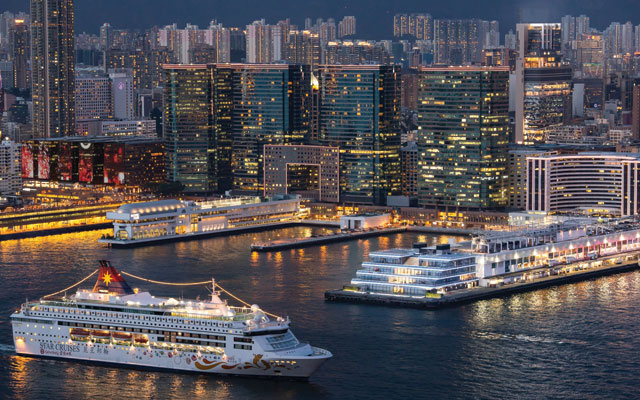
More is in the pipeline. Among the upcoming meeting and event facilities is the Harbour City Ocean Terminal Deck & New Extension at the end of Ocean Terminal. Catering both to tourists and business event delegates, the new facility will offer a 270-degree sea view of Victoria Harbour; 11 dining outlets with alfresco areas (six outlets have started operation); two event spaces, each sized 603.9m2; and a 200-seat outdoor grandstand. The rooftop takes in a lawn, terrace and lobby across 1,486m2 and can hold about 1,000 pax.

As well, the West Kowloon Cultural District (under construction at press time) will be home to flexible event spaces with versatile lawn and concrete paving, making it a good option for outdoor events.
Hyderabad keeps soaring

0
Hyderabad Convention International Centre

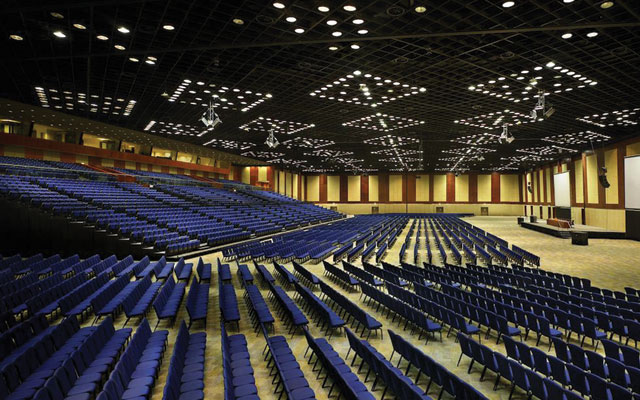
Presence of a supportive local convention bureau and state government has enabled Hyderabad to enjoy a triumphant year in inbound business events.

For Gorav Arora, director, sales & marketing with Novotel Hyderabad Convention Centre & Hyderabad International Convention Centre (HICC), the year 2017 was in fact the “most successful year in the recent past” for the capital city of Telangana state in India.

Hyderabad Convention International Centre

“We have seen double-digit growth. HICC hosted some major conferences and association events last year,” Arora revealed.

He gave credit to a supportive state government, saying: “(It) has been proactive in supporting new businesses in the city which has (in turn brought more business events) to Hyderabad. The government has also supported many conferences (held in Hyderabad), such as the recent Global Entrepreneurship Summit (GES) that has placed the city in the global spotlight.”

GES is an annual gathering of emerging entrepreneurs, investors and supporters from around the world.

Chander Mansharamani, managing director, Alpcord Network Travel & Conferences, also commended the state government for being proactive in attracting global conferences, adding that Hyderabad’s current infrastructure also brings value to interested event planners.

He explained: “Hyderabad boasts of a purpose-built events venue in the form of HICC. The ecosystem of the city includes hotels, conference venues and transport providers (that allow events to be coordinated seamlessly).”

Gary Khan, CEO of the Hyderabad Convention Visitors Bureau (HCVB), added that the entry and expansion of global business conglomerates like Samsung and Google in Hyderabad had also helped the city in its bids for trade association meetings.

Other notable business events that took place in Hyderabad last year included World Endoscopy Conference 2017, InterDrought-V, International Union of Crystallography Congress and SKAL World Congress.

According to major PCOs and PEOs in the city, Europe and the US are traditional main source markets for association events. However, 2017 witnessed the emergence of South-east Asian demand out of Malaysia, Singapore and Indonesia.

Swadesh Kumar, founder, Shikhar Group of Companies, also observed more conferences coming out of the Middle-East.

He said scientific, medical and IT meetings were the most common in Hyderabad, and were the biggest drivers of business for the local meetings industry in 2017.

“Even the domestic market performed extremely well for Hyderabad last year,” he added.
Khan revealed that HCVB has now decided to push Hyderabad aggressively to corporate incentive buyers in global markets.

According to industry players, so strong is Hyderabad’s appeal for business events that even the new Goods & Sales Tax imposed last year had failed to dampen interest.

With the new tax, the highest tax rate of 28 per cent applies to hotel room rates of more than 7,500 rupees (US$118) while an 18 per cent tax on F&B applies.
Arora expects the city’s good performance to continue into 2018.

“We have a good pipeline of business for 2018 and we expect this year will be better than 2017, even though it is too early to gauge the impact of the new Goods & Services Tax on business events performance,” remarked Arora.

Australia’s emerging cities wriggle through tight big-city competition

0
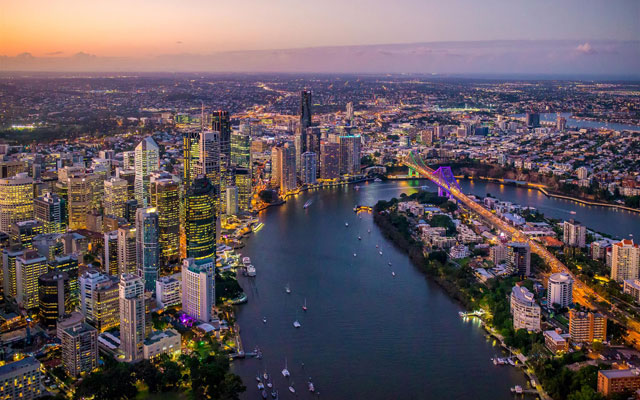
Aerial view of Brisbane

Not to be outdone by their metropolitan neighbours, smaller cities in Australia are emerging with unique marketing campaigns and new business event offerings, with some destinations set to transform entire precincts.

For example, Cairns is pumping A$176 million (US$138 million) into the expansion and refurbishment of the Cairns Convention Centre, which will open in the 2018/19 financial year near an upcoming integrated resort and entertainment district. The city is also receiving a slate of new hotels in the next three years, marking its first hotel opening in over two decades.

Aerial view of Brisbane

Rosie Douglas, director of business and tourism events, Business Events Cairns & Great Barrier Reef, said that these additions will increase the city’s total exhibition space by 3,000m2.

“We’re not a capital city, we don’t have massive universities, but we are all about the natural environment. So we’re hoping to pull in more events and conferences from the agriculture and marine science industries. That’s the identity that we’re pushing,” Douglas told TTGmice on the sidelines of AIME 2018.

Similarly, Brisbane is banking on its geographical advantage to promote the coastal city, to the extent of pumping in A$110 million to transform the previously derelict Howard Smith Wharves into a riverside restaurant and hotel complex.

Its general manager – events, Scott Bayne, shared: “We’re really pushing the focus on local and regional (aspects) of Brisbane and greater Queensland. A lot of people don’t fully appreciate that we have a river connection to a beautiful ocean and beaches that are only accessible from our site, and other sites to come (in the future).”

Hardware aside, the local supplier network plays a role in attracting agents as well.

Lilian Hii, executive assistant to chief information officer, Boral Digital Solutions, observed that unlike in certain larger cities, suppliers in Queensland are eager to help each other by referring agents to other suppliers.

“They have the drive to build up Queensland as a region instead of competing (with each other),” said Hii.

APAC grows on rising demand in China, India and SE Asia: AMEX GBT

0

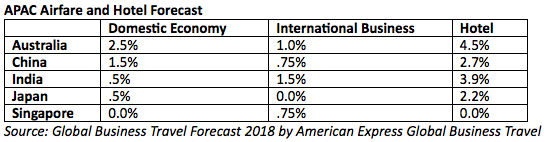
According to the Global Business Travel Forecast 2018 published by American Express Global Business Travel (GBT), the outlook for international business travel is generally optimistic, with demand being driven by a steadily improving global economy and growing confidence among the business and investor communities.

Demand for business travel started to rebound last year, and is expected to grow over the next 12 months, with some notable gains expected in Europe and Asia. China and India’s high-powered economies once again lead the way. However, prices will see only marginal gains, as suppliers rapidly increase capacity to meet demand as they compete for market share.

The forecast indicates moderate price increases across air, hotel and ground transportation

Strong growing economies across much of the Asia-Pacific region and a burgeoning middle-class are causing demand for travel to surge. However, China remains a key driver of this growth and a slowdown of its economy could have a ripple effect throughout the region.

Airfares will remain relatively stable compared to 2017, as political stability and strong demand in China and India, is counterbalanced by widespread overcapacity and flatter demand in Japan and Australia. Domestic carriers in China will also have to compete with the world’s fast-developing high-speed rail network, which accounts for more than two-thirds of the world’s capacity and is expected to grow another 50 percent by 2020.

Hotel rates in the region will generally increase as growing business confidence and a thriving tourism sector drive up demand, although this will vary considerably by country. South Korea is the only nation expected to see rate decreases, largely as a result of China’s tourism ban.

Despite the recent economic progress made in many global marketplaces, an element of caution remains in some quarters. Geopolitical instability combined with moves by some governments towards more protectionist economic policies has generated an undercurrent of uncertainty in the business community.

Additional global highlights include:

Air: While strong demand is expected to drive airfare increases across all regions, overcapacity on certain routes, aggressive expansion by low-cost carriers (LCCs), and low oil prices will keep them in check. Full-service carriers are increasingly unbundling fares and adding premium economy seating options to entice consumers to better compete with LCCs.

Hotel: Hotel performance is expected to improve globally, with small to moderate rate increases driven by strengthening regional economies, despite robust investment in new hotel supply. Total costs, however, should increase even further as additional ancillary fees and stricter cancellation policies are applied by many hotels looking to bolster profitability.

Ground: After years of flat or negative growth, rental car rates should finally see increases as companies improve their fleet management while operating costs put pressure on pricing. However, competition will remain fierce. In the absence of significant rate increases, car rental companies are once again turning to ancillary services and fees to drive greater profitability.

View the full report here.

Auckland pursues new strategies

0
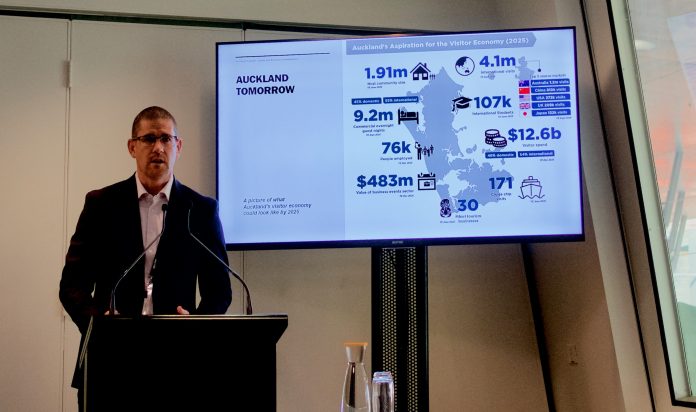
Steve Armitage addressing the crowd at AIME 2018. Photo credit: Adelaine Ng

Auckland’s economic growth agency will adopt a new strategic direction in pursuing business events as the city goes through significant restructure, with a keen focus on the Asian market.

More than NZ$23 billion (US$17 million) is being invested in infrastructure, hotel developments and a new convention centre in preparation for 2021, when Auckland hosts the America’s Cup and and the Asia-Pacific Economic Cooperation (APEC) including APEC Economic Leaders Week.

Steve Armitage addressing the crowd at AIME 2018. Photo credit: Adelaine Ng

The new strategy will see Auckland Tourism, Events & Economic Development (ATEED) make a “dramatic shift” from its previous five-year visitor marketing plan towards a destination management strategy.

Defining the difference, ATEED’s general manager destination, Steve Armitage, said: “Destination marketing is the process of attracting visitors to our place, whereas destination management is the process of ensuring that when our visitors arrive, they feel welcome and have a great experience.”

In addition to the NZ$402 million New Zealand International Convention Centre (NZICC) which will open next year, Auckland’s central city will be upgraded with new laneways, public squares and parks, a redeveloped cultural quarter with a boutique hotel, and a new central rail loop or an underground train line running through. Mass transit options from the airport are also being planned along with the addition of more than 2,500 new hotel rooms near the airport over the next five years.

“2021 is an incredible opportunity to showcase Auckland as a host city for all manner of events and that obviously includes large-scale business events,” said Armitage.

“Asia is one of our priority markets and a region where we see further growth potential, particularly with the NZICC coming on stream. With the development of a soon-to-launch Destination AKL Strategy and a series of supporting action plans – including a bespoke business events plan – we will be pouring more energy and resources into this valuable sector and our key markets,” he elaborated.

Armitage added that Auckland is in a strong position to attract new business with good connectivity to Asian markets, being just one flight away from most major cities in the region.

At press time, NZICC has nine confirmed bookings worth NZ$36 million in economic impact, including the Asia Pacific Academy of Ophthalmology with 4,000 delegates and the World Veterinary Congress bringing 3,000 pax.

New AIME organiser promises a better show

0

Following backlash from exhibitors about its buyer turnout, upcoming editions of AIME will have its list of hosted buyers and exhibitors revised and expanded.

Talk2 Media & Events, the show’s newly appointed organiser by the Melbourne Convention Bureau (MCB), will take over from Reed Travel Exhibitions next year.

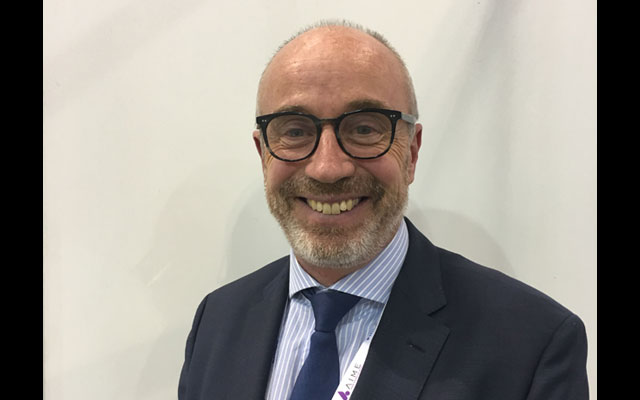
Pearce: plans to invest heavily in next year’s edition, changes afoot

“We’ve gone out to exhibitors and visitors to run through what they want changed and what they want out of the show,” said Matt Pearce, CEO of Talk2 Media & Events.

He shared that common feedback include the need for improved quality and quantity of hosted buyers, as well as a better mix of associations, PCOs and incentives and meetings among buyers.

Pearce revealed: “We will invest heavily and double the number of hosted buyers coming to AIME next year, and we will increase the numbers from Asia and the region. We need to make sure we have a good representation from Asia as well as Australia.”

Karen Bolinger, CEO of MCB, shared that “criticism from exhibitors” also included unhappiness stemming from the Welcome Event, where certain non-attendees would purchase a ticket and poach buyers without having to exhibit.

Melbourne Convention and Exhibition Centre’s chief executive Peter King said: “It’s important that AIME is reflective of the future, and it probably hasn’t been recently. I think next year we need to change it up and inspire the meetings industry, which is probably what we haven’t been doing for a while.

“The key elements around hosted buyers and education in particular need to be substantially invested in, and I’m sure Matt Pearce and his team have (received that very clear) message.”

Bolinger added that AIME’s upcoming editions will be more seamless, and the second day of the show will be focused on education.

“We want to make sure it’s an Asia-Pacific event, and not a Melbourne event,” she asserted.

Talk2 Media & Events will gather feedback from this year’s AIME before mapping out next year’s floor plans, Pearce told TTGmice.

Four new directors join ACTE’s volunteer leadership

0

Four new directors have joined the volunteer leadership of the Association of Corporate Travel Executives (ACTE) this month. They represent members in their respective regions as well as the entire ACTE membership.

Joining the board as regional board representatives are Geert Behets, head of global travel, meetings, and fleet management for UCB (Europe region); Mohammed Halawi, global travel director for Firmenich (Middle East & Africa region); Sonya Lowry, APAC travel manager for AstraZeneca (Australasia region); and Cathy Sharpe, director, strategic sourcing & global T&E management services for Illinois Tool Works (US region).

The ACTE board of directors is comprised of 14 members across the globe who represent all sectors of the business travel industry.

Beyond Asia: Radisson Blu Royal Hotel, Colorado Convention Center, and Setai Tel Aviv

0
The foyer leading to the meeting rooms at Radisson Blu Royal Hotel in Copenhagen. Photo credit: Joachim Wichmann

Radisson Blu Royal Hotel’s upgrading nears completion
The 259-key Radisson Blu Royal Hotel – designed by renowned Danish architect Arne Jacobson – in Copenhagen is now in its final stages of renovation and will be completed this spring.

At present the renovation of the ground floor, lobby area, restaurant and bar, the first floor meeting facilities and a number of guestrooms are complete.

Extensive refurbishment include the removal of the lobby bar and repositioning of the reception desk to create more space for guests to lounge and work; nine meeting rooms have been refreshed and named after Jacobson’s design classics such as the Egg chair; and guestrooms now feature beds upholstered with Kvadrat’s Fiord textile.

Colorado Convention Center goes 3D; expansion plans revealed
Concept3D has launched an interactive map and virtual tour platform for Colorado Convention Center.

Meeting planners from anywhere in the world can search for ideal spaces to host their event, now with the Colorado Convention Center’s 54,255m2 of meeting and event space – from 63 learning rooms to the 5,000-seater Bellco theatre – mapped in highly detailed 3D renderings atop interactive software.

The Colorado Convention Center has also announced a major expansion plan to add up to 7,432m2 of flexible meeting and ballroom space, more than 900m2 of pre-function and service space, and a 4,645m2 rooftop terrace.

First Israel property to join LHW
The Setai brand of hotels has opened the 120-room Setai Tel Aviv, located in a 12th-century fortress, at the entrance to the ancient city of Jaffa.

Views from the earth-tone rooms include views of the Mediterranean Sea, the historic Jaffa Clock Tower and Square, and the property’s inner courtyards.

Amenities include a spa with seven treatment rooms, a traditional Turkish Hammam, gym, restaurant and bar, rooftop infinity pool, and four function spaces that can accommodate up to 200 people.

The draw of major events

0

Trumpeting high-profile events is becoming part of the Philippines’s destination marketing action plan as the country strives to rebuild visitors’ confidence, currently rocked by safety and security concerns, among other things.

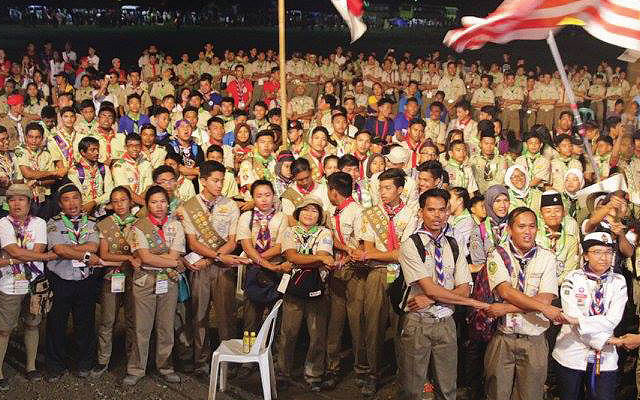
Take the significance of Tagum, a city in Mindanao that hosted the 6th ASEAN Scout Jamboree late last year for 30,000-plus participants. Tagum rose up to the challenge in ensuring the safety of everyone and meeting their needs from transport and medical care to meals.

That the jamboree was successfully staged shows that Mindanao is a safe destination and is capable of hosting big international events, according to Roberto Alabado III, regional director of the Department of Tourism (DoT).

Mindanao also capitalised on the rare diplomatic gesture of Japanese prime minister Shinzo Abe when he visited the Davao home of Philippine president Rodrigo Duterte early-2017. The resulting global media coverage favoured Davao and contributed to strong arrivals from Japan, the country’s fourth largest tourism source market.

A 2016 survey of tourists from major source markets by Frost & Sullivan showed that safety and security are top concerns when visiting the Philippines, followed by traffic congestion and unclean environment.

Among local destinations, Mindanao is the most hard pressed to dispel this image exacerbated last year by the siege of Marawi (which has since ended) and the resulting declaration of martial law (still enforced).

But safety and security concerns about the Philippines were at times exaggerated to the detriment of business events. While there are some conflict areas in Mindanao, the island has far more safe and tourist-friendly areas such as Siargao, Camiguin, Davao and Bukidnon.

Teresita Landan, MICE manager, Tourism Promotions Board, said: “We have to let the market know of prominent events. They are testimonials that the Philippines is a safe destination and capable of hosting and organising events”.

She cited the 283 meetings and conference held throughout the Philippines, including a number in Mindanao, for the 2017 ASEAN Summit.

“We ably hosted them. Some were held simultaneously and in succession. There were no untoward incidents,” she pointed out.

A source requesting anonymity said the sector is learning to spotlight high-profile events in the Philippines’ favour, “unlike in the past when (these events) breezed by unknown to the industry” due to lacking government marketing and promotional support.

“Destinations have to trumpet their own accomplishments loud and clear”, he said.

Having earned a lot of publicity mileage from hosting the 2016 International Eucharistic Congress attended by over 15,000 people from around the world, Cebu is no longer shy in highlighting the events that it will host and its new tourism infrastructure. It will host Routes Asia 2019 and the first MICE Business Asia in mid-2018.

Angel Ramos Bognot, owner of Afro Asian World Events, said that as part of Cebu’s destination marketing, both the provincial government of Cebu and TPB will help market and promote MICE Business Asia.

Manila’s congested and traffic-prone image is eased somewhat by its hosting of the Asia Pacific Regional Rotaract Conference, an event to be held in the Philippines for the first time and attended by 800 people in July.

Mitch Ballesteros, CEO of Ex-Link Events which will organise the conference, said event promotion is a way of spreading good words about Manila, and the resulting publicity will further benefit the city.

The Philippines, especially Manila, is still getting big conferences, according to Team Asia chair and president Monette Iturralde-Hamlin. While it cannot attract mega events yet due to a lack of capacity, Iturralde-Hamlin said it is imperative that destination promotion persists.

She added that the private sector is doing its own destination marketing and, in her case, organising fam trips for clients. And she’s seeing results.

Alabado said the DoT is taking a step further in promoting Mindanao as a single destination with plans for cities to join forces and coordinate with each other. Since Davao is the most developed events destination in Mindanao, it can help shore up sister cities such as General Santos and Cagayn de Oro, and others in the Autonomous Region of Muslim Mindanao.

While martial law is still in effect in Mindanao, “people realise early on that it isn’t actually a martial law. Everything is back to normal, as if nothing happened”, a source said.

Landan said it is a must to showcase major international events held in the country to inspire confidence in other business event planners.

Landan noted that recent events including the United Nations World Tourism Organization’s 6th International Conference on Tourism Statistics was a vote of confidence for the Philippines and even the Miss Universe pageant spotlights the country’s ability to host major events.

Meet in a tropical paradise

0

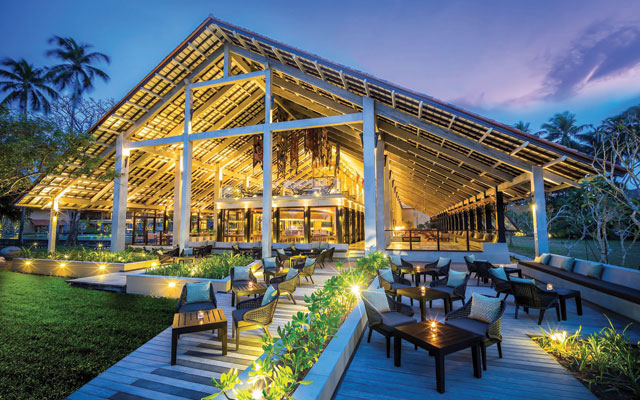
There is so much for event planners to love about the new Anantara Kalutara Resort in the south of Sri Lanka.

First, its architecture which bears the signature Tropical Modernism style of the late Geoffrey Bawa, a celebrated architect during and beyond his time. The soaring peaked roof over the heart of the resort, held up only by tall, slender pillars which blur the lines between the lush exterior and decorative interior, is the most impressive and representative of Bawa’s genius.

The result is a number of beautiful, wide open spaces for guests to recharge and refuel that are both sheltered and breezy.

Second, its clever blend of leisure and business facilities that do not overlap and yet sit so close that business event guests can easily reach for the sparkling pool, serene spa, yoga pavilion or water sports club should they wish. Furthermore, this ensures privacy for both corporate groups, and holidaying couples and families.
And that brings us to the third reason to love the Anantara Kalutara Resort. Its standalone two-storey conference centre, located just a short walk away from the resort’s lobby and down a landscaped boardwalk along the Kalu Ganga River.

Views from the ballroom and meeting rooms are memorable, as the facilities overlook the Indian Ocean and Kalu Ganga River, with coconut palms in the foreground. For meeting groups that resist staying indoors all day long and for days on end, the conference centre is a dream come true.

Also a gem for corporate groups, event planners can choose to simply book their group for meals at the resort’s three restaurants (Olu, Acquolina and Spice Traders) or work with the resort’s F&B specialists to design a unique dining event in unique locations on the resort’s sprawling grounds.

Reviews

The Ritz-Carlton, Bangkok

The newly-opened Ritz-Carlton, Bangkok anchors the One Bangkok development with cosmopolitan elegance. Featuring the city's largest ballroom and a spectacular new penthouse suite, it delivers exceptional hardware and deeply authentic, soulful service for business and leisure travellers alike

Mama Shelter Zurich

Behind the imposing, Brutalist concrete that defines Zurich’s Oerlikon district lies a surprising secret. While its exterior honours the neighbourhood’s industrial roots, stepping inside Mama Shelter reveals a vibrant, neon-soaked world that is a far cry from its rigid shell

Hyatt Regency Kuala Lumpur at KL Midtown

A polished urban retreat designed for business travellers, Hyatt Regency Kuala Lumpur at KL Midtown combines thoughtful design, seamless service, and exceptional facilities.