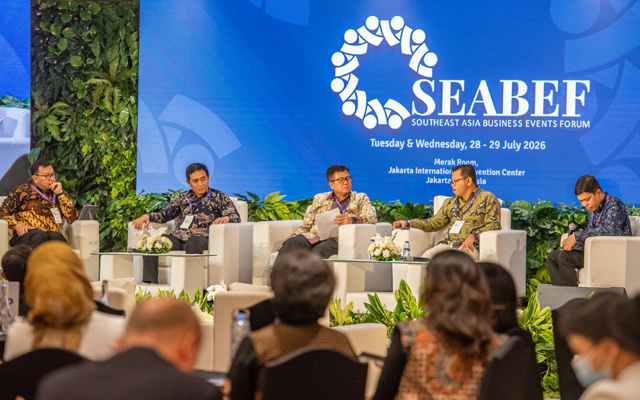
Event management is evolving rapidly, moving away from traditional metrics like attendance counts toward experience-driven value that fosters long-term loyalty and sustainable economic impact.
Speaking at Event Management Redefining Revenue through Next-Generation Event Experience Design panel at last month’s Southeast Asia Business Events Forum, Tresna Setiawan project manager at Pacto Convex emphasised that the era of measuring success solely by attendance or booth sales is over.
“Now we move into a new era with new metrics where we are focusing on key pillars: the memories attendees take home, how we build relationships, the business opportunities unlocked, and the post-event economic impact we create,” Tresna explained, adding that modern attendees have become far more selective when committing their time and money.
Within the exhibition sector, venues are also evolving from static displays into dynamic ecosystems.
Daspar Marpaung, president director of Dyandra Promosindo noted that because product details are readily available on platforms like YouTube and TikTok, events must offer holistic experiences to justify physical attendance. He highlighted that success now hinges on year-round community engagement, unlocked by experience-centric revenue models such as curated VIP networking, interactive gamification, and AI-boosted personalisation.
Beyond business conventions, sports events are delivering substantial economic benefits directly to host communities.
Reflecting on a decade of growth, Budhi Saryadi, general manager of Kompas Event (SC Borobudur Marathon) shared how Bank Jateng Borobudur Marathon adapted to stand out among thousands of competing events.
“Since 2017, we shifted our approach from a single event into a multidimensional ecosystem centred around the experience,” Budhi said.
Achieving Elite Label status enabled the marathon to attract international runners and uplift the local economy of the community around Magelang, where the temple is located.
“By doing so, we create meaningful experiences for runners while generating broader impact,” he added, noting that long-term success relies on looking beyond ticketing to empower local businesses and celebrate cultural heritage.
Echoing this regional impact, Indonesian ultra-athlete and F1 Sport founder Hendra Wijaya highlighted that trail running events draw over 1.2 million annual visitors across the country, generating more than 950 billion rupiah (US$53.4 million). Beyond filling local homestays and boosting small vendors by directing 30 per cent of visitor spending into host communities, these events act as catalysts for regional infrastructure and eco-tourism.