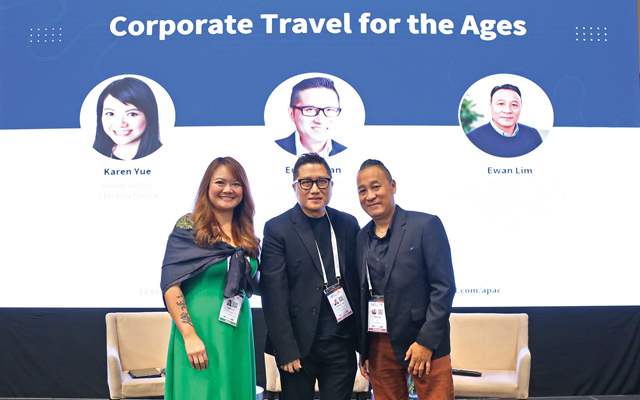
Bleisure is set to become standard in corporate travel as younger employees extend work trips, leaving travel managers to accommodate the demand without loosening cost control or duty of care, according to panellists on the Corporate Travel for the Ages session at IT&CM Asia and CTW Asia-Pacific 2026.
Eugene Tan, general manager, Trip.Biz South-east Asia, said Gen Z employees on their first business trips often add sightseeing days.
“Whether it is a four- or five-star hotel is less critical for younger travellers. They are looking for experiences. Many are keen to upgrade to business class, while opting for premium economy is a no-brainer,” said Tan.
Ewan Lim, senior manager, travel and meetings operations, APAC and emerging markets, global procurement at GSK, said his organisation has adapted to this trend with a co-funding model.
“We have to evolve with the times and allow leisure. The company will cover your airfare, but anything outside your work scope, you cover on your own,” Lim said.
Trip.Biz has responded with a co-payment feature that splits a booking between employer and employee.
“The economy portion is paid by the company, and the upgrade is paid with the traveller’s personal credit card. We are starting to see a lot more requests like this,” Tan added.
Lim said that GSK is working to provide the right level of flexibility not just in terms of bleisure, but in terms of travel procurement and travel requirements.
“We need to balance cost with duty of care, and with the flexibility to let people choose whether to travel at all or to meet virtually. From a procurement standpoint, it is a fine line between cost savings and business needs, and the needle constantly shifts,” he said.
Looking ahead, Lim highlighted duty of care as the defining priority for corporate travel over the next three to five years.
“With everything happening around the world, we need to learn to pivot faster. When something happens, we need to know who to reach out to and how quickly people can respond, so duty of care is becoming more of a focus for corporate organisations,” he noted.
While Tan sees technology as the catalyst for mainstream bleisure, Lim emphasised that vendor partnerships must align with corporate safety standards.
“We are looking for solutions that offer leisure content without breaking our risk management framework,” Lim said.