As digital connectivity accelerates across Asia-Pacific, industry leaders at the opening keynote of IT&CMA and CTW Asia-Pacific 2026 emphasised that the core engine of business events remains uniquely, irreducibly human.
Across the opening keynote and executive panel, speakers emphasised that face-to-face gatherings sustain the trust, empathy, and sensory connection that virtual screens simply cannot replace.
Delivering the opening keynote, Supawan Teerarat, president of the Thailand Convention and Exhibition Bureau (TCEB), stressed that screen-to-screen exchanges cannot match direct human engagement.
“The more digital our world becomes, the more valuable human connection becomes. Business is not about exchanging information alone; it is about building trust, understanding each other and finding an unexpected idea through a simple conversation. That is why face-to-face meetings still matter,” Supawan said.
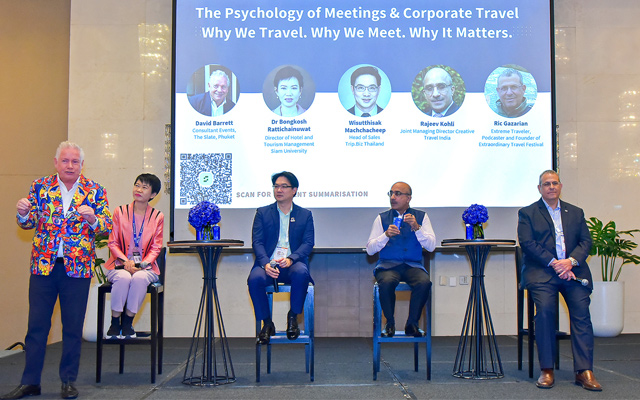
This drive to meet is deeply rooted in psychology and human biology. Bongkosh Rittichainuwat, federation secretary of the Asia Pacific Council on Hotel, Restaurant Institutional Education, and director of hotel and tourism management, Siam University, noted that physical proximity engages all five senses to build credibility.
“Trust is the most important reason why people would like to come and believe in another person,” Bongkosh explained. “Humans need to be touched, and it must be by someone we consider our contact. Even a very slight touch triggers the endorphin system, and on-site we engage all five senses, which is when we truly connect.”
Rajeev Kohli, joint managing director of Creative Travel India, reinforced that in-person gatherings satisfy a fundamental human need.
“Humans are ingrained to travel, and that is why tourism is one of the largest employers in the world. Humans cannot survive without the hug, the handshake and the kiss, and that is why face-to-face is never going to go away,” Kohli stated.
Panellists also asserted that rather than being perceived as something that reduces the human element, artificial intelligence (AI) should be reframed as a back-end tool that strips away administrative friction, freeing delegates to focus on human connection.
“AI should make our meetings smarter, not less human – let AI handle the complexity so that people can focus on the connections,” Supawan advised.
Wisutthisak Machchacheep, head of sales at Trip..Biz Thailand, affirmed that digital tools exist to support, rather than replace, face-to-face travel. “In the coming years, we still need to travel to meet, but with AI as a tool.”
“With AI, there is perhaps more opportunity to ease the (complications of) the physical meeting itself and create more bonding and leisure (activities) on any trip,” Kohli added.
To keep meetings meaningful, event strategists must move beyond measuring sheer attendance and design for emotional resonance and long-term trust.
“True luxury is not about how much we spend, but about how deeply our customers feel, how genuinely we connect, and how long we remember,” Supawan concluded.